
How to Identify the 1795 Flowing Hair Silver Dollar
The 1795 Flowing Hair silver dollar is among the earliest US dollar coins, struck in the first two years of dollar coinage with a distinctive lettered edge.
Read the full 1795 Flowing Hair Silver Dollar encyclopedia entry →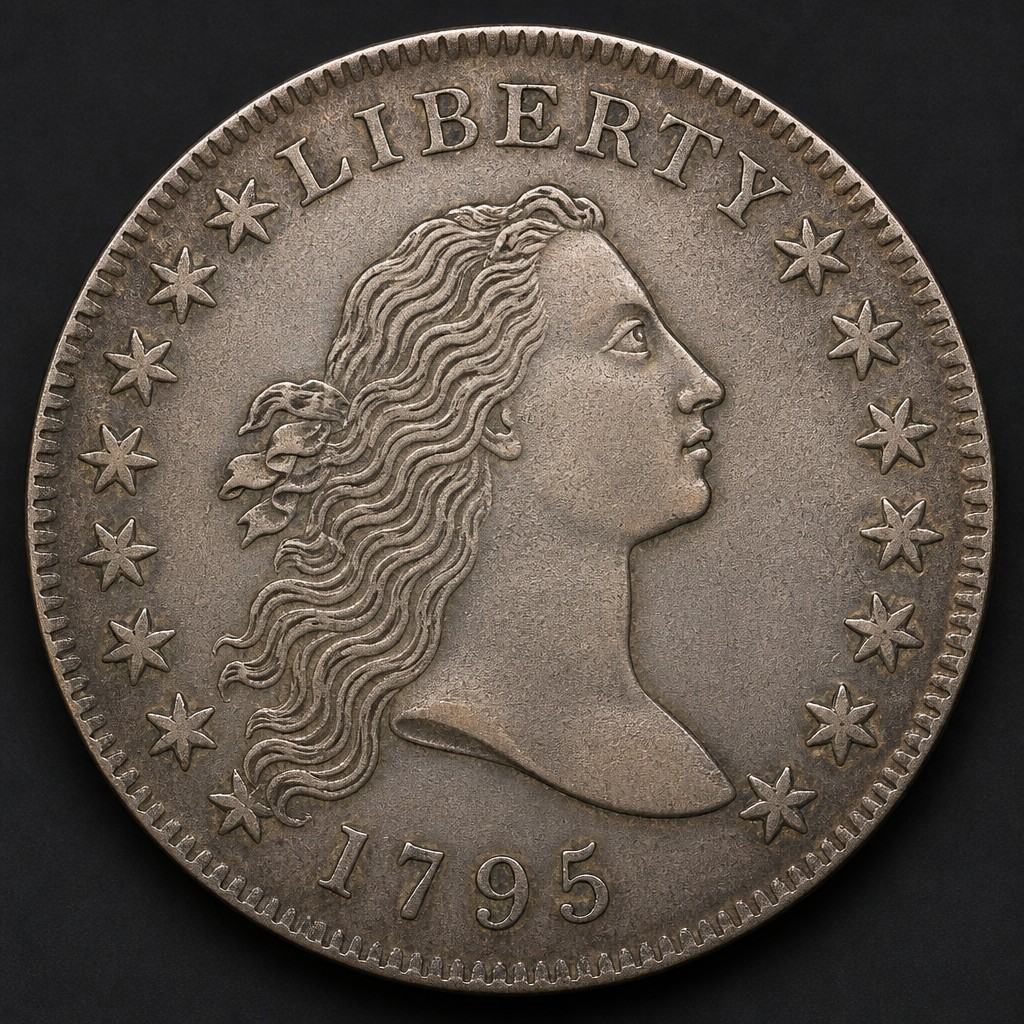
What It Is
The 1795 Flowing Hair silver dollar continued the design introduced in 1794, the first year the United States Mint struck silver dollars. All Flowing Hair dollars were produced at the Philadelphia Mint before the design was replaced by the Draped Bust type later in 1795.
Obverse Design
Liberty faces right with her hair flowing freely behind her, surrounded by stars along the rim, with the date positioned below the portrait.
Reverse Design
A small eagle stands within a wreath, wings outstretched, encircled by "UNITED STATES OF AMERICA."
Size, Weight, and Edge
The coin weighs approximately 26.96 grams, is struck in .8924 fine silver, and measures roughly 39-40mm in diameter, reflecting the larger, thinner planchets used for early silver dollars. The edge is lettered "HUNDRED CENTS ONE DOLLAR OR UNIT," a security measure used instead of reeding.
Mint Marks
No mint mark is present, as only the Philadelphia Mint produced coins during this period.
Telling It Apart From Similar Coins
The Flowing Hair dollar is easily distinguished from the later Draped Bust dollar, which shows Liberty with an upswept hairstyle and drapery over her shoulder, introduced later in 1795. Among Flowing Hair dollars, 1794 and 1795 are the only two dates, with 1794 being dramatically rarer.
Judging Condition at a Glance
Look at Liberty's hair strands and the eagle's breast feathers, which show wear or weak striking first. Because early dies and presses often produced uneven strikes, some genuine coins show soft detail in the center even in otherwise higher grades, so overall wear pattern and edge lettering clarity are also useful indicators.
Authenticity Red Flags
Confirm the lettered edge reads correctly and appears original rather than added or re-engraved, since a smooth or reeded edge on a coin claiming to be this type is a clear warning sign. Check the coin's diameter, weight, and silver color against known standards, and be cautious of unusually sharp, deep details that could indicate a modern struck copy rather than a worn 18th-century original.
Frequently asked questions
How can I tell a Flowing Hair dollar from a Draped Bust dollar?
The Flowing Hair Liberty has loose, unrestrained hair, while the Draped Bust design shows an upswept hairstyle with drapery over Liberty's shoulder.
What does the edge lettering say?
It reads HUNDRED CENTS ONE DOLLAR OR UNIT, used as a security feature instead of the reeded edges seen on later coins.
Why do some genuine 1795 dollars look weakly struck?
Early minting equipment could not always apply even pressure across the large planchet, so central details like Liberty's hair or the eagle sometimes came out soft on authentic coins.
Was a mint mark used on the 1795 dollar?
No, only the Philadelphia Mint operated at the time, and mint marks were not yet part of US coin design.