
How to Identify the 1794 Flowing Hair Half Dollar
The 1794 Flowing Hair half dollar was the first half dollar struck by the United States Mint, an extremely rare and historically important early silver coin.
Read the full 1794 Flowing Hair Half Dollar encyclopedia entry →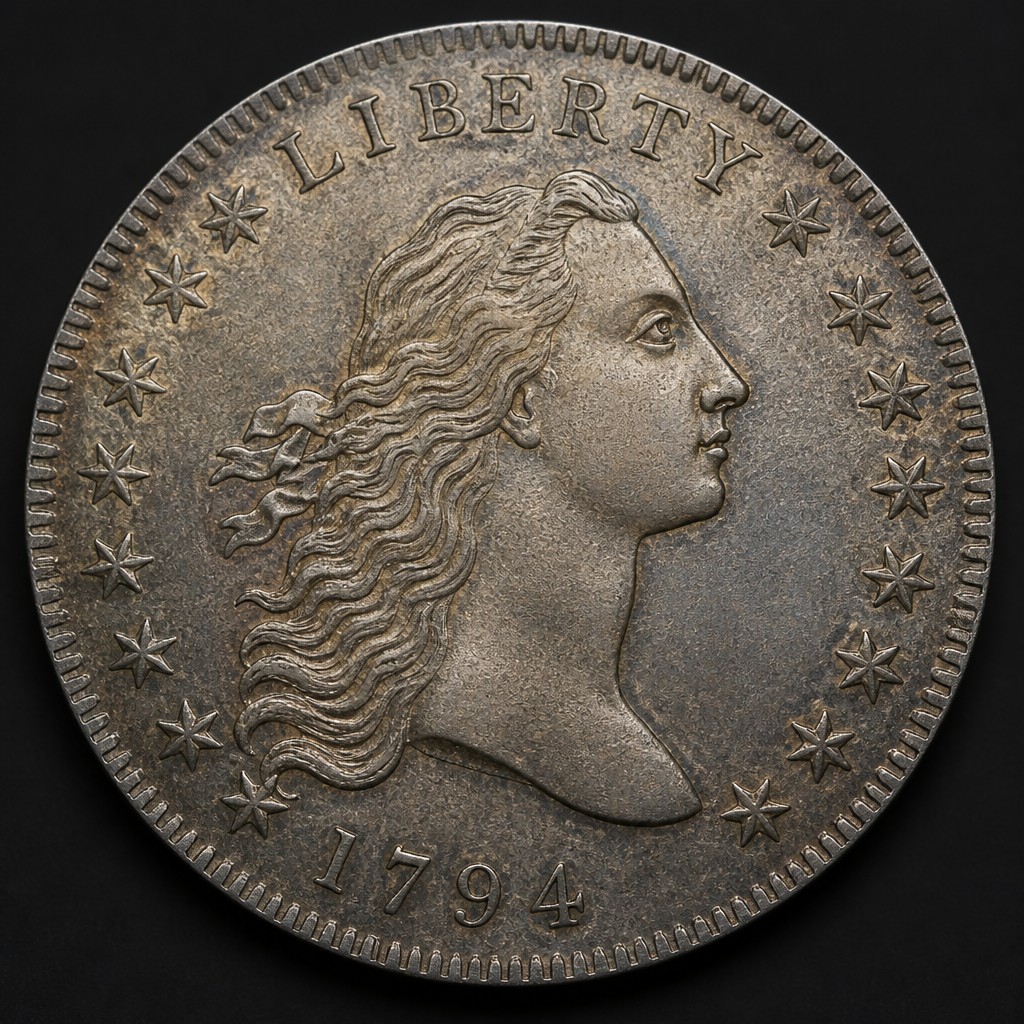
What It Is
The 1794 Flowing Hair half dollar was the very first half dollar issued by the newly formed United States Mint, produced only in that single year before the design was replaced. It was struck exclusively at Philadelphia in limited numbers using hand-operated presses.
Obverse Design
A right-facing portrait of Liberty shows her hair flowing loosely behind her head. Stars encircle the portrait near the rim, and the date appears below.
Reverse Design
A small, somewhat scrawny eagle stands within a wreath, wings spread. "UNITED STATES OF AMERICA" arches around the border, reflecting the young nation's still-developing coin designs.
Size, Weight, and Edge
The coin used the early silver standard of approximately .8924 fine silver, weighing about 13.48 grams, with a diameter close to 32.5mm. Rather than reeding, the edge carries lettering reading "FIFTY CENTS OR HALF A DOLLAR" along with decorative elements, a security feature used before reeded edges became standard.
Mint Marks
No mint mark appears on this coin, since only the Philadelphia Mint was operating in 1794 and mint marks were not yet used on US coinage.
Telling It Apart From Similar Coins
The 1794 half dollar is easily confused with the visually similar 1795 issue that continued the Flowing Hair design. The date is the primary distinguishing feature, though 1794 coins are dramatically scarcer and often show characteristic die cracks and weak striking near the center from the mint's limited equipment at the time.
Judging Condition at a Glance
Because early presses struck these coins with uneven pressure, look at Liberty's hair details and the eagle's breast for the sharpness that remains, keeping in mind that many surviving 1794 halves show adjustment marks (file lines applied at the mint to correct planchet weight) or weak central strikes even on otherwise higher-grade examples.
Authenticity Red Flags
Given the coin's rarity and value, careful comparison to documented genuine specimens is essential. Watch for a lettered edge that looks crudely added, incorrect weight or diameter, cast surfaces lacking the flow lines typical of a struck coin, or a date that appears altered from 1795. Given the significant expertise required, unusual or inconsistent details warrant close comparison against multiple trusted photographic references.
Frequently asked questions
How is the 1794 half dollar different from the 1795?
They share the same Flowing Hair design, so the date is the main distinguishing factor; 1794 coins are far scarcer and often show weaker central striking.
Does the 1794 half dollar have a reeded edge?
No, it has a lettered edge reading FIFTY CENTS OR HALF A DOLLAR along with decorative elements, rather than the reeded edges used on later halves.
Why do many 1794 half dollars look weakly struck?
The Mint's early screw presses had limited striking pressure, so the centers of the design, especially Liberty's hair and the eagle, often came out soft.
What are adjustment marks?
They are file lines mint workers applied to individual planchets to bring overweight blanks down to the correct weight before striking, and they can appear on genuine early coins.