
How to Identify the 1794 Flowing Hair Half Dime
A guide to spotting the first federal half dime, its Flowing Hair portrait, small eagle reverse, and the traits that separate genuine examples from later copies or altered coins.
Read the full 1794 Flowing Hair Half Dime encyclopedia entry →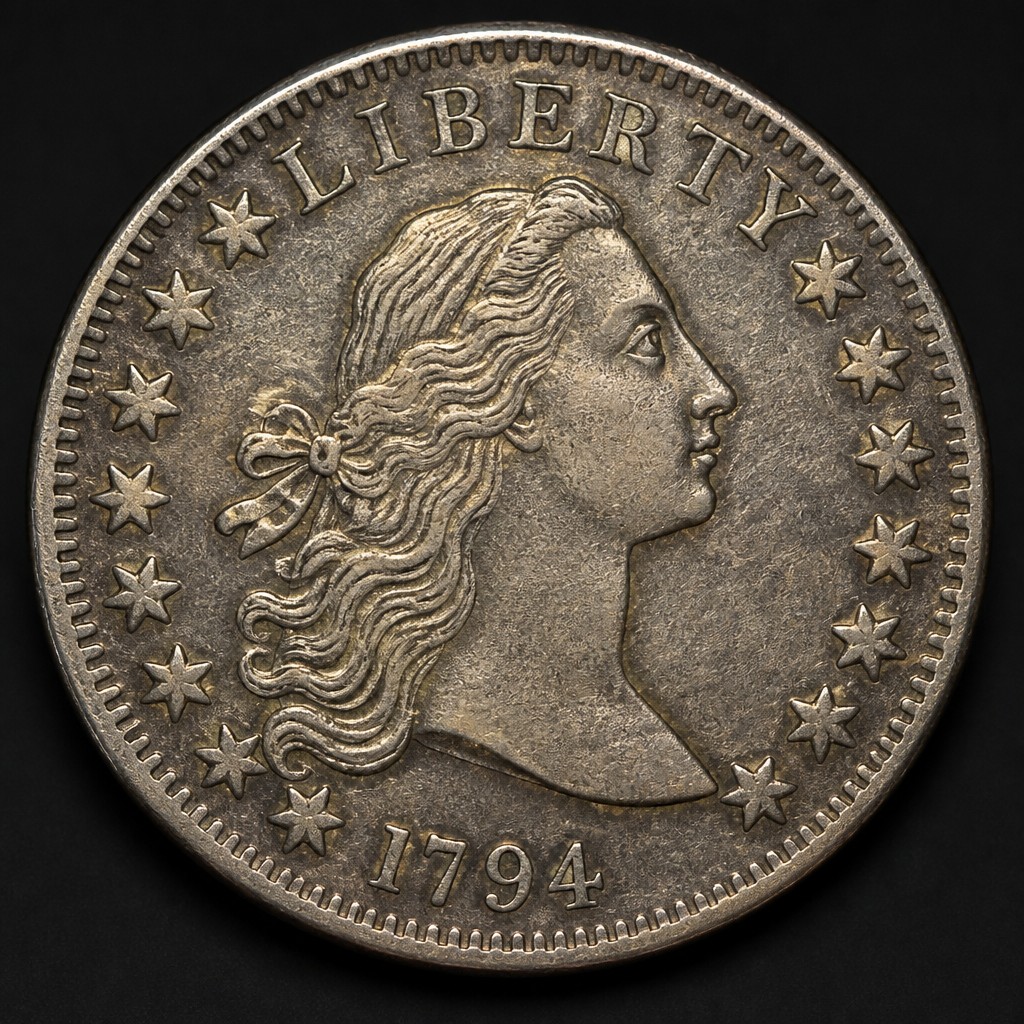
What It Is
The Flowing Hair half dime, struck in 1794 and 1795 (some 1794-dated dies continued striking into 1795), was the first half dime issued by the United States Mint under the Coinage Act of 1792. It is one of the earliest coins produced by the young federal government and predates the more familiar Draped Bust design that replaced it in 1796. Mintage records for this early combined issue are limited, but survivors are scarce and command strong collector interest across every grade.
Obverse Design
The obverse shows a right-facing bust of Liberty with loosely flowing, unbound hair, engraved by Robert Scot. The word LIBERTY arches above her head, and the date sits at the bottom. Fifteen stars, representing the states in the Union at the time, are arranged around the border, typically eight to the left and seven to the right of the portrait. The portrait style is shared with the Flowing Hair dollar and half dollar struck in the same years, though the half dime is considerably smaller.
Reverse Design
The reverse depicts a small, thin eagle perched on a cloud or rock, wings spread, encircled by a wreath. UNITED STATES OF AMERICA appears around the border. No numeral denomination appears anywhere on the coin, which was normal practice for U.S. silver coinage of this era; buyers and sellers were simply expected to recognize the coin's value by its size and design.
Size, Weight, Metal, and Edge
The half dime measures about 16.5mm in diameter and weighs roughly 1.35 grams, struck in an alloy of about 89% silver and 11% copper. The edge is reeded rather than lettered, unlike the larger silver dollar and half dollar of the same period, which carried edge inscriptions describing their weight and fineness.
Mint Marks
No mint mark appears on this coin. The Philadelphia Mint was the only mint in operation in 1794 and 1795, so all examples were struck there, and this remains true for every half dime and dime dated before the 1830s.
Telling It Apart From Similar Coins
The most important distinction is the portrait style: the Flowing Hair bust has loose, unbound hair flowing behind Liberty's head, while the Draped Bust design that followed in 1796 shows Liberty with a ribbon-tied bun and drapery at the bust. Because both types share a similarly small size and small-eagle reverse, checking the hairstyle is the fastest way to separate them. It is also worth comparing the coin's diameter to a modern dime; the half dime is noticeably smaller and should not be confused with a worn dime of any era.
Judging Condition at a Glance
Wear first appears on Liberty's hair curls near the highest point of the portrait and on the eagle's breast and wing tips on the reverse. Well-worn examples show a flat, smooth profile with the date and LIBERTY still legible but the finer hair strands merged together. In better-preserved examples, individual strands of hair and the texture of the eagle's feathers remain crisp and separated.
Authenticity Red Flags
Given its age and value, this date is a frequent target for cast counterfeits and die-struck fakes. Genuine pieces should weigh close to 1.35 grams and measure close to 16.5mm; noticeably light, heavy, or undersized examples deserve suspicion. Look for casting seams around the edge, a grainy or pitted surface texture inconsistent with struck coinage, and soft, mushy design details rather than crisp lettering. Because this issue is scarce and highly collected, third-party grading and authentication from a major grading service is the most reliable way to confirm a genuine example.
Frequently asked questions
Does the 1794 half dime have a mint mark?
No. It was struck only at the Philadelphia Mint, which did not use a mint mark at the time.
How can I tell a 1794 from a 1795 half dime?
Compare the date at the bottom of the obverse; some 1794 dies were also used to strike coins into 1795, so die details and star spacing are sometimes needed to confirm the exact year for worn examples.
Why doesn't the coin say '5 CENTS' or a denomination?
Early U.S. silver coins did not state a numeral value; denomination was implied by size and design rather than printed on the coin.
What is the easiest way to distinguish it from a Draped Bust half dime?
Look at Liberty's hair: flowing and unbound means Flowing Hair type (1794-1795); tied back with drapery at the bust means Draped Bust type (1796 onward).