
How to Identify the 1794 Flowing Hair Dollar
The first U.S. silver dollar, struck only in 1794 in tiny numbers; identified by its flowing-hair Liberty portrait, small perched eagle, and lettered edge.
Read the full 1794 Flowing Hair Dollar encyclopedia entry →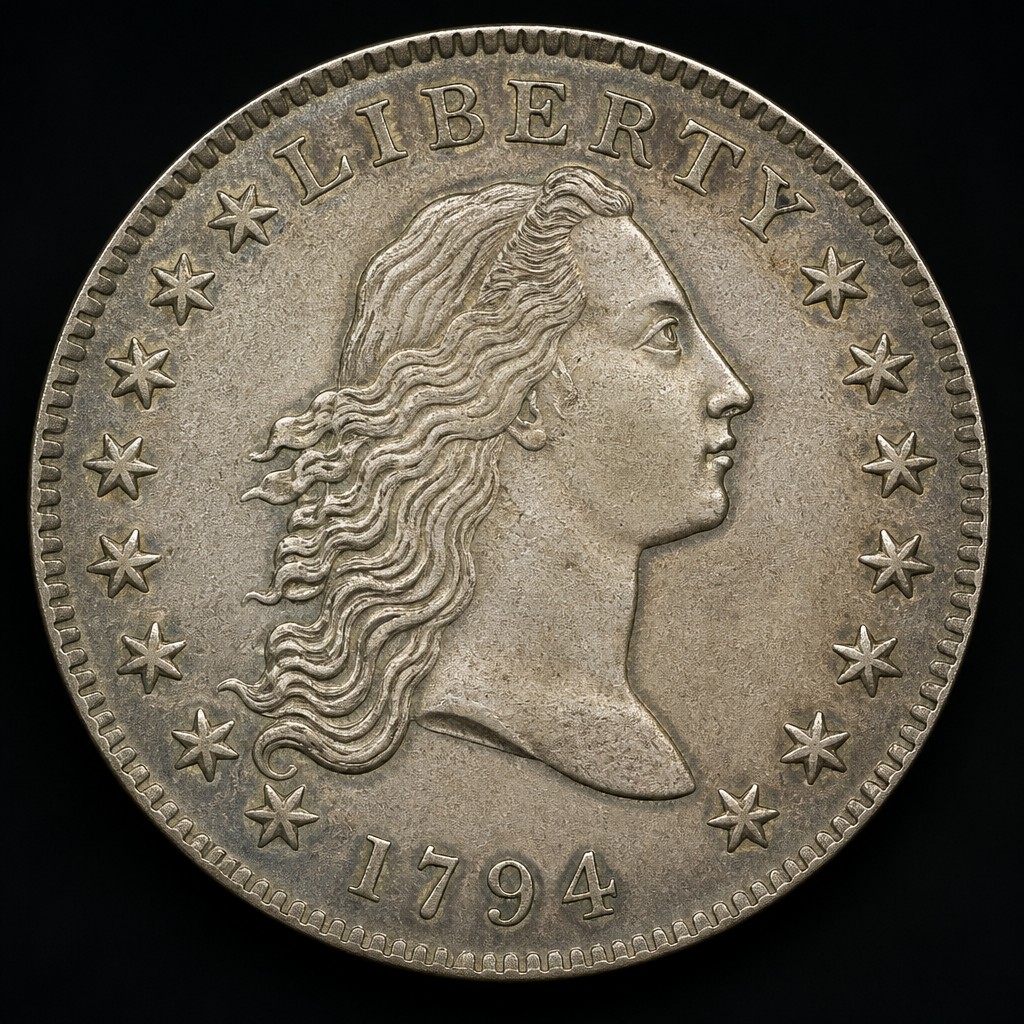
What It Is
The Flowing Hair dollar was the first silver dollar issued by the United States Mint, produced only in 1794 and 1795. The 1794 date is exceptionally scarce because it was the Mint's very first attempt at striking a large silver coin, and only a small number of examples survive today.
Obverse Design
The obverse depicts Miss Liberty facing right with loose, flowing hair, a style meant to symbolize a free nation. "LIBERTY" arches above her head, and the date sits below. Stars line the rim — eight to the left of Liberty's portrait and seven to the right, totaling fifteen, representing the states in the Union at the time.
Reverse Design & Inscriptions
The reverse carries a small, delicate eagle perched on a rocky outcrop, wings raised, encircled by a wreath of laurel or olive branches. "UNITED STATES OF AMERICA" wraps around the border. There is no stated denomination on the coin — its value was understood from its weight and silver content rather than printed numerals.
Size, Weight, Metal, and Edge
The coin was struck in silver at roughly 26.96 grams and about 39–40 mm in diameter, though early Mint striking was inconsistent and weights vary somewhat from piece to piece. The edge carries lettering reading "HUNDRED CENTS ONE DOLLAR OR UNIT" separated by decorative devices, applied before striking on a Castaing edge machine.
Mint Marks
There are none. The Philadelphia Mint was the only U.S. mint operating in 1794, so no mint mark appears anywhere on the coin.
Telling It Apart From Similar Coins
The 1794 and 1795 Flowing Hair dollars share the same design, so the date is the only way to separate them; die varieties known to specialists can further narrow down 1794 examples. Do not confuse this type with the Draped Bust dollar that followed starting in late 1795 — the Draped Bust obverse shows a more mature Liberty portrait with drapery over her shoulder, and its reverse eventually adopted a larger heraldic eagle rather than the small perched eagle used here.
Judging Condition at a Glance
Wear first appears on Liberty's hair above her ear and on the highest curls, and on the eagle's breast and head on the reverse. Because striking pressure at the Mint's earliest presses was often uneven, some genuine coins show natural weakness in the center that should not be mistaken for wear.
Authenticity Red Flags
This is one of the most valuable and most replicated early American coins, so extreme caution is warranted. Cast reproductions typically show a seam around the edge, mushy or overly uniform detail, and incorrect edge lettering or spacing. Genuine pieces should match documented die varieties in the position of stars, letters, and date numerals, and weight should fall within the expected historical range for the type.
Frequently asked questions
Does the 1794 Flowing Hair dollar have a mint mark?
No. Only the Philadelphia Mint existed in 1794, so the coin carries no mint mark anywhere.
How is the 1794 dollar different from the 1795 Flowing Hair dollar?
They share the same overall design; the date is the primary distinguishing feature, along with specific die varieties known to specialists.
What does the edge of the coin say?
It reads 'HUNDRED CENTS ONE DOLLAR OR UNIT,' lettering applied to the edge before the coin was struck.
Why is this coin so rare?
It was the Mint's first attempt at a large silver coin and only a very small number were struck and have survived in any condition.
What should raise suspicion about a claimed 1794 dollar?
A visible seam on the edge, blurry or overly smooth details, incorrect edge lettering, or a weight far outside the historical range are all warning signs of a reproduction.