
How to Identify the 1794 Flowing Hair Cent
A guide to the early Flowing Hair large cent's hand-struck features, chain and wreath reverse varieties, and the visual cues used to judge these irregularly made early coins.
Read the full 1794 Flowing Hair Cent encyclopedia entry →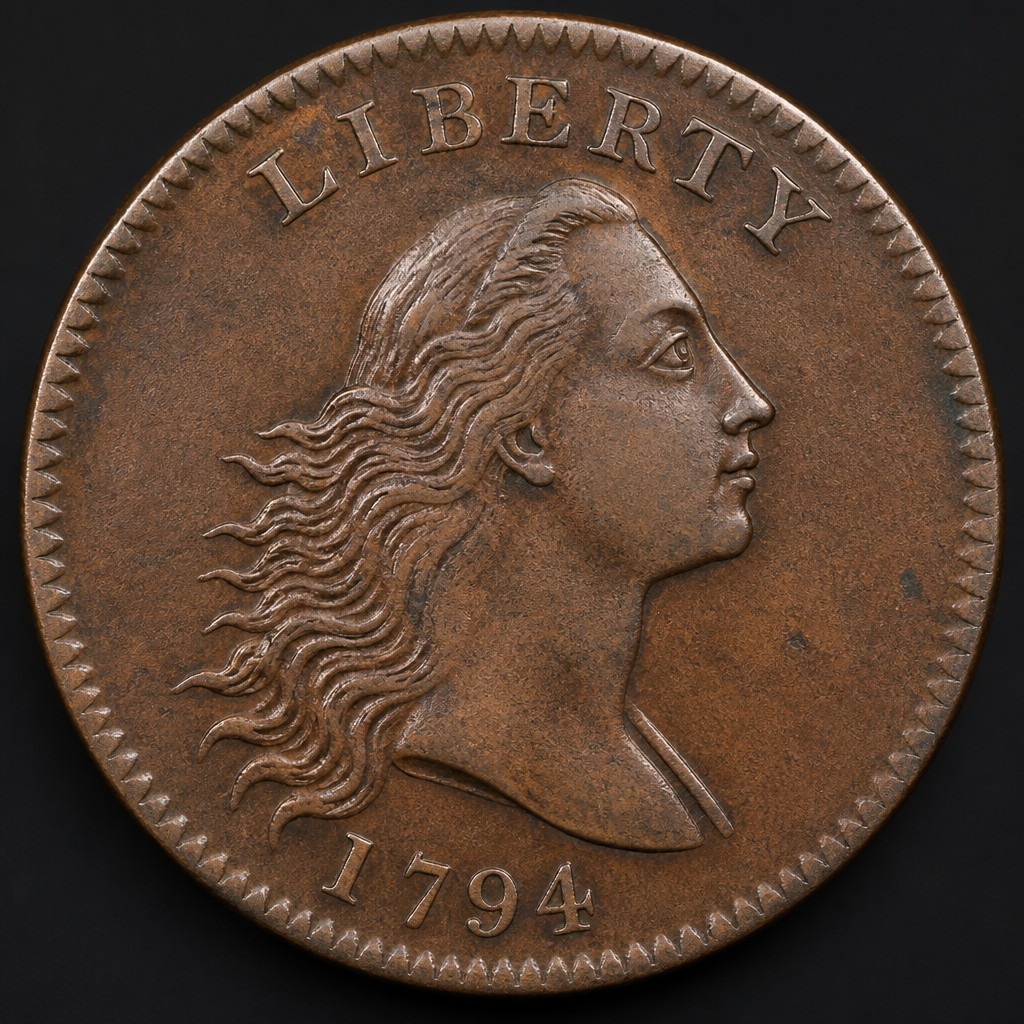
What It Is
The Flowing Hair cent was one of the first cent designs issued by the newly formed United States Mint, with the 1794 date falling within the broader "large cent" era that ran from 1793 to 1857. Early large cents were hand-struck on manually operated presses, so they show more variation in strike quality, centering, and die wear than later machine-struck coinage.
Obverse (Front)
A right-facing bust of Liberty with loose, flowing hair is shown, with "LIBERTY" above and the date below. Because of the manual production methods, the exact style of the bust and lettering varies somewhat between individual die varieties struck that year.
Reverse (Back)
A wreath, generally of laurel, encircles "ONE CENT" and a fraction denoting the coin's weight relationship to the dollar, with "UNITED STATES OF AMERICA" around the border. Numerous distinct reverse die varieties exist for 1794 due to the number of different dies used that year.
Size, Weight, Metal, and Edge
The coin is pure copper, notably larger than later cents at roughly 26-28 mm in diameter (large cents varied slightly by year and die), weighs about 13.48 grams under the standard in effect in 1794, and has a lettered or decorated edge in this early period rather than the plain edge used on later cents.
Mint Marks
Early U.S. coinage, including the 1794 cent, carries no mint mark, since only the Philadelphia Mint was operating at the time.
Telling It Apart from Similar Coins
The 1794 cent should not be confused with the 1793 Chain cent or Wreath cent (the very first cent designs, with a different, more primitive-looking Liberty portrait) or with later large cents of the Draped Bust (1796-1807) or Classic Head/Coronet designs (1808 onward), which show a more refined, fuller portrait style. Comparing the hairstyle, the presence or absence of drapery on the bust, and the date's font and placement helps place a coin correctly within the large cent series.
Judging Condition at a Glance
Because these coins were hand-struck with less consistent pressure and alignment, look for weakness of strike (which is a manufacturing characteristic, not wear) separately from actual circulation wear on Liberty's hair, cheek, and the wreath. Genuine 18th-century large cents typically show natural, uneven, dark copper toning built up over centuries; the sharpness of individual design elements varies more by which working die was used than by a uniform grading standard.
Authenticity Red Flags
Given the age, rarity, and value of this coin, it is one of the most heavily reproduced and counterfeited series in American numismatics, so any suspected genuine example should be closely compared against documented die varieties in terms of letter spacing, die cracks, and hair-curl positioning. Cast reproductions typically show a grainy or pitted surface texture, seams, and a slightly incorrect diameter or weight compared to genuine coins, while lightweight or overly uniform-looking surfaces are also red flags warranting expert review.
Frequently asked questions
How does the 1794 Flowing Hair cent differ from the 1793 Chain and Wreath cents?
The 1793 designs came first and have a different, more primitive Liberty portrait style; the 1794 Flowing Hair cent shows a more developed bust with flowing hair, followed later by the Draped Bust design starting in 1796.
What metal and edge does this coin have?
It is pure copper with a lettered or decorated edge, unlike the plain edges used on cents from the 1800s onward.
Why do early large cents vary so much in strike quality?
They were hand-struck on manually operated screw presses using multiple different dies, leading to natural variation in centering, pressure, and detail from coin to coin.
Are there mint marks on this coin?
No, all coinage in 1794 came from the single Philadelphia Mint, so there is no mint mark.