
How to Identify the 1793 Wreath Cent
A visual guide to the 1793 Wreath Cent, which replaced the criticized Chain Cent, covering its leafy wreath reverse, vine-and-bars versus lettered edge varieties, and rare die attributions collectors look for.
Read the full 1793 Wreath Cent encyclopedia entry →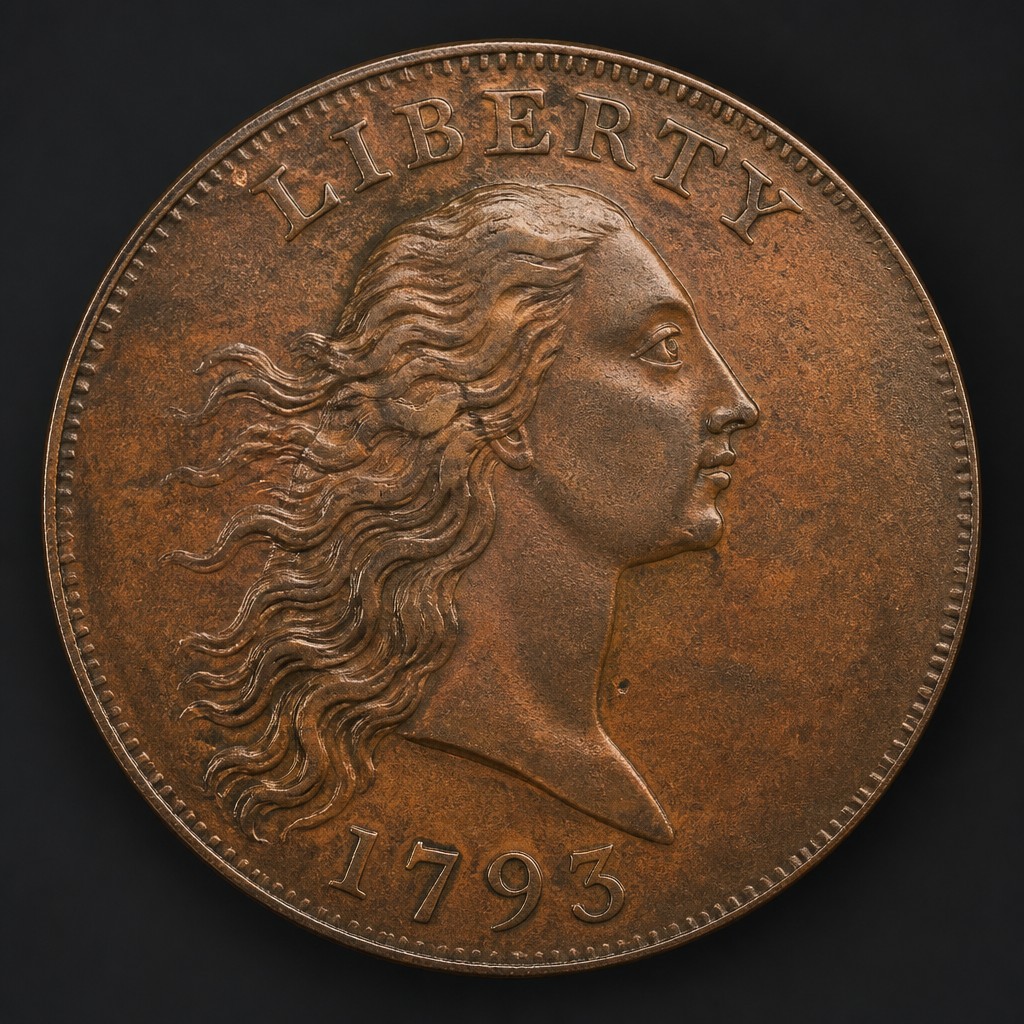
What It Is
The 1793 Wreath Cent replaced the Chain Cent partway through the year after public objections to the earlier chain reverse. It kept the same general obverse portrait style while introducing a wreath reverse that would set the template for large cents for decades to follow.
Obverse Design
Liberty faces right with flowing hair, LIBERTY above, and 1793 below. The portrait on the Wreath Cent is generally regarded as somewhat more refined in proportion than the Chain Cent obverse that came just before it, though it still carries the hand-engraved character typical of the Mint's earliest work.
Reverse Design
A wreath of leafy sprigs encircles ONE CENT and the fraction 1/100, with UNITED STATES OF AMERICA around the border. This wreath format proved far more publicly acceptable than the chain design it replaced.
Size, Weight, Metal, and Edge
The coin is struck in pure copper at the earlier 1793 weight standard, roughly 208 grains (about 13.48 grams), with a diameter in the high 20s of millimeters. Two distinct edge treatments exist for this type: a vine-and-bars edge design and a lettered edge, and identifying which edge a coin has is an important step in attributing its specific variety.
Mint Marks
No mint mark appears on this coin, as it was produced only at the original Philadelphia Mint in 1793.
Telling It Apart From Similar Coins
The leafy wreath reverse clearly separates this coin from the chain-link reverse of its immediate predecessor. Among Wreath Cent varieties, specialists recognize an extremely rare variant with an unusual leaf shape on the obverse, sometimes called the "Strawberry Leaf" variety, which is among the great rarities of American numismatics; ordinary Wreath Cents show the standard leaf style. Compared to the Liberty Cap Cent introduced later in 1793, the Wreath Cent's obverse lacks the cap-and-pole motif behind Liberty's shoulder.
Judging Condition
As with other 1793 issues, look at the sharpness of the wreath leaves, the readability of LIBERTY, and the clarity of the date. Striking irregularities and planchet marks from the era's hand-operated equipment are common and should be considered separately from actual circulation wear.
Authenticity Notes
Because early Wreath Cent varieties, and especially the rare leaf variety, carry significant historical and numismatic importance, they have long been targets for counterfeiting, including cast copies and coins with altered details. Red flags include a grainy or pitted cast-like surface, a seam near the rim, a diameter or weight that falls outside documented genuine ranges, and design details inconsistent with the known dies for this issue.
Frequently asked questions
How is the 1793 Wreath Cent different from the Chain Cent?
It replaced the chain-link reverse with a leafy wreath around ONE CENT, following public criticism of the chain design.
What edge types are found on the 1793 Wreath Cent?
It is known with a vine-and-bars edge and with a lettered edge, both used to help identify specific varieties.
What is the "Strawberry Leaf" variety?
It is an extremely rare Wreath Cent obverse variety with an unusual leaf shape, considered one of the great rarities in American coinage.
Does the 1793 Wreath Cent have a mint mark?
No, it was struck only at the original Philadelphia Mint and carries no mint mark.