
How to Identify the 100 Won
A collector's checklist for South Korea's 100 won: spotting the Yi Sun-sin portrait, the large 100 reverse, nickel edge and common look-alikes.
Read the full 100 Won encyclopedia entry →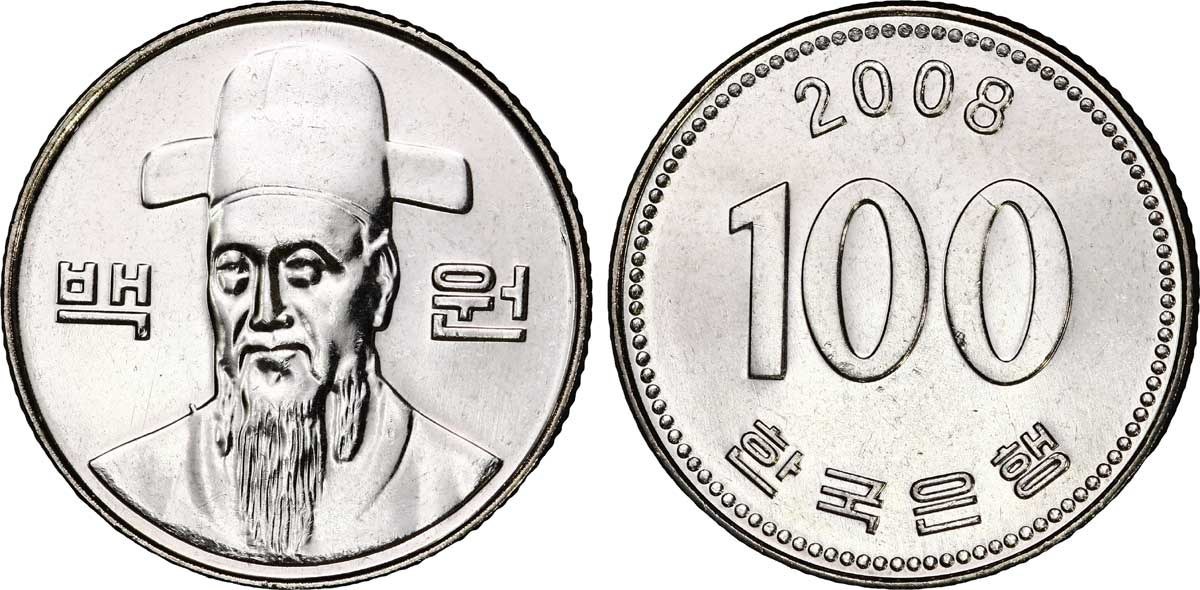
Begin with the obverse portrait, the quickest diagnostic. The 100 Won shows the bust of Admiral Yi Sun-sin wearing a winged, crested helmet, accompanied by Korean (Hangul) characters. If your coin has a helmeted historical portrait and Korean script, you are on the right track. The helmet's wing-like crest is a distinctive detail that separates this design from plain portrait coins.
Check the reverse, which is dominated by a large numeral 100 set inside a pearl (beaded) border, with the four-digit Western year below. Reading that date is the most important step, because every coin in this series shares the same design and differs only by year. Record the exact date when cataloguing the coin.
Confirm the physical traits. The coin is nickel, silvery-gray, with a reeded (grooved) edge, and is a mid-size circulation piece — larger than the 10 and 50 won, smaller than the brass-colored 500 won. The combination of nickel color, reeded edge, Korean lettering and the 100 denomination pins down the type.
Separate it from look-alikes. Other Korean coins (10, 50, 500 won) differ in size, design and sometimes color, and similarly sized silvery coins from Japan or elsewhere use different scripts and portraits. Korean commemorative and special issues exist, but the standard circulating 100 won always pairs the Yi Sun-sin helmeted portrait with the large 100 reverse.
Apply light authentication caution. Because this is a low-value everyday coin, deliberate counterfeiting is uncommon, so the main task is correct attribution rather than fraud detection. Watch instead for wear that obscures the date, and note whether a coin is circulated or a lustrous mint-state example, since condition and year are what drive any premium above face value.
Frequently asked questions
What is the fastest way to recognize a 100 won coin?
Look for the helmeted portrait of Admiral Yi Sun-sin on one side and a large numeral 100 inside a pearl border on the other, with Korean script and a reeded nickel edge. That pairing identifies the standard South Korean 100 won.
Where is the date on the coin?
The four-digit Western year appears on the reverse, below the large 100 and within the pearl border. Since the design is unchanged across the series, the date is the key detail to note for each coin.
How do I tell it apart from other Korean coins?
Compare size, color and design. The 100 won is a mid-size silvery nickel coin with the Yi Sun-sin portrait; the 10 and 50 won are different sizes and designs, and the 500 won is larger and brass-toned with a crane. Only the 100 won shows the helmeted admiral with a large 100.
Do I need to worry about fakes?
Rarely. As a low-value circulation coin, the 100 won is seldom counterfeited, so the priority is accurate identification and grading rather than fraud detection. Focus on reading the date clearly and judging whether the coin is circulated or mint state.