
How to Identify the 100 Dinara
A collector's guide to confirming the 1987 Yugoslav 100 Dinara by its large numeral, dinara denomination, state emblem, and copper-nickel format.
Read the full 100 Dinara encyclopedia entry →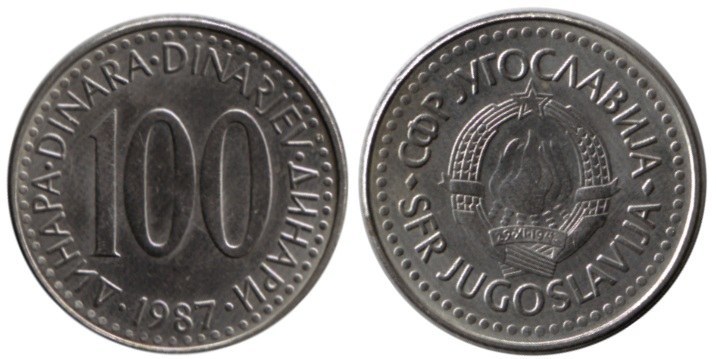
Read the Big Numeral and Denomination
Start with the face that carries the large numeral 100. On this type the value is shown boldly and is paired with the denomination word dinara and a date, here 1987. A coin showing an oversized 100 with dinara wording and a late-1980s date is your first strong signal that you are looking at the Yugoslav high-denomination series rather than a lower value or a different currency.
Confirm the Yugoslav Emblem and Country Name
Turn to the other face and check for the Yugoslav coat of arms alongside the country name for Yugoslavia. The socialist-era state emblem is the decisive identifier. If instead you see the arms of Serbia, Croatia, Slovenia, Macedonia, or another successor state, you have a post-breakup coin, not this unified-Yugoslavia issue. The country legend and the emblem must both match.
Check Metal, Color, and Size
This is a modern base-metal strike in a copper-nickel alloy, so expect a plain silvery-gray tone, not the golden hue of brass or the reddish color of bronze. It should feel like an ordinary circulation coin rather than a heavy silver piece. A coin of this design that is golden, coppery, or unusually heavy for its size is worth a second look.
Watch for Look-Alikes and Cautions
Yugoslavia issued several dinar denominations in this era with a similar style of big numeral plus state emblem, so always read the exact value and date rather than assuming from the layout alone; a 10, 20, or 50 dinara can look broadly similar at a glance. Because this is a low-value common coin, deliberate counterfeiting is unlikely, so the main cautions are misreading the denomination, confusing it with a successor-state coin, and downgrading value for cleaning, corrosion, or heavy wear.
Frequently asked questions
How do I tell this from other Yugoslav dinar coins?
Read the numeral and denomination directly. Several Yugoslav coins share the big-number-plus-emblem style, so confirm the value reads 100 and note the date rather than judging by layout alone.
How do I know it is not a successor-state coin?
Check the reverse legend and arms. This type names Yugoslavia and shows the Yugoslav coat of arms; coins of Serbia, Croatia, Slovenia, and other later states use their own national arms and country names.
What should the coin be made of?
It is a copper-nickel base-metal circulation coin with a silvery-gray tone. It has no precious-metal content, so a golden or coppery color, or unusual weight, would suggest a different coin.
Do I need to worry about fakes?
Not really. As a common, low-value coin it is rarely counterfeited. The bigger risks are misreading the denomination or mistaking it for a similar successor-state issue, plus value loss from cleaning or damage.