
How to Identify the 100 CFA Francs
A collector's guide to identifying the West African 100 CFA francs by its legend, floral design, crossed-sword emblem, metal, and date.
Read the full 100 CFA Francs encyclopedia entry →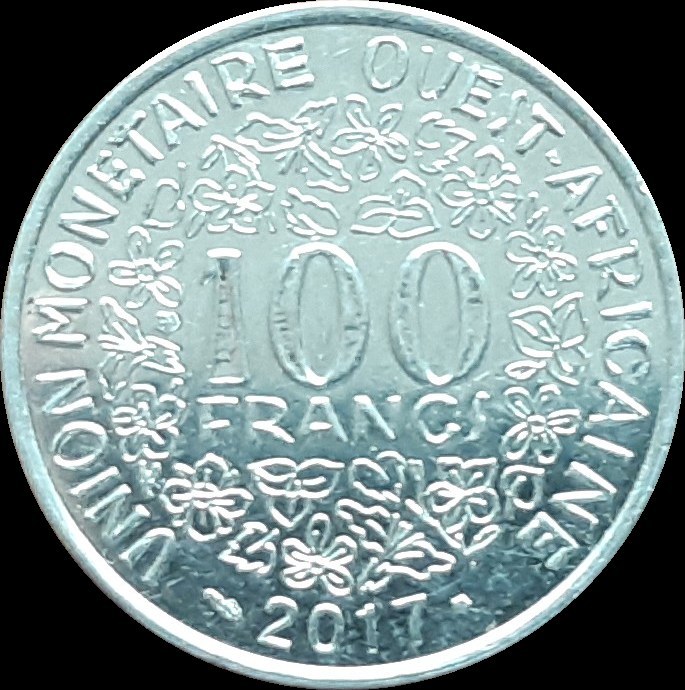
Begin with the inscription. The decisive clue is the French legend COMMUNAUTÉ OUEST-AFRICAINE. This text confirms the coin belongs to the West African CFA franc, and it is what separates this piece from the visually related Central African CFA franc, which uses different wording. Confirm the value by locating the numeral 100 and the word FRANCS on the floral side.
Examine the two faces. One side carries a stylized floral or plant motif surrounding the denomination; the other shows the crossed-sword emblem that is the signature device of this coinage. Both designs are held constant across years, so seeing this pairing together is a strong identification. There is no portrait, ruler, or national coat of arms to look for.
Check size, metal, and edge. The coin is round and struck in nickel-silver, giving a pale silvery tone with no gold or copper color and no precious-metal content. It is a mid-size circulation coin, and the edge is typically plain or lightly reeded. Weighing and measuring the piece and comparing it to a catalog listing for the type will confirm you have the 100-franc denomination rather than a smaller or larger CFA coin.
Find the date. A four-digit year, such as 2011 on the photographed example, sits in the field and is the main feature that changes from coin to coin. Since the design itself does not vary, the date is how you distinguish one issue from another. Do not expect a country name; its absence is normal for this shared regional type.
Watch for look-alikes. The Central African CFA franc and other francophone African coins can resemble this piece at a glance, so always read the full legend before concluding. Because these are inexpensive modern coins, deceptive counterfeits are uncommon, but tourist replicas and heavily cleaned pieces exist; corroded surfaces, wrong weight, or a mismatched legend are reasons to look more closely.
Frequently asked questions
How do I tell the West African from the Central African CFA franc?
Read the legend. The West African coin is inscribed COMMUNAUTÉ OUEST-AFRICAINE, while Central African CFA coins carry different wording. The inscription, not the design alone, is the reliable test.
Where is the date on the coin?
The four-digit year appears in the field of the coin, for example 2011. Because the design is unchanged year to year, the date is the main way to distinguish one issue from another.
Does a missing country name mean the coin is fake?
No. This is shared regional money issued for the West African CFA union, so it deliberately carries no single national name. The community legend and emblem, not a country, identify it.
Is it worth authenticating professionally?
Usually not. These are low-value base-metal circulation coins, so costly authentication rarely makes sense. Confirm the legend, metal, size, and date against a standard world-coin reference instead.