How to Identify the 10 Sen
A collector's checklist for the Meiji silver dragon 10 Sen: reading the dragon and sunburst faces, the reign-year date, size and metal, and spotting fakes.
Read the full 10 Sen encyclopedia entry →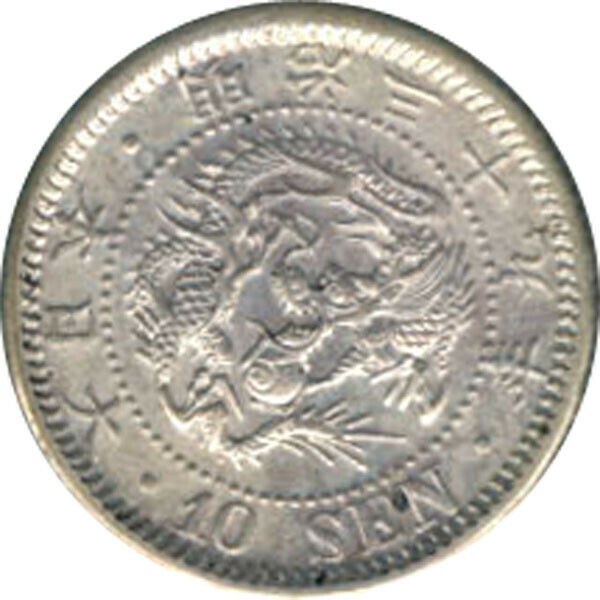
Begin with format and metal. The Meiji dragon 10 Sen is a small, thin, round silver coin with a reeded edge, only about 17–18 mm across and roughly 2 grams of .800 fine silver — clearly a minor denomination, smaller than a modern coin of similar face role. Bright white metal, a raised rim, crisp pressed relief, and grooved edge reeding all confirm a modern machine striking rather than a cast piece.
Examine the dragon face. A coiled dragon occupies the center inside an ornamental border, ringed by Japanese characters. Look for 大日本 (Great Japan), the reign era 明治 (Meiji), the year, and the value; many issues also carry ‘10 SEN’ in Roman letters, which is a quick confirmation of the denomination. The dragon face is where you read the era and year.
Date the coin by reign year. Japanese coins use the emperor's reign, not the Western calendar: read Meiji followed by the year in kanji numerals. The pictured coin is Meiji 39, which equals 1906 (add the Meiji year to 1867 to get the Western year). Getting the exact year right is essential, since value and scarcity vary date by date across the series.
Turn to the other face, which shows a central sunburst of radiating lines enclosed by paired ornamental branches forming a wreath, topped by a chrysanthemum-style crest, with the denomination 十錢 (ten sen). Use this value marking, the coin's small diameter, and its silver weight together as your primary diagnostics, then match them to a Meiji coinage catalog to confirm the type and any variety.
Apply normal authentication caution. Weigh and measure the coin and compare to published silver specifications; an underweight, oversized, or non-magnetic-but-wrong-color piece is suspect. Watch for casting seams or bubbles (a genuine coin is struck, not cast), mushy or soft dragon detail, tooled surfaces, and added mount traces. Common circulated dates are rarely worth faking, but verify any coin offered as a scarce date or high grade against documented specimens, and consider professional grading for better examples.
Frequently asked questions
Which side shows the date?
The dragon face carries the dating legend. Read the era characters for Meiji, followed by the reign year in kanji, alongside the country name Great Japan. That reign year, not a Western calendar year, tells you when the coin was struck — Meiji 39 is 1906.
How do I convert the Meiji year to a Western date?
Add the Meiji reign year to 1867. For example, Meiji 39 plus 1867 gives 1906. Read the kanji numerals carefully, since a misread digit changes the date and can change the coin's scarcity and value.
What confirms it is the silver dragon 10 Sen and not another coin?
Look for the combination of a coiled dragon with a Meiji reign legend on one face, a rayed sunburst framed by ornamental branches on the other, the value ten sen, a small diameter around 17–18 mm, a reeded edge, and a light silver weight near 2 grams.
How can I spot a fake?
Check weight and diameter against catalog figures, and inspect for casting seams, bubbles, soft detail, or artificial toning. Struck genuine coins show sharp relief and edge reeding. Be especially careful with any piece sold as a scarce date or in high grade, and verify it against documented examples.
10 Sen identified by the community
Recent 10 Sen coins identified with Coin Identifier.