
How to Identify the 1 Sol (Gold)
A collector's checklist for the Peruvian 1 Sol: recognizing the Banco de Piura banknote, its vignettes, printer imprint, and authentication cautions.
Read the full 1 Sol (Gold) encyclopedia entry →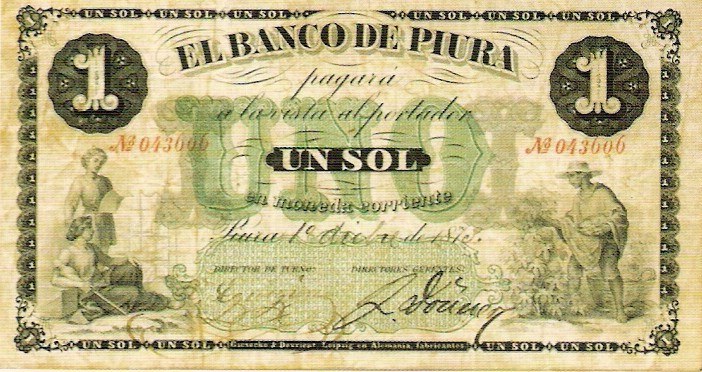
Begin by recognizing the medium. Although catalogued as a "1 Sol (Gold)," the pictured example is a printed paper banknote, not a struck coin. Look for text, serial numbers, and signatures rather than a raised relief design. The "gold" in the name points to Peru's sol de oro currency unit; it does not describe the object's material.
Read the legends to place the note. The heading EL BANCO DE PIURA identifies the issuing bank, and UN SOL in large central letters gives the denomination. The promissory line pagara a la vista al portador UN SOL en moneda corriente and a date line starting Piura confirm both the value and the Peruvian origin. These inscriptions are the fastest way to separate this note from other soles issued by different banks or the later national government.
Examine the design elements as diagnostics. Expect a seated female figure holding a torch at one side and a standing laborer at the other, ornate numeral 1 medallions in the upper corners, and matching serial numbers (such as No 043000) at left and right. Along the bottom margin, a printer's imprint naming Giesecke & Devrient of Leipzig confirms the German security printer, a hallmark of quality nineteenth-century engraving.
Note whether the piece is issued or a remainder. Issued notes carry signatures and a filled-in serial and date; unsigned or blank-dated examples are remainders that never circulated, and the distinction affects both attribution and value. Record the exact date and any series or signature details for comparison against specialized Peruvian paper-money references.
Apply normal authentication caution. Nineteenth-century banknotes can be reproduced or restored; watch for modern printing that lacks engraved sharpness, artificial aging, repaired tears, or trimmed margins. For a valuable example, professional grading and authentication give the most reliable confirmation, and comparison with documented Banco de Piura notes helps rule out fantasy or altered pieces.
Frequently asked questions
Is this a coin or a banknote?
It is a banknote. The pictured 1 Sol is printed paper issued by El Banco de Piura, identifiable by its text, serial numbers, and signatures rather than any struck relief. The "gold" label refers to Peru's sol de oro currency, not the material.
How do I confirm the issuing bank and denomination?
Read the top heading EL BANCO DE PIURA and the central UN SOL. The promissory phrase and the date line beginning Piura confirm the Peruvian origin and the one-sol value, distinguishing it from soles issued by other banks.
What is the imprint along the bottom edge?
It is the printer's imprint referencing Giesecke & Devrient of Leipzig, Germany, the security printer that produced the note. Such imprints help authenticate nineteenth-century bank issues and confirm the manufacturer.
How can I spot a fake or altered note?
Look for printing that lacks fine engraved detail, artificial aging, repaired tears, or trimmed margins, and check whether it is a genuine issued note or an unsigned remainder. For higher-value examples, seek professional grading and compare with documented Banco de Piura notes.