
How to Identify the 1½ Roubles
A collector's guide to confirming a Nicholas I silver 1½ Roubles / 10 Złotych by its profile, shield-laden eagle, dual value, size and metal.
Read the full 1½ Roubles encyclopedia entry →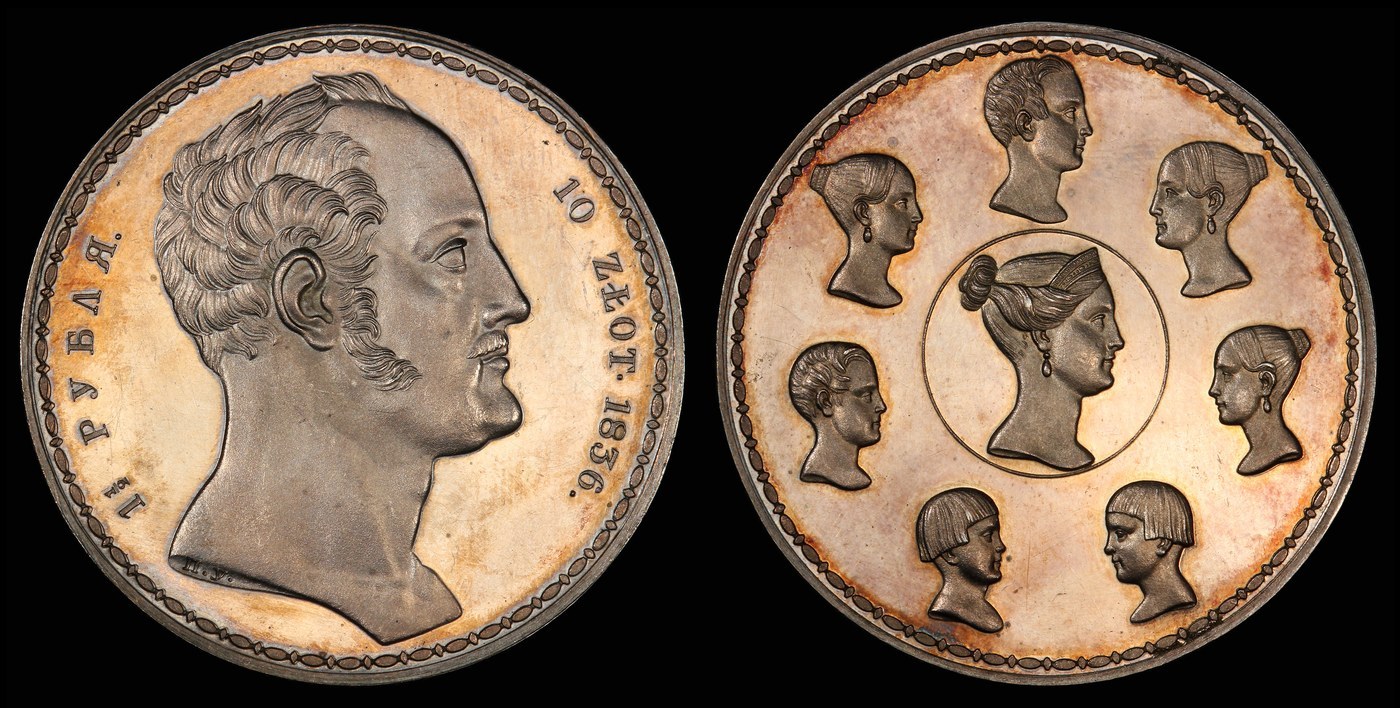
Read the Dual Value First
The single most decisive feature of this coin is that it states two values. Look for the Russian denomination 1½ Roubles paired with the Polish 10 Złotych on the same face. A large Nicholas I silver coin carrying only one of these values, or the family-group reverse used on some special 1½ rouble medals, is a different piece. The bilingual Russian-and-Polish value is what marks the Russo-Polish union type shown here.
Confirm the Obverse Portrait
The obverse should carry a bare-headed profile of Emperor Nicholas I with the characteristic curled hair, ringed by a Russian legend naming him. It is an uncrowned classical bust, not a crowned or facing portrait and not a female or juvenile figure. Check that the lettering is Cyrillic and that the head style matches the mature Nicholas I portraits of the 1830s.
Study the Eagle Reverse
Turn the coin over and confirm a crowned Imperial double-headed eagle whose spread wings and body are covered with numerous small heraldic shields, holding orb and sceptre in its talons. This crowded, shield-laden eagle differs from the plainer single-shield eagles on many later Russian coins. The date, here 1836, appears with the values.
Verify Size, Weight and Metal
This is a crown-sized silver piece, on the order of roughly 31 grams and about 40 mm in diameter at a high imperial fineness. It should feel substantial, ring as silver, and be non-magnetic. A coin that is noticeably light, thin, small, or attracted to a magnet is not a genuine 1½ Roubles and points to a cast, plated, or base-metal imitation.
Watch for Look-Alikes and Fakes
Because it is valuable, this type is widely counterfeited, and modern replicas and tooled or added-date pieces exist. Do not confuse it with the ordinary single-value Nicholas I rouble, with the smaller dual-denomination silver coins of the same Russo-Polish series, or with the separate 1½ rouble family portrait medal-coin. Weigh and measure any suspect example, examine the many shields and legend for crisp, correct detail, and for a high-value purchase seek third-party authentication before relying on the attribution.
Frequently asked questions
What is the quickest way to confirm this exact type?
Check for the paired value: 1½ Roubles in Russian together with 10 Złotych in Polish on one coin. That dual Russian-and-Polish denomination, with the shield-laden double-headed eagle, identifies the Russo-Polish union type rather than an ordinary rouble.
What size and weight should it be?
It is a large silver crown on the order of roughly 31 grams and about 40 mm across, struck to a high imperial fineness. It should be heavy, non-magnetic, and clearly silver; large deviations suggest a fake or a different coin.
How is it different from the 1½ rouble family portrait coin?
The type shown here has a single Nicholas I profile on the obverse and a shield-covered eagle with dual Russian/Polish values on the reverse. The famous 'family' 1½ rouble instead shows the empress and children in medallions and does not carry the 10 Złotych value.
How can I spot a counterfeit?
Confirm the coin is non-magnetic and matches the expected large weight and diameter, and look for sharp, correct detail in the portrait, the many eagle shields and the legends. Wrong weight, magnetism, soft cast-like surfaces, or a re-cut date are warning signs; high-value examples are best authenticated by a third-party grading service.