
How to Identify the 1 Kopeck
A collector's guide to confirming an Imperial Russian 1 Kopeck of 1908 by its wreath-framed value, crowned double-headed eagle, and small copper format.
Read the full 1 Kopeck encyclopedia entry →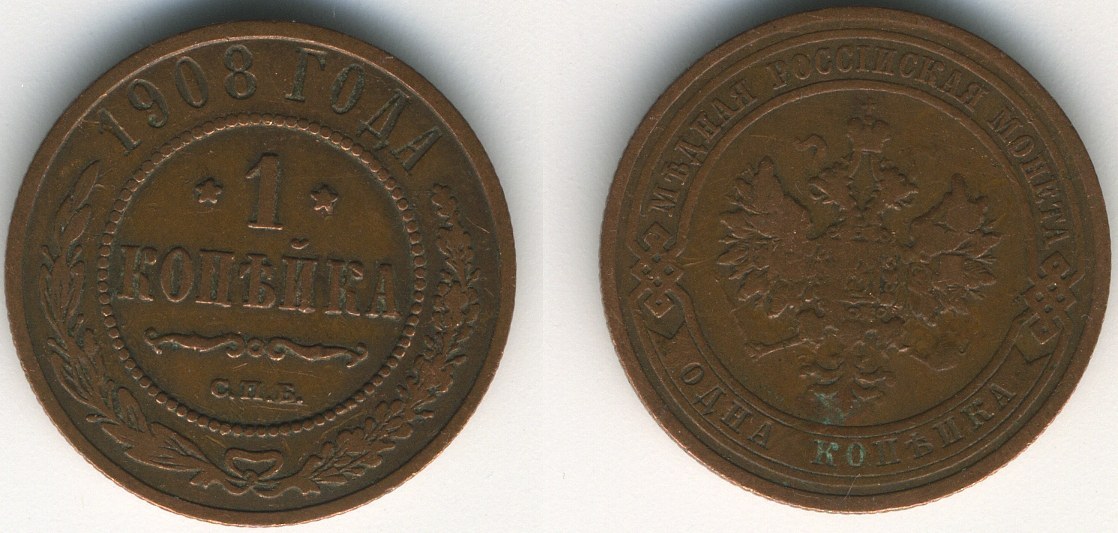
Read the Denomination and Date
Start with the value side. A genuine coin of this type shows the Cyrillic denomination 1 КОПѢЙКА (1 Kopeck) inside a wreath, with the date 1908 below it. The old-style Cyrillic spelling and the wreath frame are strong signs of the Imperial copper series and set it apart from later Soviet-era kopecks, which use different lettering and designs.
Confirm the Eagle Side
Turn the coin over and check for the Imperial double-headed eagle, crowned and bearing the orb and scepter, encircled by Cyrillic legend that includes РОССІЯ (Russia). On this small copper denomination you should not expect a portrait of the Tsar; the arms of the empire, not a bust, appear here. If one side shows a ruler's head instead of the eagle-and-wreath pairing, you are looking at a different coin.
Check Size, Metal, and Color
This is a small copper coin, roughly 21-22 mm across and only a few grams in weight, with the warm brown or reddish tone of aged copper. It should be non-magnetic and feel like a thin minor coin, not a heavy silver crown. A bright white, heavy, or magnetic piece of this design is a warning sign, since the genuine coin is plain copper.
Rule Out Look-Alikes
Imperial Russia struck several copper denominations of similar style, including the 1/2 Kopeck, 2 Kopecks, 3 Kopecks, and 5 Kopecks, which share the eagle and wreath layout but differ in stated value and size. Always read the numeral and word in the wreath to confirm it says 1 КОПѢЙКА. Later Soviet kopecks and coins of neighboring countries can look superficially similar, so match the РОССІЯ legend, the Imperial eagle, and the 1908 date together.
Authentication Cautions
Old copper is prone to corrosion, pitting, and harsh cleaning, all of which hurt originality and value, so examine the surfaces for damage and unnatural bright or smoothed areas. Altered dates and tooled fields occasionally appear on Imperial copper, so compare the numerals and eagle detail to trusted reference images. For anything beyond a common circulated example, favor coins with honest, original surfaces and consider third-party authentication for higher-grade pieces.
Frequently asked questions
How do I confirm it is a 1 Kopeck and not a larger copper coin?
Read the wreath. This type states 1 КОПѢЙКА (one kopeck). Related Imperial copper coins such as 2, 3, or 5 kopecks share the eagle-and-wreath style but show a different numeral and are larger.
What size and metal should it be?
Expect a small copper coin about 21-22 mm across and only a few grams, with a brown or reddish copper tone. It should be non-magnetic; a heavy, white, or magnetic piece of this design is suspect.
How can I tell an Imperial kopeck from a Soviet one?
Look for the crowned double-headed eagle and the РОССІЯ legend with old-style Cyrillic spelling. Soviet kopecks drop the Imperial eagle for revolutionary emblems and use modernized lettering.
Is it worth authenticating?
For common worn examples, usually not. But because old copper is often cleaned, corroded, or altered, verify size, metal, and design against references, and consider certification for scarce high-grade or unusual pieces.