
How to Identify the 1 Franc Ceres
A collector's guide to the silver 1 Franc Cérès — reading the wheat-crowned goddess, the motto-and-wreath reverse, the mint marks, and telling it from other Cérès denominations.
Read the full 1 Franc Ceres encyclopedia entry →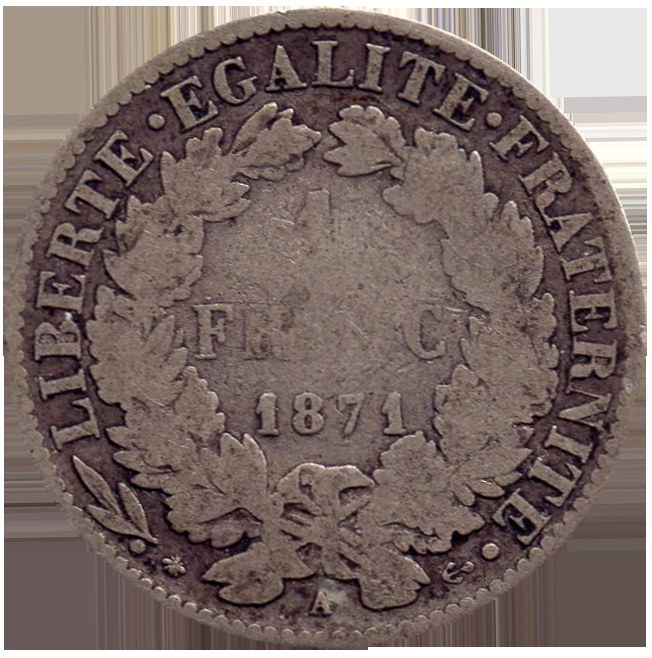
Start with the obverse portrait. A 1 Franc Cérès shows the head of Cérès facing left, her hair bound and crowned with ears of wheat and often other harvest produce, with a small star in the field. Look for tiny engraver's lettering below the neck. This wheat-crowned female head is the key diagnostic — do not confuse it with the striding Sower of the later Semeuse francs, who is a full standing figure rather than a head.
Confirm the denomination from the reverse, not the goddess. The same Cérès head was used on the 50 centimes, 1 franc and 2 francs, so the portrait alone does not fix the value. Read the numeral in the wreath: this coin shows 1F. Note the size while you are there — the silver 1 franc is a small coin of about 23 mm and roughly 5 g, distinctly smaller and lighter than the 2 franc piece and a little larger than the 50 centimes.
Check the reverse legend and layout. It should read LIBERTE EGALITE FRATERNITE and REPUBLIQUE FRANÇAISE around a wreath tied at the base, with the value 1F and the date inside; here the date is 1871. The republican motto is a hallmark of the type and separates it from imperial and royal francs of other reigns.
Read the mint mark and privy symbols. French coins of this period carry a small letter for the striking mint together with tiny engraver's or director's symbols near the base of the reverse. Paris is the most common. These marks are part of a correct attribution and can affect scarcity, so record them rather than ignore them.
Finally, weigh metal and authenticity. The coin should be silver of about .835 fineness, giving a bright, slightly grey-white tone and a soft ring, at roughly 5 g and 23 mm. Because these francs are common and low in face value, outright forgery is less of a concern than cleaning, wear and edge damage, all of which depress value. If a date or mint mark looks scarce or a coin seems unusually fine, weigh and measure it, compare the design to reference images, and consult recent sales or a dealer before assuming a premium.
Frequently asked questions
How do I tell the Cérès franc from the Semeuse (Sower) franc?
Look at the obverse. The Cérès franc shows only a head — the goddess crowned with wheat — while the Semeuse shows a full standing woman striding forward and scattering seed. The Cérès type is the older nineteenth-century design; the Sower came later.
The same head is on other coins — how do I know it is a 1 franc?
Read the reverse. The Cérès head appears on the 50 centimes, 1 franc and 2 francs, but only the 1 franc shows 1F in the wreath. Size helps too: the 1 franc is smaller and lighter than the 2 franc and larger than the 50 centimes.
What is the small letter near the date on the back?
It is the mint mark, identifying the mint that struck the coin, alongside small engraver's or director's privy symbols. Paris is the most common. These marks help attribute the coin and can matter for scarcer dates.
Is it worth authenticating a common silver Cérès franc?
For ordinary dates in worn condition, formal authentication rarely pays, since the coin is common and close to silver-bullion value. Reserve closer study or a dealer's opinion for apparently scarce dates, mint marks, or high-grade examples.