Jefferson Nickel (Wartime Alloy)
Country of Origin: United States of America
Year of Issue: 1942
Denomination: 5 Cents ($0.05)
Composition: 35% Silver, 56% Copper, 9% Manganese
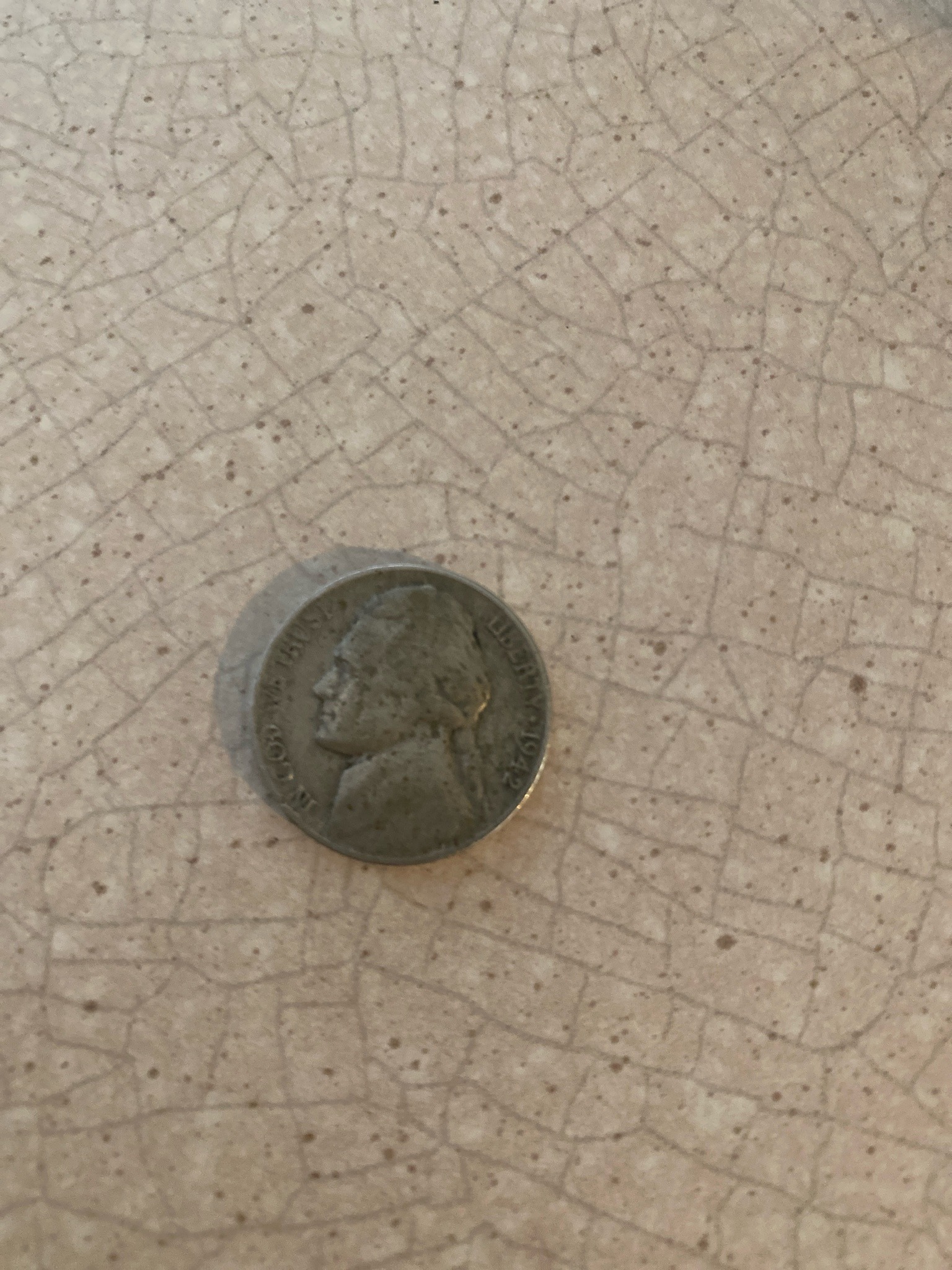
Brief Description
A circulated 1942 Jefferson nickel with dark toning, showing Thomas Jefferson on the obverse and Monticello on the reverse.
Historical Significance
Known as 'War Nickels', these were produced from late 1942 to 1945. Nickel was a critical material for the war effort (armor plating etc.), so the composition was changed to a silver alloy. This was the first time a large mint mark was used above the dome of Monticello to distinguish them from cupronickel versions.
Estimated Value
$1.50-$3.00 in average circulated condition; $15-$50+ in high Mint State grades.
Care Instructions
Do not clean with abrasives or chemicals, as this ruins numismatic value. Store in a PVC-free flip or coin tube to prevent further oxidation.
Mint Mark
P (Philadelphia) - visible as a large letter above the dome of Monticello on the reverse.
Mintage & Rarity
57,873,000 (Philadelphia 1942-P). Common, though many have been melted for silver content over the years.
Weight & Diameter
5.0 grams / 21.2 mm
Edge
Plain
Apparent Grade
Good to Very Good (G-VG). The coin shows significant even wear, with the features of the building and hair flattened. The surface is heavily toned/oxidized.
Obverse (Front)
Left-facing portrait of Thomas Jefferson. Legends: 'IN GOD WE TRUST', 'LIBERTY', and '1942'. Designed by Felix Schlag.
Reverse (Back)
Frontal view of Monticello, Jefferson's Virginia home. Legends: 'E PLURIBUS UNUM', 'MONTICELLO', 'FIVE CENTS', and 'UNITED STATES OF AMERICA'. Featuring a large 'P' mint mark above the dome.
What Drives This Coin's Value
Current silver spot price provides a 'melt value' floor. Higher premiums are found for 'Full Steps' (FS) on Monticello or coins in high-grade uncirculated condition.
Similar Coins
1942 cupronickel nickels (look for NO large mint mark above the dome) and later silver-colored nickels which lack the 35% silver content.
Authenticity & Counterfeit Red Flags
Look for the large mint Mark (P, D, or S) above the dome; if missing on a 1942-1945 coin, it is either a counterfeit, a counterfeit 'Henning' nickel, or a regular nickel-base 1942 issue. Silver war nickels also have a distinct 'soapy' feel and a different sound when dropped.
Notable Varieties & Errors
1942-P DDO (Doubled Die Obverse) and the 'Over-date' 1942/1-P variety where the 2 is stuck over a 1 in the date side-by-side or overlapping. These are highly valuable errors. Also note the 1942 nickel-base (non-silver) issue exists without the large mint mark on reverse. Since yours has the large mint mark, it is the silver version. Regular 1942 nickels have no mint mark if from Philly, or a small mint mark to the right of the building if from Denver or San Francisco. Only the silver war nickels have the large mark ABOVE the dome. Note: some 1942-S nickels are also silver. To tell for 1942: if the mint mark is LARGE and ABOVE the dome, it is silver. If it is small and to the right, it is likely the standard nickel-alloy type (or the 1942-D which was only made in standard alloy). Actually, all 1942 S nickels were silver war alloys, while 1942 D were all standard nickel. 1942 P could be either, but the large P confirms silver composition here.
Created At: 2026-06-16T18:00:53.708457