Alexander the Great Gold Stater (Style)
Country of Origin: Macedonian Empire (Ancient Greece)
Year of Issue: c. 336-323 BC (Life) or 323-300 BC (Posthumous)
Denomination: Gold Stater
Composition: High Karat Gold (Nominally 24k, though the image exhibits casting texture typical of modern replicas)
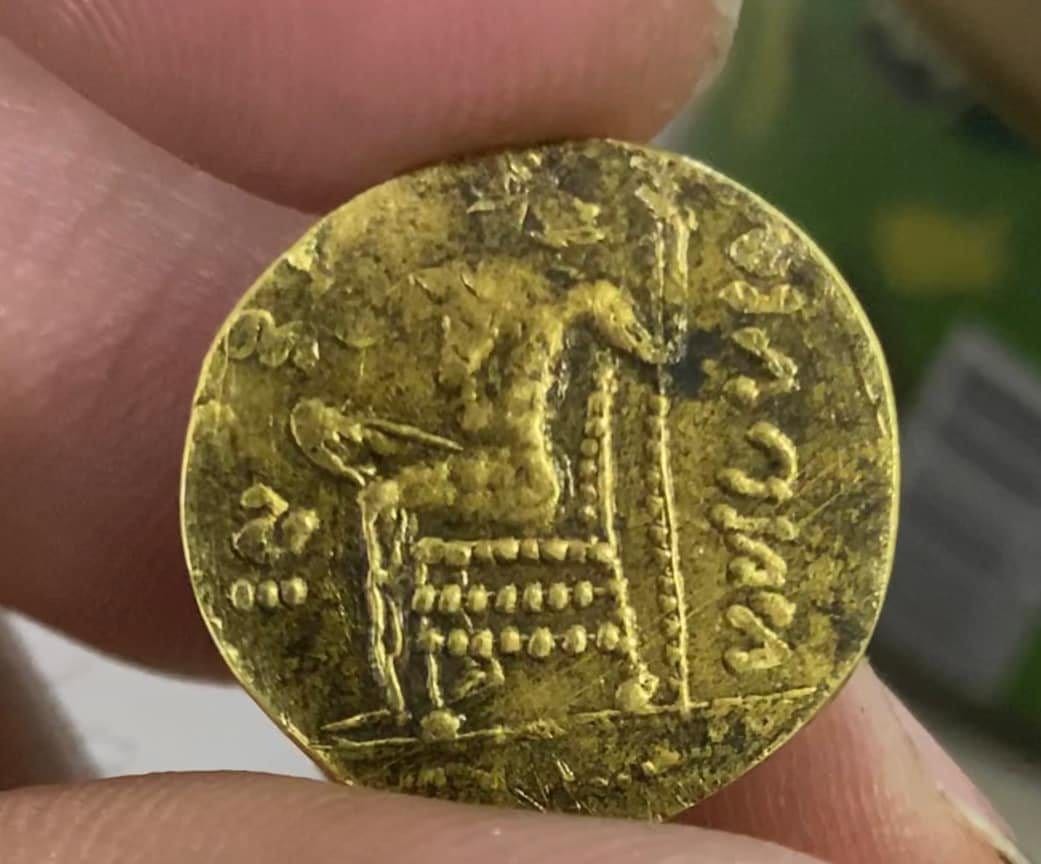
Brief Description
A gold-colored ancient Greek coin featuring a seated deity on the reverse, though it appears to be a modern cast replica with a granular, pitted surface texture.
Historical Significance
The gold stater of Alexander III of Macedon is one of the most iconic ancient coins, used to pay his vast armies and facilitate trade across his newly conquered empire from Greece to India.
Estimated Value
$10-$30 as a modern souvenir/replica; $2,500-$10,000+ if an authentic ancient gold stater in high grade.
Care Instructions
Handle by the edges; do not clean with chemicals or abrasives. Store in a PVC-free plastic flip or a velvet-lined case. Avoid rubbing the surface.
Mint Mark
Monograms and symbols (like the 'M' under the throne seen here) varied by mint; major ones were in Babylon, Susa, and various Asia Minor cities.
Mintage & Rarity
Originals are scarce to rare; replicas are extremely common as tourist pieces.
Weight & Diameter
Standard original: ~8.5g / 18-20mm. Replicas vary wildly.
Edge
Plain / Irregular (hand-struck)
Apparent Grade
Poor/Very Fine (VF) details, but the surface exhibits suspicious casting bubbles and lack of flow lines typical of modern copies.
Obverse (Front)
Typically shows the head of Athena wearing a Corinthian helmet adorned with a serpent or griffin.
Reverse (Back)
Nike (Goddess of Victory) standing, or Zeus/Seated figure (as seen here, which is more common on Silver Tetradrachms of this era). Inscribed 'ALEXANDROU' in Greek (AΛEΞANΔPOY).
What Drives This Coin's Value
Authenticity is the primary value factor. After that, centering, strike quality, and the presence of rare mint monograms determine price.
Similar Coins
Silver Tetradrachms of Alexander the Great share the seated Zeus reverse design; gold staters of Philip II (his father) feature a chariot.
Authenticity & Counterfeit Red Flags
Look for a 'seam' on the edge, casting pits/bubbles on the field, and weight. Authentic ancient gold was struck with dies, creating 'flow lines' in the metal; this coin's 'bubbly' texture is a major red flag for a cast fake.
Notable Varieties & Errors
Posthumous vs. Lifetime strikes; varieties identified by the specific symbols (lightning bolt, eagle, kantharos) near the feet of the seated figure.
Created At: 2026-04-19T12:07:13.285029