British 50 Pence (Decimal Coinage)
Country of Origin: United Kingdom (Royal Mint)
Year of Issue: 1997-2022 (Modern reduced size)
Denomination: 50 Pence
Composition: Cupro-nickel (75% Copper, 25% Nickel)
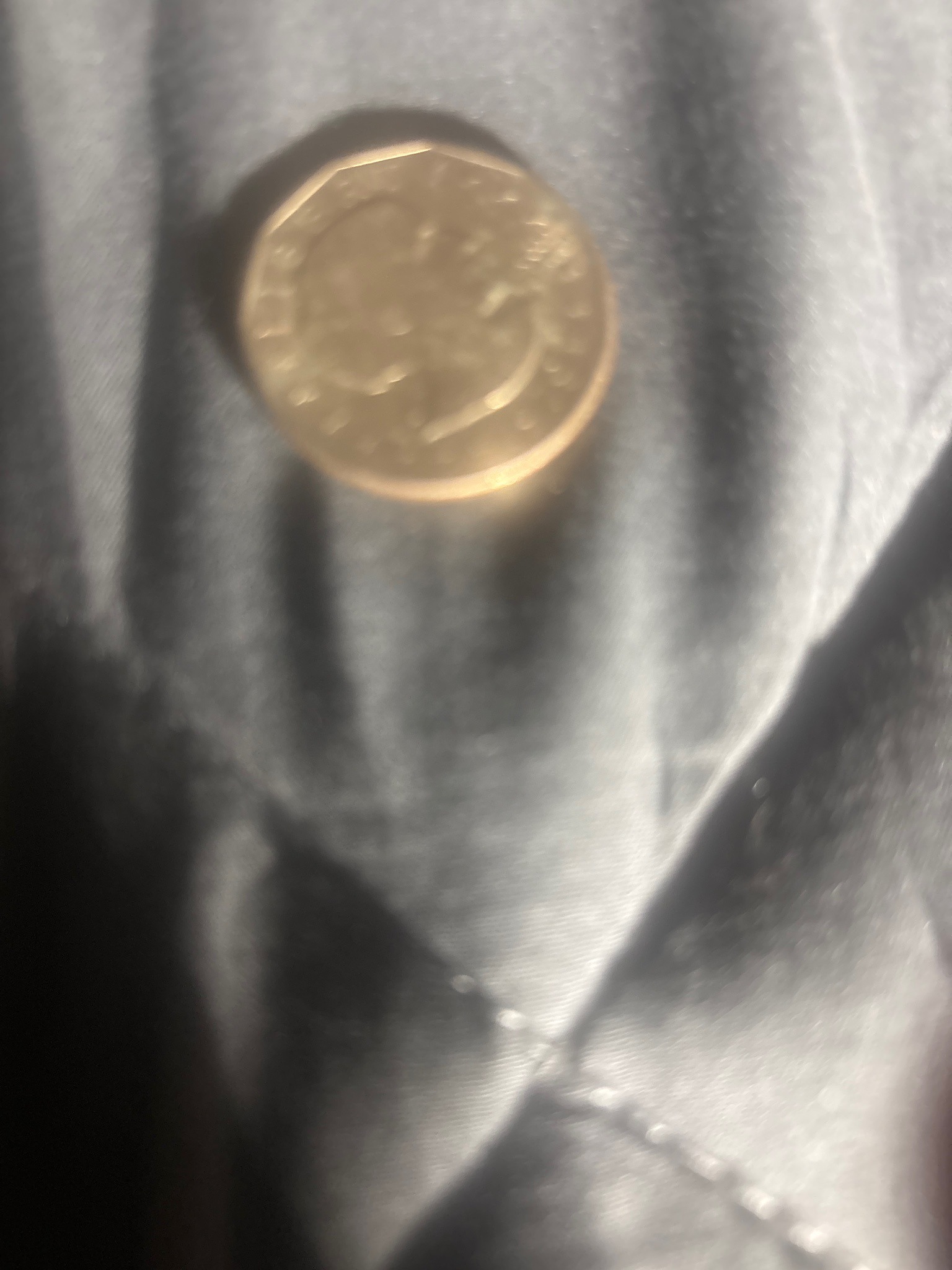
Brief Description
A seven-sided (equilateral curve heptagon) silver-colored coin featuring the profile of Queen Elizabeth II.
Historical Significance
The 50p coin was introduced in 1969 as part of decimalization. In 1997, it was replaced by this smaller version. It is one of the most collected coins in the UK due to its many commemorative reverse designs.
Estimated Value
$0.65 - $1.00 USD (Face value/Circulated), Highly variable for rare commemoratives (e.g. Kew Gardens can reach $200+).
Care Instructions
Avoid cleaning with chemicals or abrasives. Store in a cool, dry place in a PVC-free holder to prevent 'green slime' or corrosion.
Mint Mark
None (Produced by the Royal Mint in Llantrisant, Wales)
Mintage & Rarity
Common for standard Britannia or Shield designs; mintage ranges from millions to tens of millions depending on the year.
Weight & Diameter
8.00 grams; 27.3 mm diameter
Edge
Plain
Apparent Grade
Circulated (Blurry images prevent precise grading, but appears to have typical surface wear).
Obverse (Front)
Features the head of Queen Elizabeth II. Most likely the 4th portrait (by Ian Rank-Broadley) or 5th portrait (by Jody Clark) facing right, with the legend ELIZABETH II D G REG F D.
Reverse (Back)
Standard designs include the Seated Britannia (1997-2008) or the Royal Shield of Arms section (2008-present). The image is too blurry to confirm if it is a commemorative design.
What Drives This Coin's Value
Rarity of the reverse design is the primary factor. Circulated standard designs are only worth face value, while rare commemoratives like the 2009 Kew Gardens or certain Olympic varieties are highly valuable.
Similar Coins
The original large-size 50p (pre-1997) which is much heavier (13.5g). It can also be confused with 50p coins from British Overseas Territories (e.g., Isle of Man, Gibraltar).
Authenticity & Counterfeit Red Flags
Check for crispness of the lettering and the distinct heptagonal shape. Weight should be exactly 8 grams. Some high-value commemoratives have sophisticated fakes, but standard shield/Britannia types are rarely faked.
Notable Varieties & Errors
The 2009 Kew Gardens is the most famous 'key date'. Other rare varieties include the 2011 Olympic 'Offside' or 'Aquatics' (with lines over face) errors/designs.
Created At: 2026-04-21T18:09:38.433925