Indian Head Cent
Country of Origin: United States of America
Year of Issue: 1899
Denomination: One Cent ($0.01)
Composition: 95% Bronze (95% copper, 5% tin and zinc)
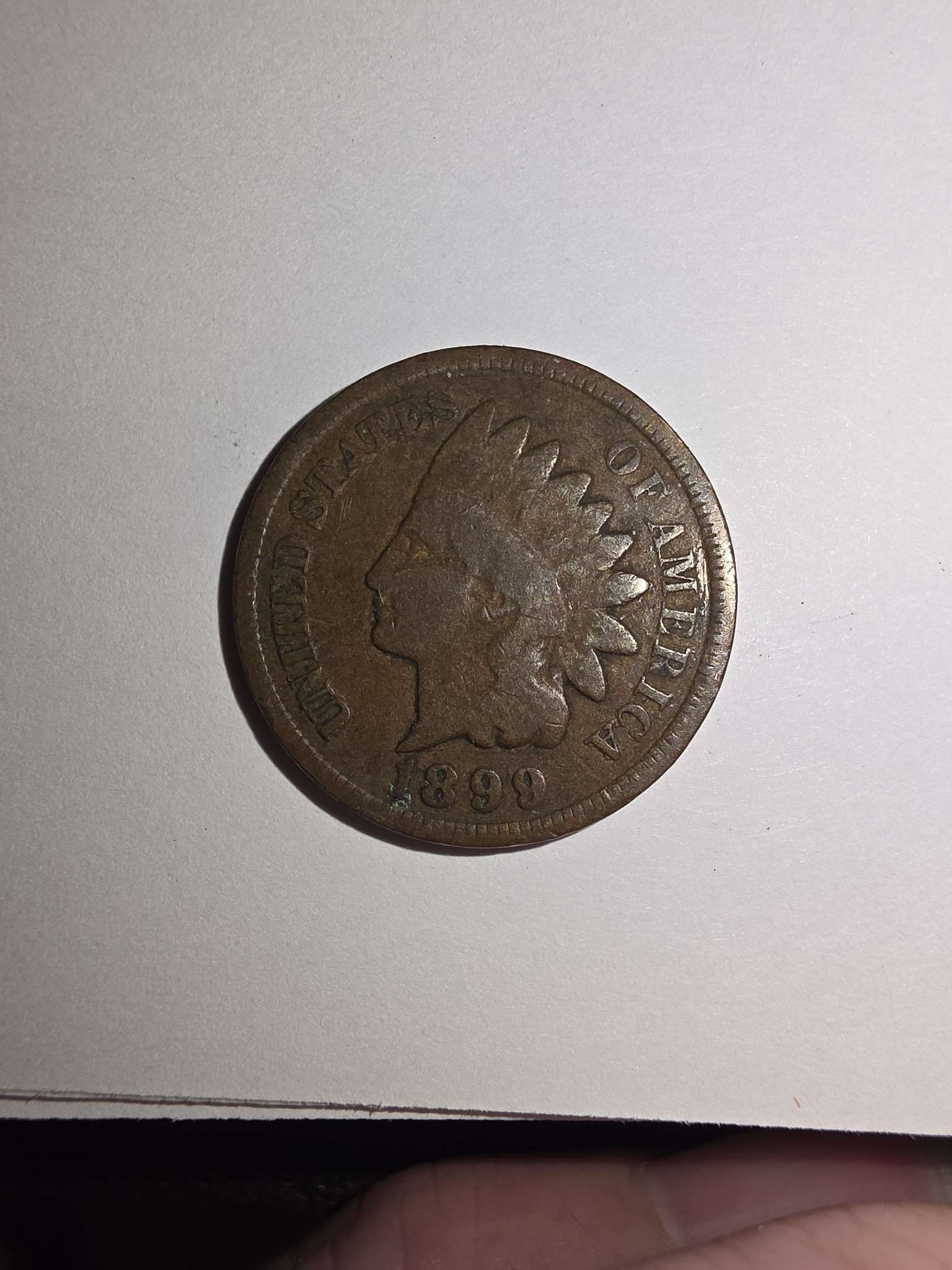
Brief Description
A bronze cent featuring a profile of Liberty in a Native American headdress on the obverse and a wreath on the reverse.
Historical Significance
Designed by James B. Longacre, the Indian Head Cent was minted from 1859 to 1909. Despite the name, the figure is actually Lady Liberty wearing a feathered headdress, symbolizing freedom. This 1899 issue comes from the later years of the series when production was high to meet the needs of a growing economy.
Estimated Value
$1-$3 in Good condition, $5-$10 in Fine, $30-$60 in Extremely Fine, $100+ in Mint State.
Care Instructions
Do not clean or polish the coin, as this destroys numismatic value. Store in a PVC-free flip or archival-safe holder to prevent 'bronze disease' (green corrosion visible on this specimen).
Mint Mark
None (Philadelphia Mint). During this era, only the 1908 and 1909 cents had mint marks (S for San Francisco).
Mintage & Rarity
53,598,000; Common date.
Weight & Diameter
3.11 grams / 19.05 mm
Edge
Plain
Apparent Grade
Good (G-4) to Very Good (VG-8). The coin shows heavy circulation wear; the word 'LIBERTY' is not visible on the headband, and there is significant environmental damage/corrosion (verdigris).
Obverse (Front)
Liberty facing left wearing a feathered headdress with 'LIBERTY' on the band. Legend 'UNITED STATES OF AMERICA' with the date '1899' at the bottom.
Reverse (Back)
The words 'ONE CENT' inside a wreath of oak leaves and acorns, with a small Union shield at the top of the wreath.
What Drives This Coin's Value
Condition is the primary factor for this common date. Environmental damage, such as the green pitting seen here, significantly reduces value to collectors.
Similar Coins
Flying Eagle Cents (earlier series) or later Lincoln Cents. It is distinct due to the headdress design.
Authenticity & Counterfeit Red Flags
Check for correct weight (3.11g) and diameter. Common dates like 1899 are rarely counterfeited for circulation, but high-grade examples should be checked for surface artificial toning.
Notable Varieties & Errors
None particularly famous for 1899; collectors look for 'Red' (original luster) or 'Red-Brown' designations in higher grades.
Created At: 2026-06-10T23:43:35.704332