Bicentennial Kennedy Half Dollar
Country of Origin: United States of America
Year of Issue: 1776-1976 (Minted in 1975 and 1976)
Denomination: Half Dollar ($0.50)
Composition: Outer layers of 75% copper/25% nickel bonded to a core of pure copper
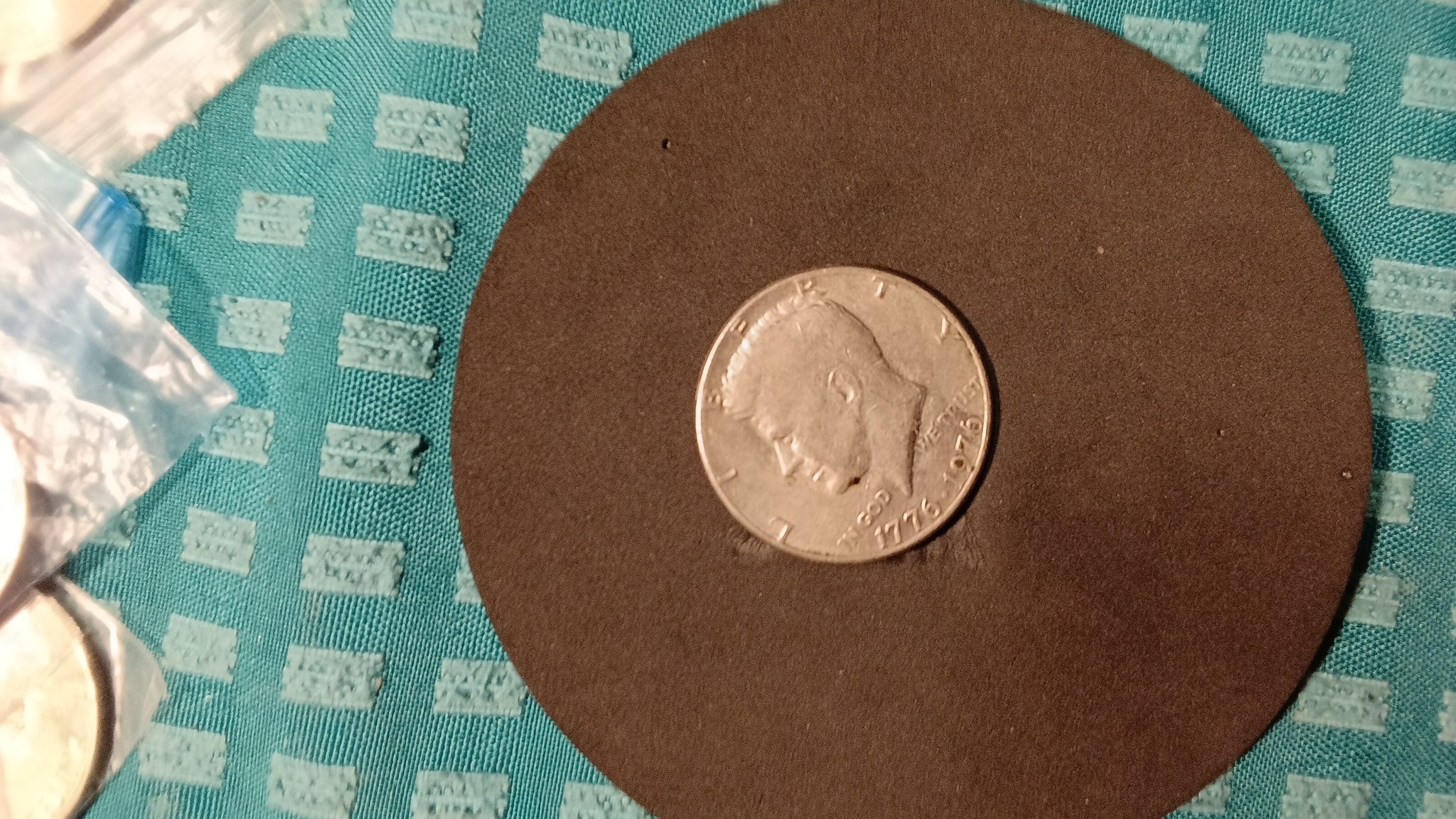
Brief Description
A United States half dollar featuring the dual date 1776-1976 and Independence Hall on the reverse.
Historical Significance
Issued to commemorate the 200th anniversary of American independence. It is one of three coins (including the quarter and dollar) featuring one-year-only reverse designs for the 1976 Bicentennial.
Estimated Value
$0.50-$2.00 in circulated condition; $5.00-$20.00 in high uncirculated grades (MS-65+)
Care Instructions
Avoid cleaning or polishing as it destroys numismatic value. Handle by the edges and store in a PVC-free flip or archival-safe container.
Mint Mark
None visible (typically 'D' for Denver or 'S' for San Francisco clad/silver proof; no mark indicates Philadelphia)
Mintage & Rarity
Common; total mintage exceeded 500 million between the Philadelphia and Denver mints.
Weight & Diameter
11.34 grams / 30.61 mm
Edge
Reeded
Apparent Grade
Extremely Fine to About Uncirculated (XF-AU) based on visible high-point wear on the hair and building details.
Obverse (Front)
Profile of John F. Kennedy facing left with the dual date '1776-1976' below. Legends: LIBERTY, IN GOD WE TRUST.
Reverse (Back)
Independence Hall in Philadelphia. Legends: UNITED STATES OF AMERICA, 200 YEARS OF FREEDOM, E PLURIBUS UNUM, INDEPENDENCE HALL, HALF DOLLAR. Designer: Seth G. Huntington.
What Drives This Coin's Value
Most circulated examples are worth face value. Value is primarily driven by high-grade specimens (MS-67 or higher) or the identification of 40% silver 'S' mint versions.
Similar Coins
1964 Kennedy Half (90% silver) and 1965-1970 Kennedy Halves (40% silver). These are distinguished by their single dates and the heraldic eagle reverse.
Authenticity & Counterfeit Red Flags
Weight and magnetism are key; the coin should not be magnetic and should weigh approx 11.3g. Look for clear, crisp lettering.
Notable Varieties & Errors
1974-D Doubled Die Obverse (often found in late Bicentennial transition batches) and various proof 'no S' errors, though rare.
Created At: 2026-05-25T03:10:10.791756