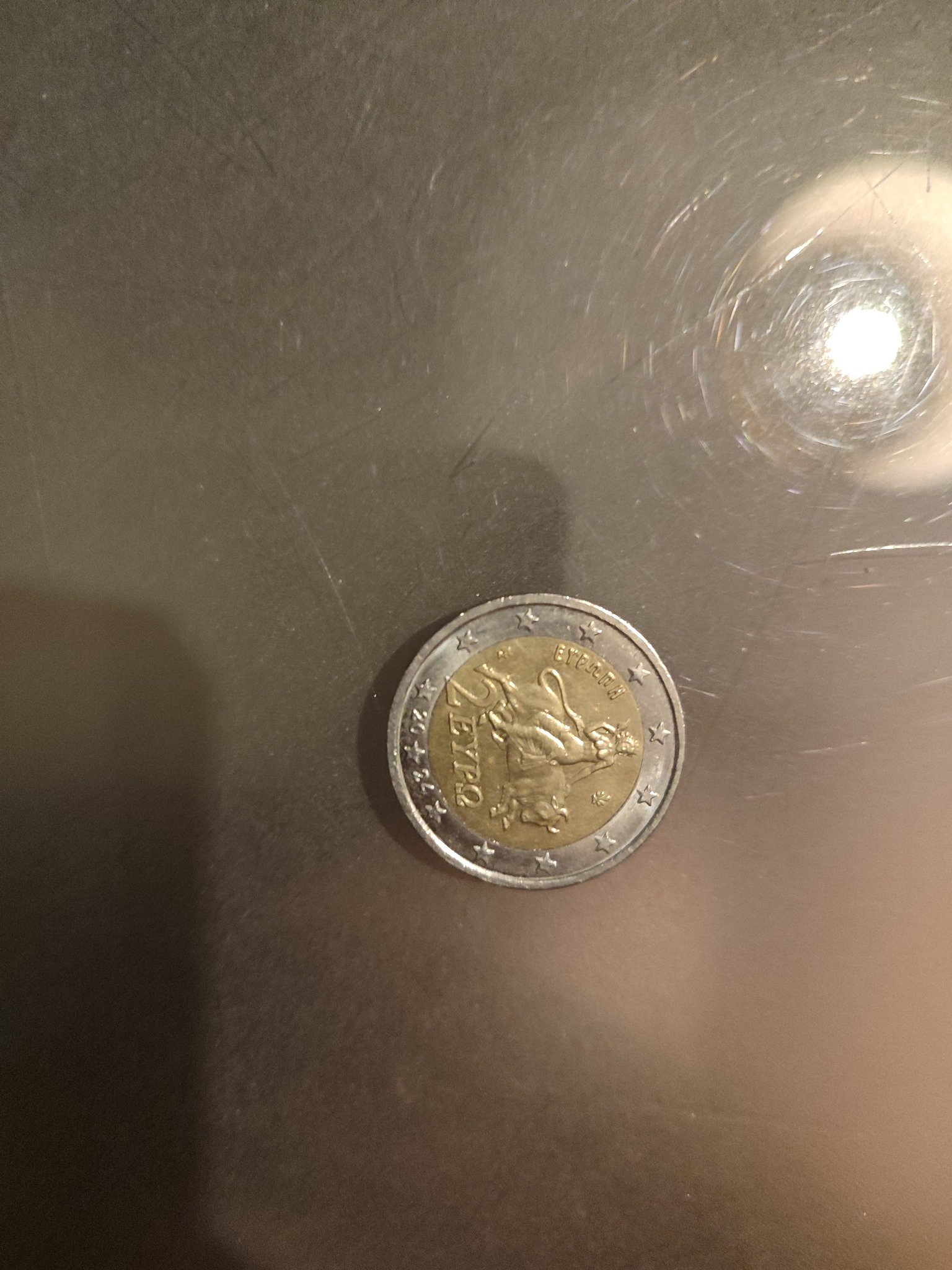
Greece 2 Euro (Europa and the Bull)
Country of Origin: Greece / Hellenic Republic
Year of Issue: 2002
Denomination: 2 Euro
Composition: Bimetallic: Nickel-brass clad Nickel center in Copper-nickel ring
Brief Description
A bimetallic 2-euro coin featuring a scene from Greek mythology on the national side and the standard map of Europe on the common side.
Historical Significance
Issued during the initial adoption of the Euro physical currency in 2002. The design references the founding myth of Europe, where Zeus transforms into a bull to abduct the princess Europa.
Estimated Value
$2.20 - $5.00 USD in circulated condition; up to $15.00 in high-grade uncirculated condition.
Care Instructions
Store in a cool, dry place. Handle by the edges only. Avoid cleaning or polishing as it destroys numismatic value.
Mint Mark
S (inside the star at 6 o'clock), indicating production by the Mint of Finland (Vantaa).
Mintage & Rarity
70,000,000 (total for 2002 with S mark). This is a very common coin.
Weight & Diameter
8.50g / 25.75mm
Edge
Lettered (ΕΛΛΗΝΙΚΗ ΔΗΜΟΚΡΑΤΙΑ ★)
Apparent Grade
Fine to Very Fine (circulated with visible wear and scratches on the surfaces).
Obverse (Front)
The national side (often called the obverse in Europe) depicts the scene of the bull (Zeus) abducting Europa, with the Greek inscription 'EYPΩΠH' and '2 EYPΩ'. The year 2002 is split at the bottom.
Reverse (Back)
The common side features a map of the European Union (pre-expansion) next to the numeral 2 and the word 'EURO'. Designed by Luc Luycx.
What Drives This Coin's Value
Most valuable in pristine, uncirculated condition; common circulated examples are worth only face value.
Similar Coins
Greek 2 Euro coins from other years without the 'S' mint mark (minted in Athens).
Authenticity & Counterfeit Red Flags
Check for magnetic properties (the center should be slightly magnetic), edge lettering clarity, and the presence of the 'S' mark in the star.
Notable Varieties & Errors
The 'S' mint mark is often mistaken by amateurs as a rare mistake; it actually just denotes the Finnish mint and is very common.
Created At: 2026-06-14T21:03:32.849809