German Reichspfennig (WWII Zinc issue)
Country of Origin: Nazi Germany (Third Reich)
Year of Issue: 1941
Denomination: 10 Reichspfennig
Composition: Zinc
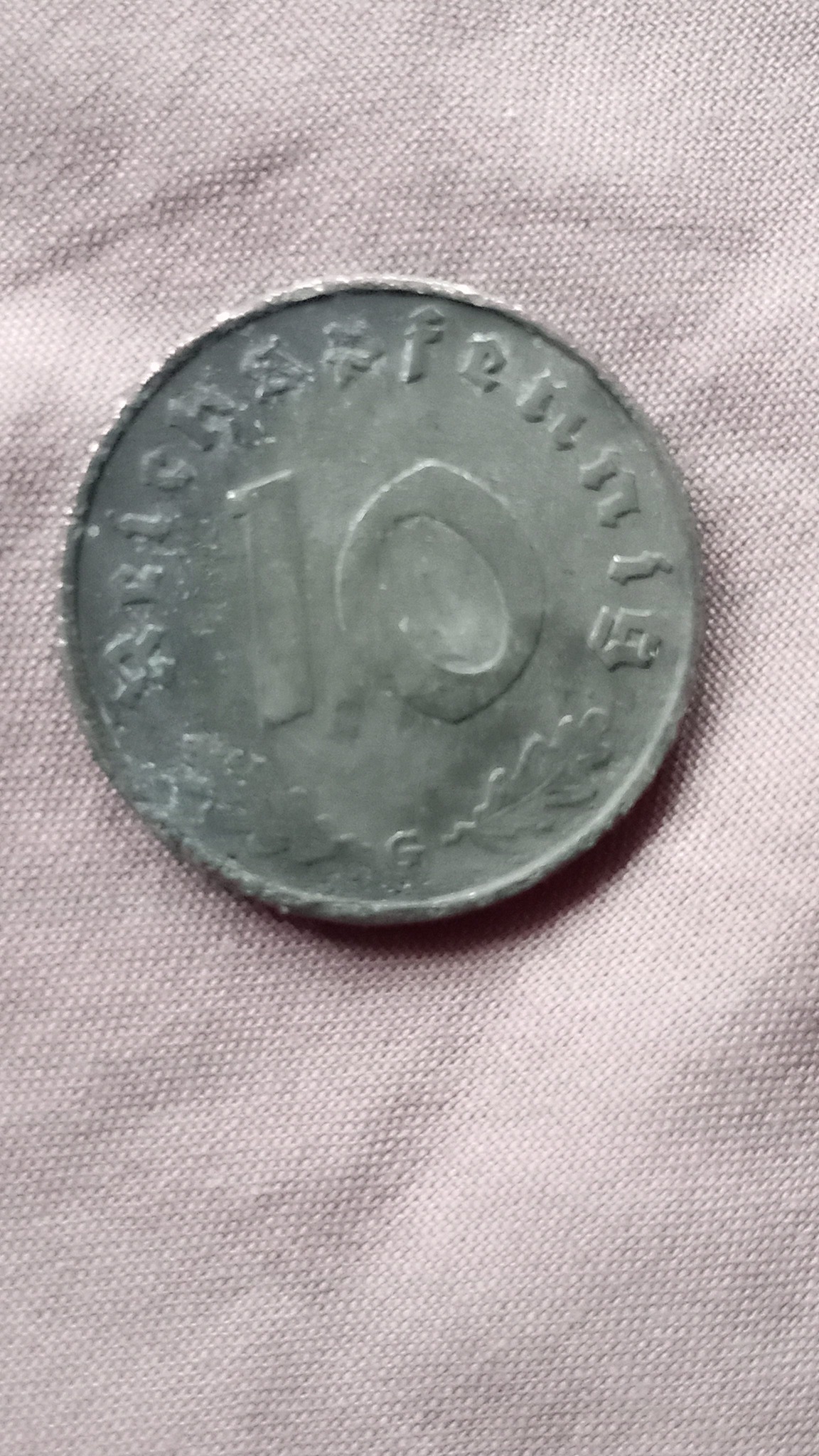
Brief Description
A dull grey zinc coin featuring a large numeral 10 on the obverse and a national eagle clutching a swastika on the reverse.
Historical Significance
Issued during World War II, these coins were made of zinc to conserve copper and bronze for the war effort. The design reflects the iconography of the Third Reich under the Nazi regime.
Estimated Value
$1-$3 in circulated condition, $10-$20 in high Mint State (zinc pest often reduces value)
Care Instructions
Do not clean. Zinc is highly susceptible to 'zinc pest' (a white, powdery oxidation). Store in a dry, PVC-free environment. Avoid high humidity which causes rapid deterioration of the metal.
Mint Mark
G (Karlsruhe Mint)
Mintage & Rarity
Common; however, 'G' mint coins often have lower mintage than 'A' (Berlin). High-grade specimens are scarcer due to metal reactivity.
Weight & Diameter
3.52g, 21.0mm
Edge
Smooth / Plain
Apparent Grade
Very Fine (VF). Design details are visible but there is significant grey oxidation and typical zinc dullness.
Obverse (Front)
Large numeral '10' in the center. Above, 'Reichspfennig' in Fraktur script. At the bottom, a small 'G' mint mark flanked by two oak leaves.
Reverse (Back)
A German eagle (Reichsadler) facing left, clutching a wreath containing a swastika. 'Deutsches Reich' is inscribed at the top, and '1941' at the bottom.
What Drives This Coin's Value
Condition is the primary factor; zinc coins are prone to environmental damage. The 'G' mint mark adds slight interest over the common 'A' mark.
Similar Coins
Often confused with the 5 Reichspfennig of the same era (which is smaller) or pre-war bronze/brass versions (which are different colors).
Authenticity & Counterfeit Red Flags
Zinc coins are rarely faked due to low value, but check for 'zinc pest' which can sometimes be mistaken for dirt. Real coins should not be magnetic.
Notable Varieties & Errors
None widely recognized for this specific year and mint, though die cracks are common due to the soft metal.
Created At: 2026-05-04T15:03:33.353355