Buffalo Nickel (Indian Head Nickel)
Country of Origin: United States of America
Year of Issue: 1936
Denomination: Five Cents (5c)
Composition: 75% Copper, 25% Nickel
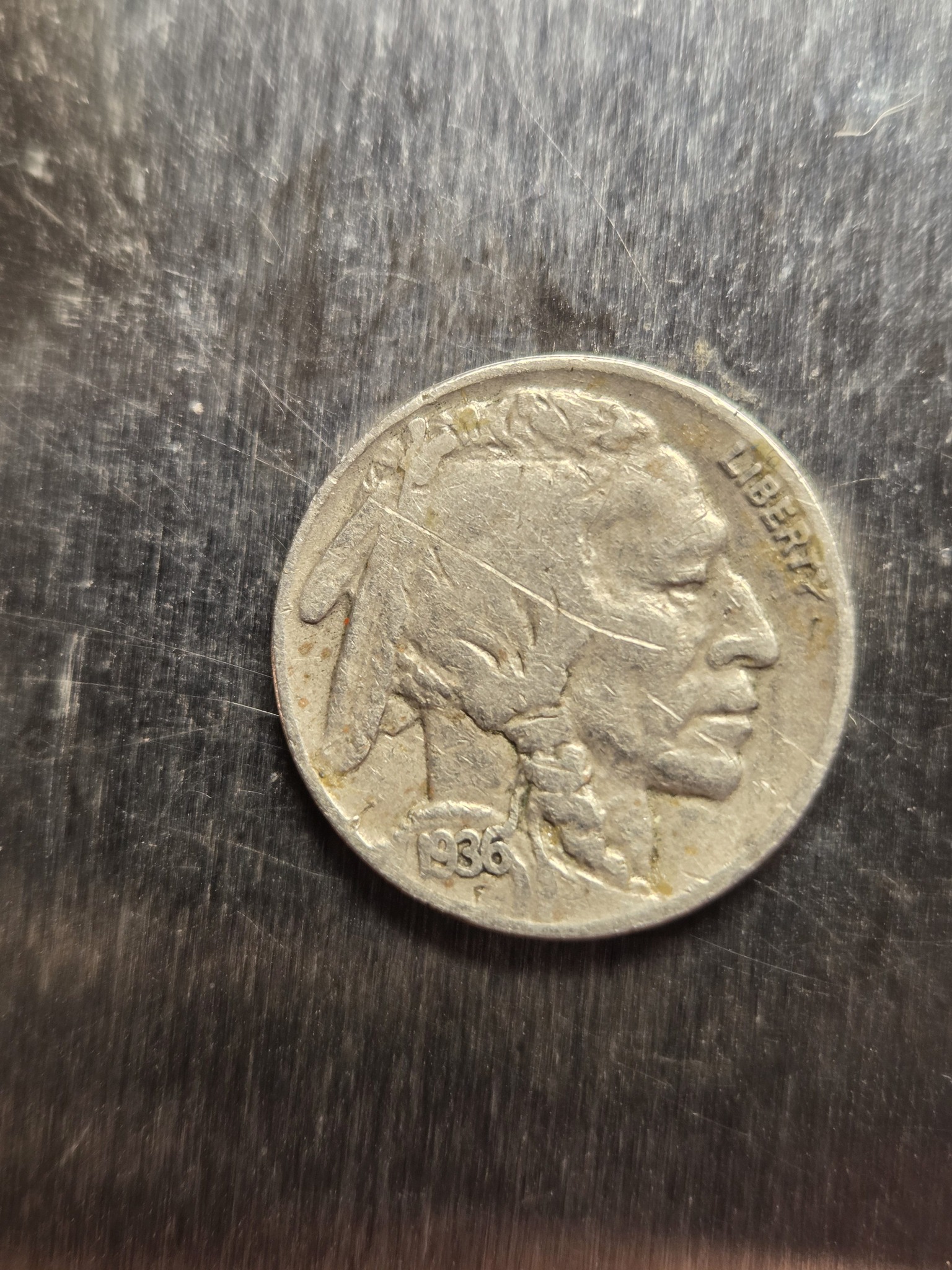
Brief Description
A 1936 United States nickel featuring the profile of a Native American on the obverse and an American Bison (Buffalo) on the reverse.
Historical Significance
Designed by James Earle Fraser and minted from 1913 to 1938, this coin is celebrated for its uniquely American motifs, meant to honor the country's indigenous heritage and western frontier.
Estimated Value
$1-$3 in circulated condition; $25-$50 in Mint State (MS-63); higher for exceptional Gem examples.
Care Instructions
Do not clean or polish the coin, as this removes original surface luster and lowers collector value. Store in a PVC-free plastic holder or an archival-quality flip to prevent environmental damage.
Mint Mark
No mint mark visible (Philadelphia Mint)
Mintage & Rarity
Common; Philadelphia produced 119,001,420 of these in 1936.
Weight & Diameter
5.00 grams / 21.21 mm
Edge
Plain
Apparent Grade
Fine to Very Fine (F-VF). The date is clear, but there is significant wear on the Native American's hair and the buffalo's shoulder/horn details.
Obverse (Front)
Right-facing profile of a Native American man, a composite of three different chiefs. The word 'LIBERTY' is at the top right, and the date '1936' is on the bottom left shoulder. The 'F' below the date is the designer's initial (Fraser).
Reverse (Back)
An American Bison (buffalo) standing on a mound. Legend 'UNITED STATES OF AMERICA' and 'E PLURIBUS UNUM' at the top, and 'FIVE CENTS' below the mound.
What Drives This Coin's Value
The primary factor for this specific year is the grade. Because 1936 is a high-mintage year, only coins in high Mint State or with rare errors carry significant premiums.
Similar Coins
Modern Westward Journey 'Bison' nickels (2005) and American Buffalo Gold Bullion coins also feature similar imagery but are modern issues.
Authenticity & Counterfeit Red Flags
Check for proper weight (5g) and the distinct 'mound' type reverse. 1936 is rarely counterfeited due to its commonality, but look for fuzzy details or off-center strikes on low-quality fakes.
Notable Varieties & Errors
The most famous variety for 1936 is the 3-1/2 leg variety (mostly found on Denver mint marks) and various Doubled Die Obverses.
Created At: 2026-05-20T10:57:28.059457