Canadian 2 Dollars ('Toonie')
Country of Origin: Canada (Royal Canadian Mint)
Year of Issue: 1996
Denomination: 2 Dollars (CAD)
Composition: Bimetallic: Nickel outer ring, bronze-plated aluminum core (92% Cu, 6% Al, 2% Ni)
Brief Description
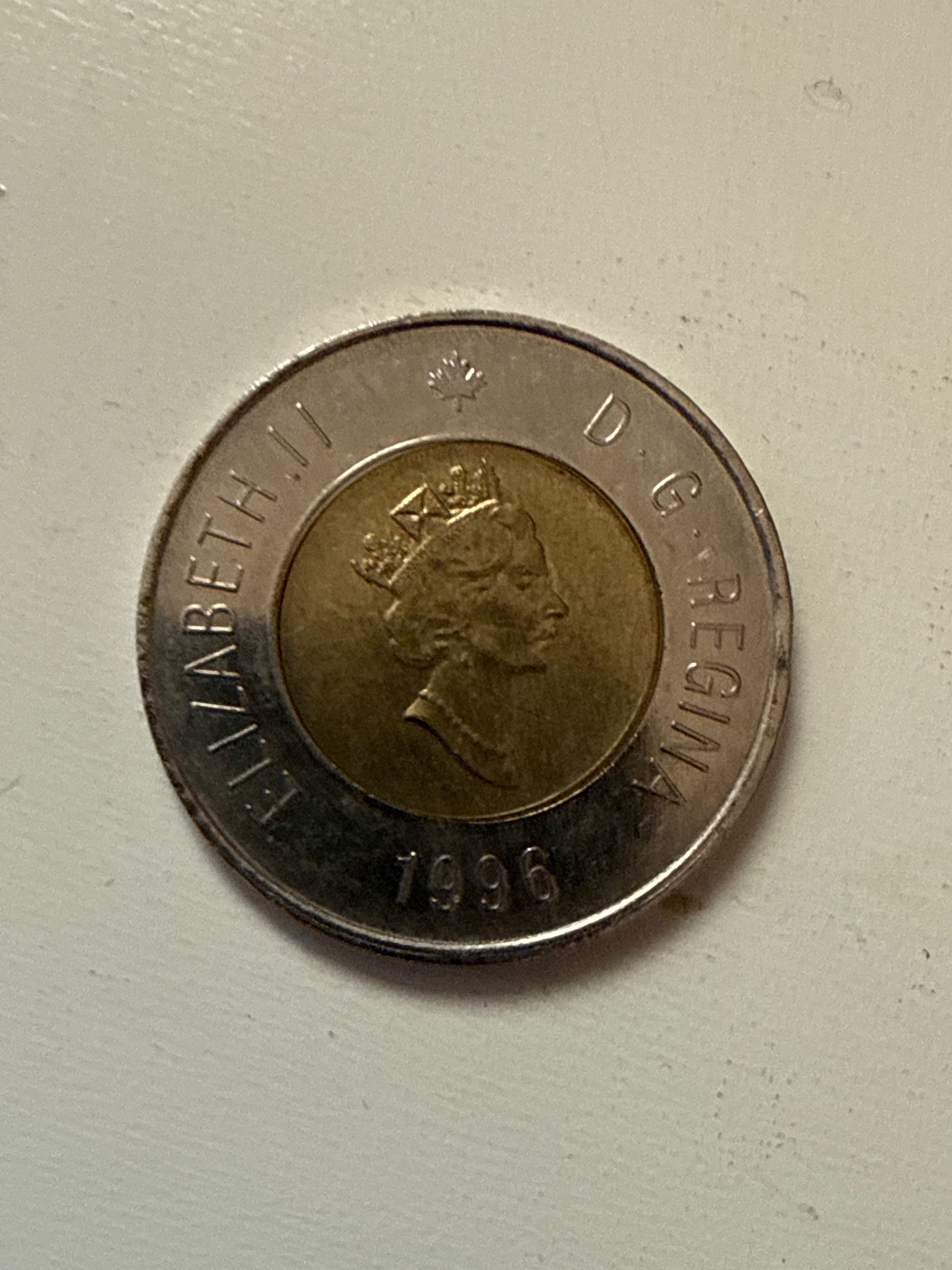
A bimetallic coin with a silver-colored outer ring and a gold-colored center, featuring a polar bear.
Historical Significance
1996 was the introductory year for the two-dollar coin in Canada, replacing the two-dollar paper banknote. It was nicknamed the 'Toonie' to rhyme with the one-dollar 'Loonie'.
Estimated Value
$1.50 - $2.00 in circulated condition; $5.00 - $10.00 in high uncirculated grades (MS-65+).
Care Instructions
Handle by the edges to avoid fingerprint oils. Do not clean or polish, as this removes the numismatic patina and reduces value. Store in a cool, dry place in a PVC-free holder.
Mint Mark
None (Produced at the Winnipeg Mint)
Mintage & Rarity
375,483,000 (Very common introductory mintage)
Weight & Diameter
7.30 grams; 28.00 mm
Edge
Interrupted serrations (alternating plain and reeded sections)
Apparent Grade
Circulated / About Uncirculated (Visible minor surface scratches and darkening on the outer ring, but detail remains sharp).
Obverse (Front)
The 'Third Portrait' of Queen Elizabeth II wearing a diadem, facing right. Lettering includes 'ELIZABETH II', 'D.G. REGINA', and the year '1996'. Designed by Dora de Pédery-Hunt.
Reverse (Back)
An adult polar bear on an ice floe. Lettering includes 'CANADA' and '2 DOLLARS'. Designed by Brent Townsend.
What Drives This Coin's Value
Most 1996 Toonies are worth only face value unless they are in pristine uncirculated condition or possess a known error.
Similar Coins
The 1996 'Churchill' variety or the 'German Planchet' variety. Many counterfeit 'Toonies' circulate, identifiable by poor detail on the bear's fur.
Authenticity & Counterfeit Red Flags
Authentic 1996 coins have a distinct 'interrupted serration' edge. Check the center core for a tight fit; early counterfeits often have loose or poorly centered cores.
Notable Varieties & Errors
The 'German Planchet' variety (slightly different finish) and the rare 'Cigar' or 'Fire' die cracks/errors.
Created At: 2026-05-31T02:00:52.656073