German Empire 10 Pfennig (Kriegsgeld)
Country of Origin: German Empire (Deutsches Reich)
Year of Issue: 1921
Denomination: 10 Pfennig
Composition: Zinc
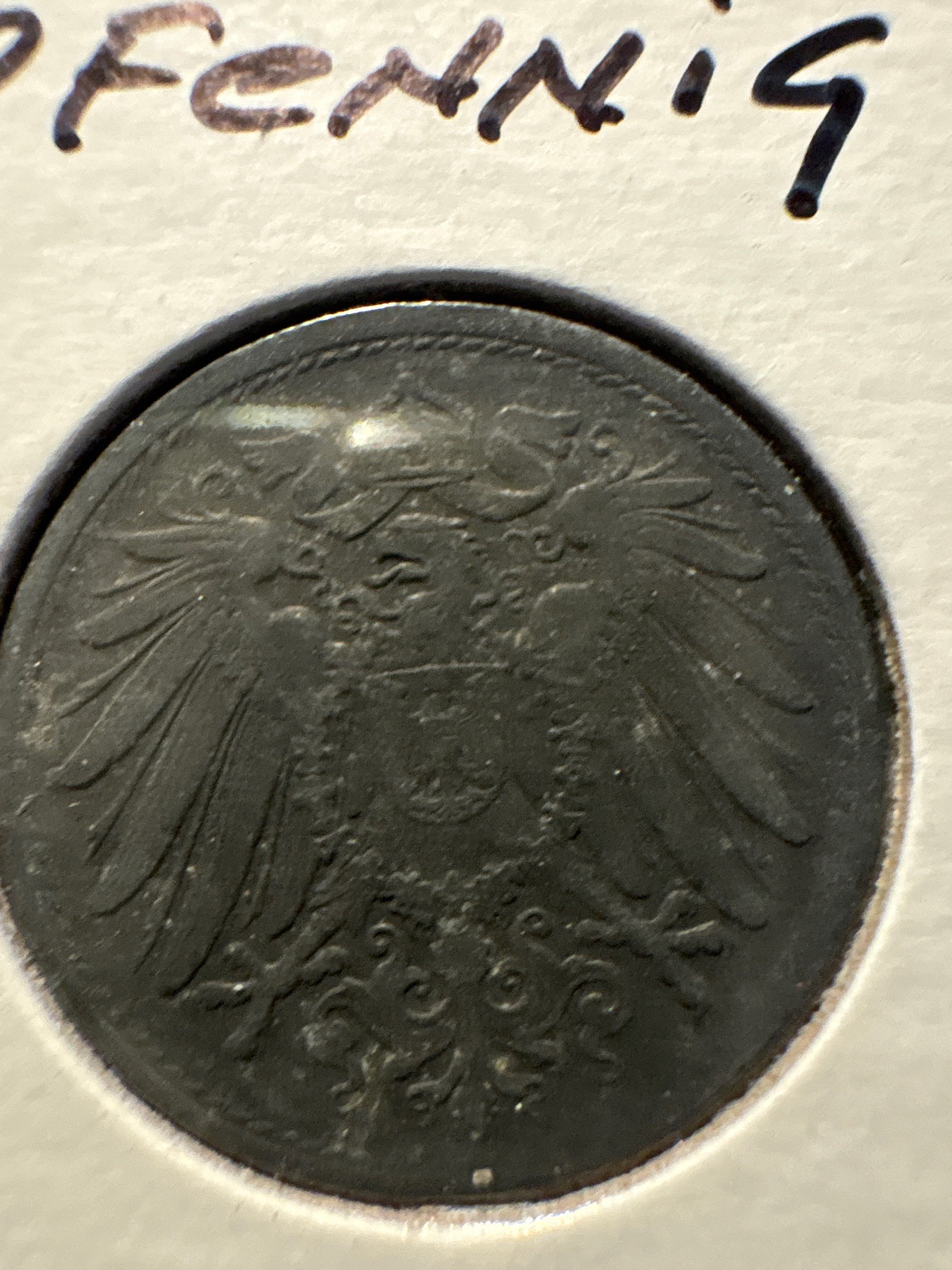
Brief Description
A dark, dull grey 10 Pfennig coin with a heraldic eagle on the obverse and the denomination and date on the reverse.
Historical Significance
Issued during and shortly after WWI, these zinc coins are known as 'Kriegsgeld' or war money. Zinc was used as a substitute for copper-nickel, which was needed for the war effort. The 1921 date represents one of the final years of the German Empire's currency system before the hyperinflation of the Weimar Republic took full hold.
Estimated Value
$1-$3 circulated, $10-$20 in high Uncirculated grades.
Care Instructions
Zinc coins are highly susceptible to 'zinc pest' or oxidation. Do not clean. Store in a cool, dry environment with low humidity and avoid contact with PVC-based plastics.
Mint Mark
A (Berlin) - typical, though often obscured on zinc issues.
Mintage & Rarity
Common; mintage for 1921-A was approximately 40,753,000.
Weight & Diameter
3.23g and 21.0mm
Edge
Plain
Apparent Grade
Very Good to Fine. The coin shows typical oxidation and loss of detail common for zinc coins of this era, with significant surface darkening.
Obverse (Front)
The Imperial Eagle (Reichsadler) with a shield on its breast, representing the German Empire.
Reverse (Back)
Large numeral '10' in the center, 'DEUTSCHES REICH' inscribed above, and 'PFENNIG 1921' below.
What Drives This Coin's Value
The primary value factors for zinc coins are the level of corrosion (zinc pest) and the clarity of the date and mint mark. Coins without white powdery oxidation are preferred.
Similar Coins
Similar to the 5 Pfennig zinc issues (smaller) and earlier copper-nickel 10 Pfennig (lighter color, more durable).
Authenticity & Counterfeit Red Flags
Zinc coins are rarely counterfeited due to low value, but check for proper weight and magnetic properties (Zinc is non-magnetic).
Notable Varieties & Errors
Varieties exist in the size of the eagle and the spacing of the lettering, primarily interest-driven for specialized German numismatists.
Created At: 2026-06-03T20:49:10.031593