1 Deutsche Mark (West Germany)
Country of Origin: West Germany (Federal Republic of Germany)
Year of Issue: 1972
Denomination: 1 Deutsche Mark
Composition: Cupronickel (75% copper, 25% nickel)
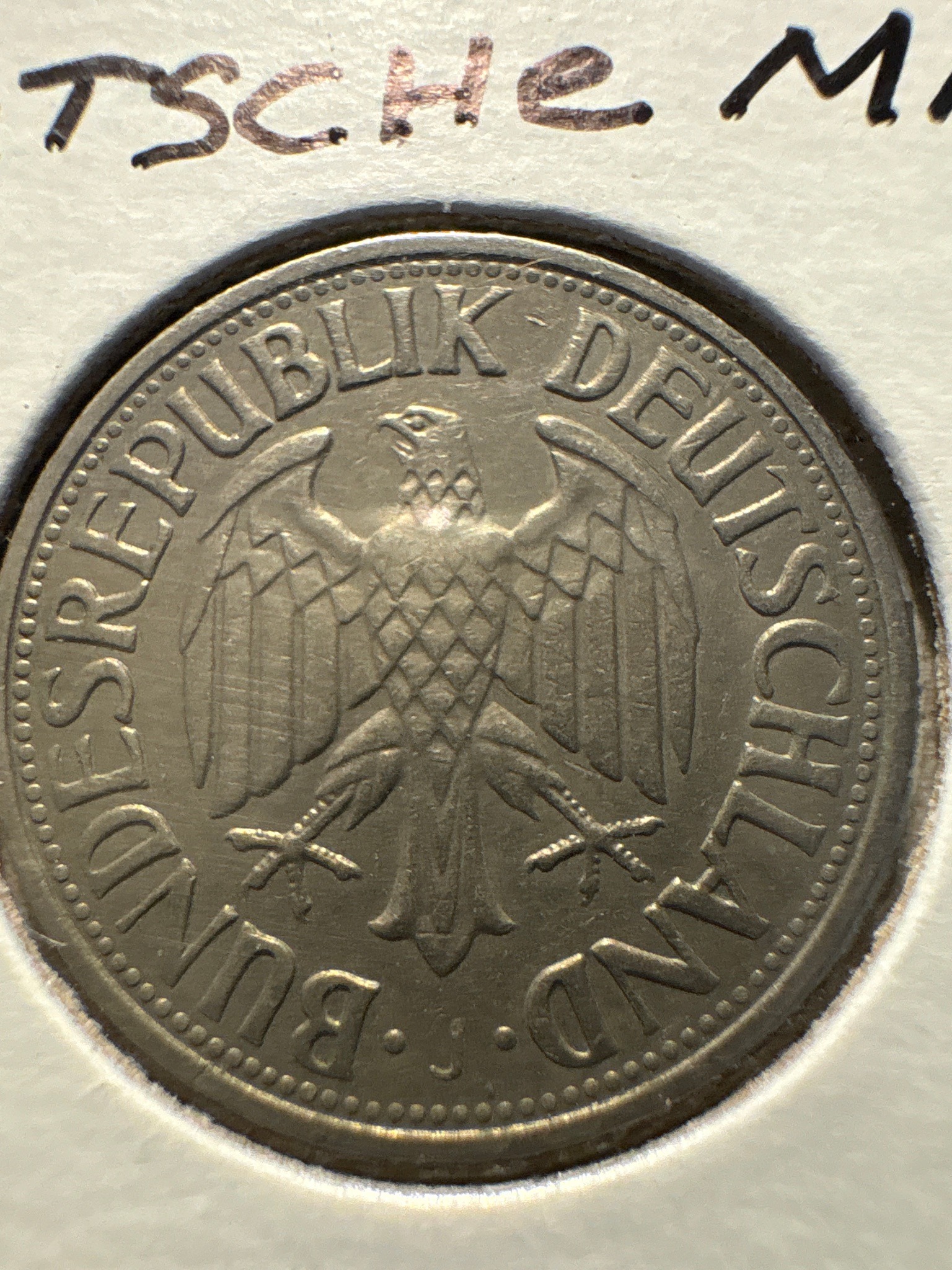
Brief Description
A standard circulation coin from West Germany featuring the Federal Eagle on the obverse and the denomination with oak leaves on the reverse.
Historical Significance
The Deutsche Mark was the official currency of West Germany from 1948 until the introduction of the Euro. The 1972 issue is significant as it coincides with West Germany hosting the Summer Olympics in Munich, although this is a standard circulation piece.
Estimated Value
$0.50 - $1.50 in circulated condition; $5.00 - $10.00 in Mint State (UNC)
Care Instructions
Store in a PVC-free flip or archival-safe coin holder. Avoid cleaning or polishing as it removes the original surface luster and lowers collector value.
Mint Mark
J (Hamburg Mint)
Mintage & Rarity
26,456,862 (Common)
Weight & Diameter
5.5 grams / 23.5 mm
Edge
Ornamented (Arabesque pattern)
Apparent Grade
Very Fine (VF) - Visible circulation wear and surface scratches, but all major details and lettering remain sharp.
Obverse (Front)
Features the Federal Eagle (Bundesadler), the national symbol of Germany, with the legend 'BUNDESREPUBLIK DEUTSCHLAND' and the mint mark 'J' at the bottom center.
Reverse (Back)
Shows the numeral '1' flanked by two oak leaves, with the text 'DEUTSCHE MARK' and the date '1972' below.
What Drives This Coin's Value
Condition (grade), mint mark rarity, and presence of original mint luster. 1972-J is a very common date/mint combination.
Similar Coins
Often confused with the East German 1 Mark coin, which is made of lighter aluminum, or later Euro coinage of similar diameter.
Authenticity & Counterfeit Red Flags
Counterfeits of this specific common date are very rare; verify by checking the edge ornamentation and the weight of 5.5 grams.
Notable Varieties & Errors
There are few notable varieties for the 1972-J, though some collectors look for slight die rotations or doubling.
Created At: 2026-06-03T21:09:14.143399