Japanese 10 Sen (Large Holed Type)
Country of Origin: Japan, Imperial Household
Year of Issue: 1926 (Taisho Year 15)
Denomination: 10 Sen
Composition: Copper-Nickel (75% Copper, 25% Nickel)
Brief Description
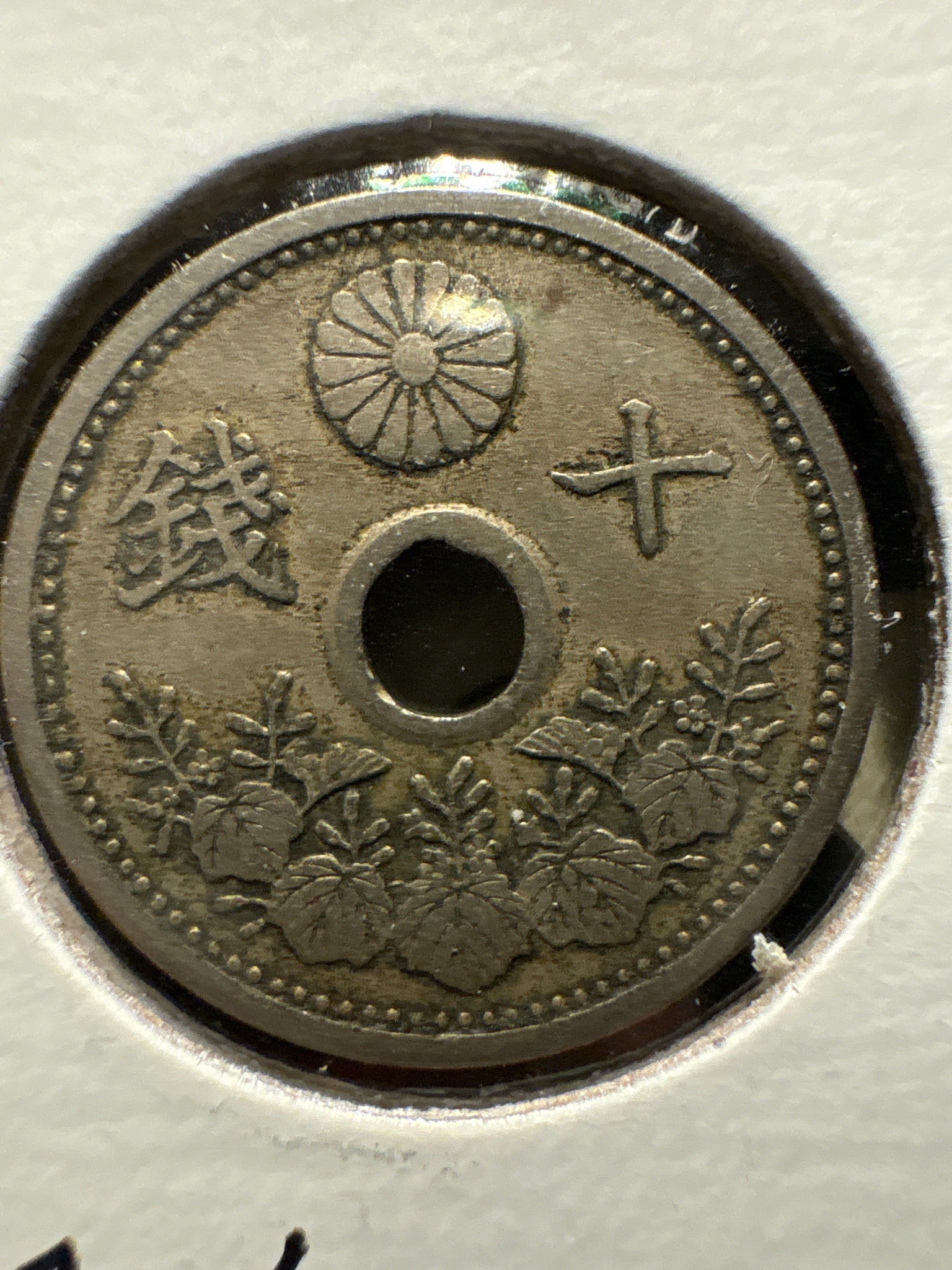
A small copper-nickel coin with a central hole, featuring a chrysanthemum throne on the front and Paulownia flowers on the back.
Historical Significance
This coin dates to the final year of the Taisho era (1912-1926). It represents the transitional period of Japanese coinage before the Showa era began later that same year.
Estimated Value
$1-$5 circulated, $15-$40 in Mint State
Care Instructions
Store in a PVC-free flip or capsule. Do not clean or polish as it destroys numismatic value. Handle only by the edges.
Mint Mark
None (struck at the Osaka Mint)
Mintage & Rarity
Approx. 34,700,000; common although the final year (Taisho 15) is popular with collectors.
Weight & Diameter
3.75g, 22mm
Edge
Smooth / Plain
Apparent Grade
Very Fine to Extremely Fine (visible wear on the waves and the chrysanthemum petals).
Obverse (Front)
Central hole surrounded by stylized Paulownia flowers (Mon) below, value in Kanji characters (10 Sen) above, divided by the Imperial Chrysanthemum Seal.
Reverse (Back)
Central hole surrounded by a Qinghai wave (Seigaiha) pattern; top legend reads 'Great Japan', bottom legend reads 'Taisho Year 15'.
What Drives This Coin's Value
Condition (grade) and year of issue. High-grade specimens with original luster are much more valuable.
Similar Coins
5 Sen coins of the same era, which are smaller. Showa era 10 Sen coins look similar but have different dates.
Authenticity & Counterfeit Red Flags
Check for magnetic properties (should be non-magnetic), verify weight and diameter, and look for sharp, non-mushy Kanji lettering.
Notable Varieties & Errors
Minor die rotations or planchet flaws.
Created At: 2026-06-04T02:12:07.856024