Buffalo Nickel (Indian Head Nickel)
Country of Origin: United States of America
Year of Issue: 1913-1938 (Date worn off)
Denomination: 5 Cents ($0.05)
Composition: 75% Copper, 25% Nickel
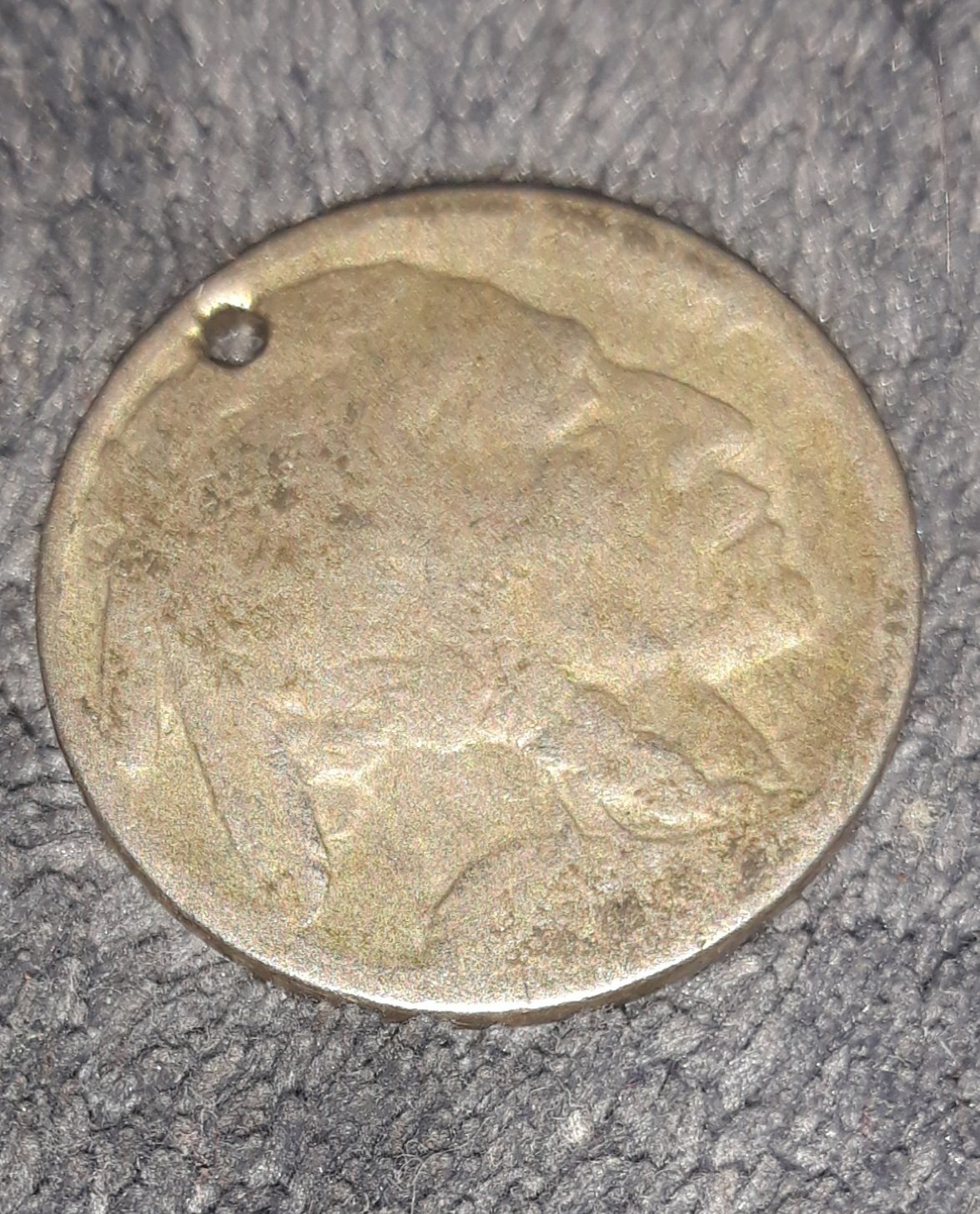
Brief Description
A heavily worn United States five-cent piece featuring the profile of a Native American on the obverse and an American Bison on the reverse. Notable for a puncture hole at the 10 o'clock position.
Historical Significance
Designed by James Earle Fraser, the Buffalo Nickel is an iconic American coin meant to capture the spirit of the American West. It was minted during a transition toward more artistic coinage in the U.S.
Estimated Value
$0.05 - $0.25 (Cull/Damaged). Generally, worn Buffalo nickels with no dates are worth very little above face value. The hole ('holed') and extreme wear further reduce value to 'cull' status.
Care Instructions
Avoid chemical cleaning, especially 'Nic-A-Date' unless necessary for identification, as it damages the surface. Store in a dry place. Handle by the edges, although this specific specimen is already heavily damaged.
Mint Mark
None visible (Philadelphia, Denver, or San Francisco could be possible under the bison's tail on the reverse).
Mintage & Rarity
Common (Hundreds of millions minted across the series). Without a date, it is considered a common 'filler' or 'cull' coin.
Weight & Diameter
5.0 grams, 21.21 mm
Edge
Plain (smooth)
Apparent Grade
Poor-1 / Cull (Damaged). The coin is heavily worn (G-4 or less) and is holed, which is a major environmental damage defect.
Obverse (Front)
Rightward-facing profile of a Native American man, modeled after three different individuals. The date usually appears on the shoulder but is completely worn away here. 'LIBERTY' is typically at the 1-2 o'clock position.
Reverse (Back)
An American Bison (often called a buffalo) standing on a mound. 'UNITED STATES OF AMERICA' and 'E PLURIBUS UNUM' above. 'FIVE CENTS' below. This is the 'Type 2' variety where the ground is a line/recessed area.
What Drives This Coin's Value
Date, mint mark, and condition. Key dates like 1913-S Var 2 or 1921-S are valuable, but non-readable dates are essentially bulk items. Holes significantly decrease numismatic value.
Similar Coins
1913 Type 1 Buffalo Nickel (which has the bison on a raised mound) and the 2005 Westward Journey Buffalo Nickel (a modern tribute).
Authenticity & Counterfeit Red Flags
Check for weight and 'mushy' details. Counterfeits mainly exist for key dates like the 1937-D 3-legged variety. For a dateless specimen, authenticity is rarely an issue due to low value.
Notable Varieties & Errors
1937-D 3-Legged Buffalo, 1918/7-D overdate, and 1916 Doubled Die Obverse.
Created At: 2026-06-08T11:15:53.398779