Hadrian Silver Denarius
Country of Origin: Roman Empire
Year of Issue: 121-125 AD
Denomination: Denarius
Composition: Silver (approx. 80-90% fineness)
Brief Description
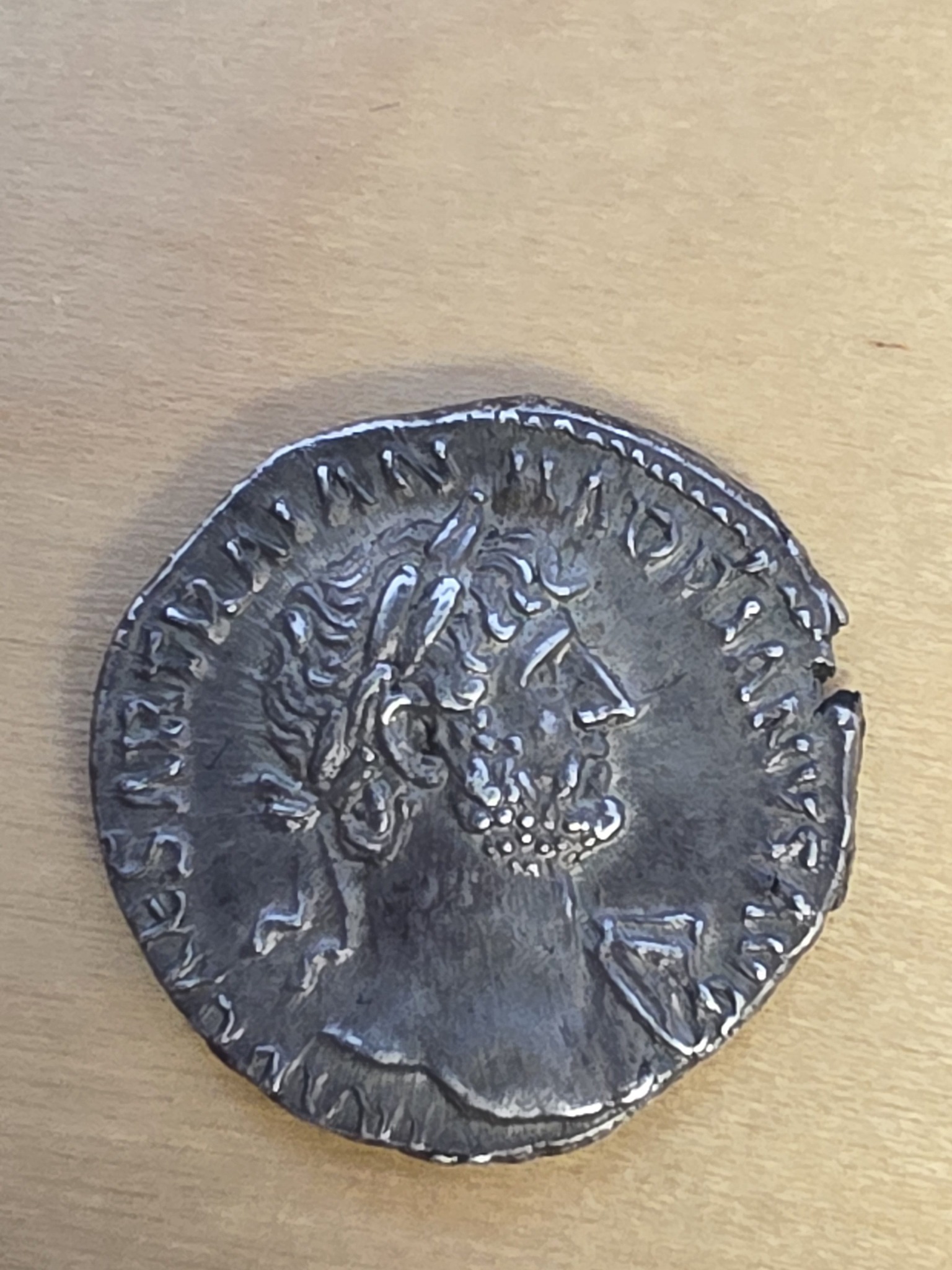
A silver Roman denarius featuring the portrait of Emperor Hadrian and a standing female deity on the reverse.
Historical Significance
Hadrian (reigned 117-138 AD) was one of the 'Five Good Emperors.' This coin type is part of his extensive 'Travel' and 'Vota' series which emphasized the stability and piety of the empire during his frequent travels.
Estimated Value
$40-$80 in heavily worn/damaged condition; $150-$350 in Choice XF/AU condition.
Care Instructions
Handle by the edges only. Do not clean or polish, as this destroys the historical patina. Store in a PVC-free flip or an acid-free archival tray.
Mint Mark
None (Minted in Rome)
Mintage & Rarity
Common for the era, but surviving specimens vary greatly in quality; this specific example shows some surface issues or potential casting signs.
Weight & Diameter
Standard approx. 3.0-3.4g, 18-19mm
Edge
Plain/Irregular
Apparent Grade
Fine to Very Fine, but with significant surface pitting, edge chipping, and suspicious surface texture that may affect marketability.
Obverse (Front)
Laureate head of Hadrian right, possibly draped on left shoulder. Legend: IMP CAESAR TRAIAN HADRIANVS AVG.
Reverse (Back)
Pietas standing right, veiled, raising both hands; VOT PVB across fields. Legend: P M TR P COS III.
What Drives This Coin's Value
Centering, portrait clarity, surface quality (corrosion vs. wear), and the legibility of the legends. Surface pitting and edge damage significantly lower value.
Similar Coins
Denarii of Trajan (his predecessor) or Antoninus Pius (his successor), which feature similar high-relief portraits and Roman deities.
Authenticity & Counterfeit Red Flags
Check for a casting seam along the edge, soapy/soft details in the hair, and circular pits that suggest bubbles from a mold. Many modern replicas of this specific Hadrian type exist.
Notable Varieties & Errors
Variations in the legend (placement of AVG) and differences in the depiction of Pietas (e.g., holding a patera or near an altar).
Created At: 2026-05-04T11:55:00.675624