Roman Imperial Coin (likely an Antoninianus)
Country of Origin: Roman Empire
Year of Issue: Circa 3rd Century CE (specific year difficult to determine without clearer legends)
Denomination: Antoninianus (likely, given the bust style and period)
Composition: Billon or Bronze (originally silvered bronze or silver-washed bronze, often appearing as bronze/copper due to wear and corrosion)
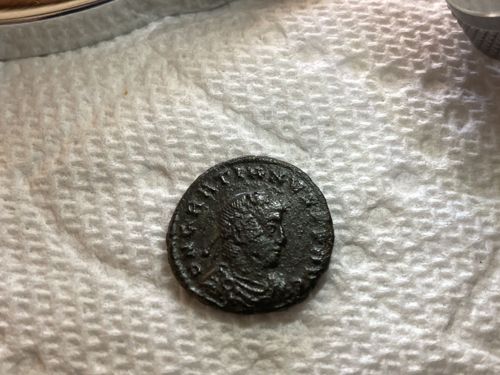
Brief Description
The coin features a radiate bust of an emperor (possibly facing right, indicated by the 'crown' which is typical for Antoniniani) on the obverse, surrounded by a partially visible Latin inscription. Its surface is dark and somewhat corroded, typical for ancient bronze or billon coins.
Historical Significance
Coins from the Roman Imperial era, particularly the 3rd century CE, are significant as they represent a period of great political instability known as the Crisis of the Third Century. Antoniniani were a key denomination during this time, suffering from severe debasement as the empire struggled economically. They provide valuable insights into Roman rulers, propaganda, and economic conditions of the period.
Estimated Value
Due to its heavily worn and corroded state, and without clear identification of the emperor or reverse, the estimated value is low, likely between "$10 - $70" for an unidentified common type in this condition. A clearer specimen, or one of a rarer emperor/type, would significantly increase the value.
Care Instructions
Ancient coins, especially those made of billon or bronze/copper, are fragile. Do not attempt to clean this coin yourself without expert knowledge, as improper cleaning can severely damage its surface and further reduce its value. Store it in a stable environment, ideally in a non-PVC coin holder or slab, away from extreme temperature changes and humidity, to prevent further degradation.
Created At: 2025-12-16T17:54:03.841197