Jefferson Nickel
Country of Origin: United States of America
Year of Issue: 1940
Denomination: 5 Cents ($0.05)
Composition: 75% copper, 25% nickel
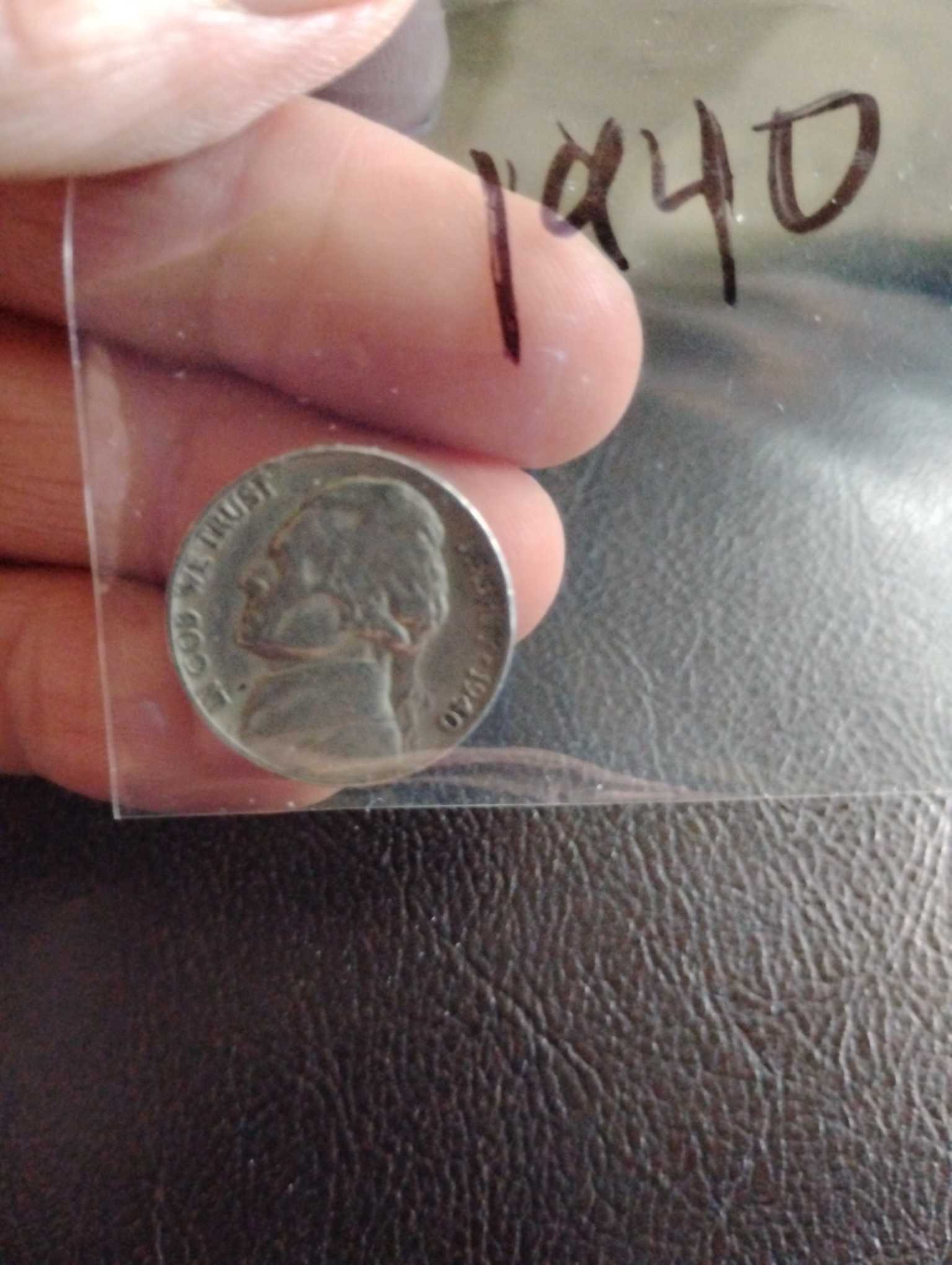
Brief Description
A 1940 United States five-cent piece featuring Thomas Jefferson on the obverse.
Historical Significance
The Jefferson Nickel was introduced in 1938 to replace the Buffalo Nickel. The design by Felix Schlag was chosen following a competition. This 1940 issue predates the 'Wartime' silver composition used from 1942-1945.
Estimated Value
$0.10-$0.40 in circulated condition; $15-$50 in Mint State 65. Rare 'Full Steps' specimens can be worth $100+.
Care Instructions
Do not clean or polish the coin, as this destroys its numismatic value. Handle by the edges only and store in a PVC-free plastic flip or acid-free paper holder.
Mint Mark
None (Philadelphia). If 'D' or 'S' were present, they would appear on the reverse to the right of Monticello.
Mintage & Rarity
176,485,000 (Philadelphia). This is a very common date and not considered rare.
Weight & Diameter
5.00 grams / 21.20 mm
Edge
Plain
Apparent Grade
Very Good to Fine. Shows significant circulation wear on Jefferson's hair and clothing; the fields are somewhat scratched.
Obverse (Front)
Profile of Thomas Jefferson facing left, designed by Felix Schlag. Legend: 'IN GOD WE TRUST', 'LIBERTY', and '1940'.
Reverse (Back)
View of Monticello, Jefferson's Virginia home. Legend: 'E PLURIBUS UNUM', 'MONTICELLO', 'FIVE CENTS', 'UNITED STATES OF AMERICA'.
What Drives This Coin's Value
Condition (especially the detail on the steps of Monticello), mint mark, and overall eye appeal. Early nickels with 'Full Steps' details carry a significant premium.
Similar Coins
Often confused with the 1940 Proof version (which has a mirrored finish) or the 1940-D and 1940-S which have mint marks on the reverse.
Authenticity & Counterfeit Red Flags
Weight should be exactly 5.0 grams for uncirculated specimens. Look for 'mushy' details or off-metal colors which may indicate a counterfeit or contemporary forgery.
Notable Varieties & Errors
The 1940 Reverse of 1938 (curved steps) and the Reverse of 1940 (straight steps) are significant variants for collectors.
Created At: 2026-04-26T18:11:57.835341