Athenian Owl Drachm
Country of Origin: Ancient Greece, Athens
Year of Issue: c. 454-404 BC
Denomination: 1 Drachm
Composition: Silver (traditionally high purity, approx. 95-98%)
Brief Description
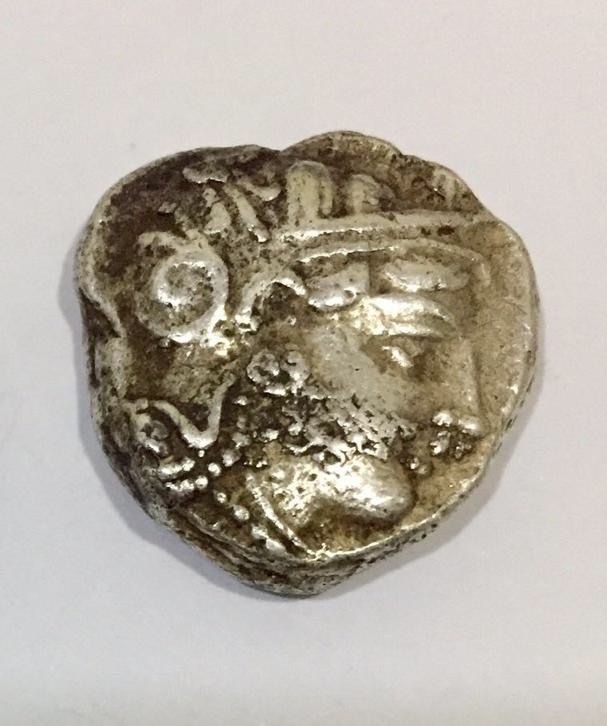
A thick, irregular silver coin featuring the head of Athena and her owl symbol. This specific specimen has a deep 'test cut' on the reverse.
Historical Significance
The Athenian 'Owl' is one of the most famous and influential coins in history. It was the international currency of the 5th century BC, used in trade across the Mediterranean. This 'Classical' style coincides with the Golden Age of Pericles and the height of Athenian democracy.
Estimated Value
$150-$400 in this condition (the test cut and wear significantly reduce value compared to pristine examples)
Care Instructions
Store in PVC-free holders. Avoid cleaning or polishing, as ancient patina is valued. Handle by edges to avoid skin oils reacting with the silver surface.
Mint Mark
None (Attic Greek legend AΘE indicates Athens)
Mintage & Rarity
Common for Athenian silver, though drachms (the smaller unit) are less common than the larger Tetradrachms.
Weight & Diameter
Approx. 4.3 grams / 14-16 mm (varies due to hand-striking)
Edge
Plain / irregular
Apparent Grade
Fine to Very Fine with a significant 'Test Cut'. Deep wear on the obverse high points.
Obverse (Front)
Helmleted head of Athena facing right, wearing a crested Attic helmet decorated with three olive leaves and a floral scroll.
Reverse (Back)
Owl standing right, head facing; olive sprig and crescent moon to left; AΘE inscription to right; all within an incuse square. Note: Visible 'test cut' across the owl's body.
What Drives This Coin's Value
Centering of the strike, presence of the helmet crest, and the 'test cut'. Test cuts were made in antiquity to ensure the coin was solid silver and not a plated counterfeit.
Similar Coins
Athenian Tetradrachm (larger), Athenian Hemidrachm (smaller), and various Eastern imitations (Persian / Egyptian copies) of the Athenian type.
Authenticity & Counterfeit Red Flags
Check for 'casting bubbles' or seams along the edge. The test cut is actually a sign of authentic ancient circulation, as few modern forgers would deface a high-value coin this way. Weight must be near standard specifications.
Notable Varieties & Errors
Early 'Archaic' styles vs. the more common 'Classical' and later 'New Style' (broad flan) varieties used in different centuries. Transitional types from 449 BC are highly prized.
Created At: 2026-05-25T16:23:09.731664