Kennedy Half Dollar (Proof)
Country of Origin: United States of America
Year of Issue: 1983
Denomination: Half Dollar (50 Cents)
Composition: Outer layers of 75% copper, 25% nickel; Inner core of pure copper
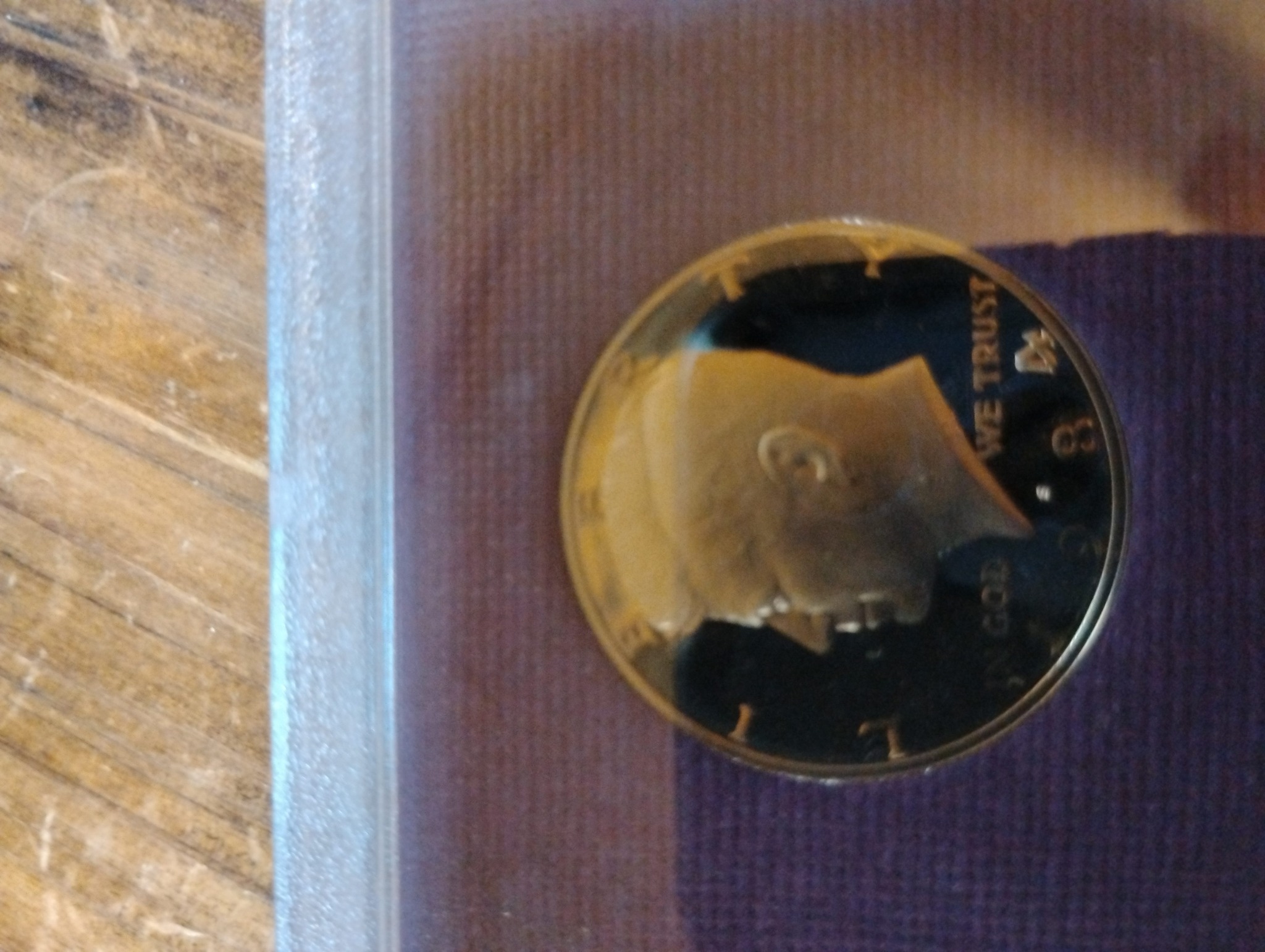
Brief Description
A Proof Kennedy Half Dollar featuring a cameo finish with frosted devices and mirrored fields, housed in a plastic lens.
Historical Significance
The Kennedy Half Dollar was first minted in 1964 as a memorial to the assassinated President John F. Kennedy. By 1983, these were produced primarily for collectors in proof sets.
Estimated Value
$3-$7 in PR-67 to PR-69 Deep Cameo condition; slightly more if part of a full original 1983 S Proof Set.
Care Instructions
Do not remove from the plastic holder. Proof surfaces are extremely sensitive to fingerprints (which cause permanent damage) and physical hair-line scratches.
Mint Mark
S (San Francisco Mint)
Mintage & Rarity
3,279,126 (Common for proof issues)
Weight & Diameter
11.34 grams / 30.61 mm
Edge
Reeded
Apparent Grade
Proof (Appears to be a Gem Proof with Deep Cameo contrast)
Obverse (Front)
Left-facing portrait of John F. Kennedy. Motto 'IN GOD WE TRUST' and 'LIBERTY' around the perimeter. Date '1983' at bottom with 'S' mint mark. Designer: Gilroy Roberts.
Reverse (Back)
The Presidential Seal: a heraldic eagle with a shield, holding an olive branch and arrows, surrounded by 50 stars. 'UNITED STATES OF AMERICA' and 'HALF DOLLAR' around the edge. Designer: Frank Gasparro.
What Drives This Coin's Value
Condition (scratches on mirrors), degree of cameo contrast, and whether it is housed in its original government packaging.
Similar Coins
Circulating 1983 Kennedy Half Dollars (no mint mark or 'P'/'D') which lack the mirrored proof finish.
Authenticity & Counterfeit Red Flags
Check for the distinct 'S' mint mark and the high-relief, mirror-like finish characteristic of US Mint proof products. Counterfeits of this date are extremely rare.
Notable Varieties & Errors
No major rare varieties; collectors look for 'Deep Cameo' (DCAM) designations where the contrast between fields and devices is maximized.
Created At: 2026-05-18T17:04:33.968422