Justinian I Follis (Large Bronze 40 Nummi)
Country of Origin: Byzantine Empire (Eastern Roman Empire)
Year of Issue: 538-539 AD (Regnal Year 12)
Denomination: Follis (40 Nummi)
Composition: Copper/Bronze
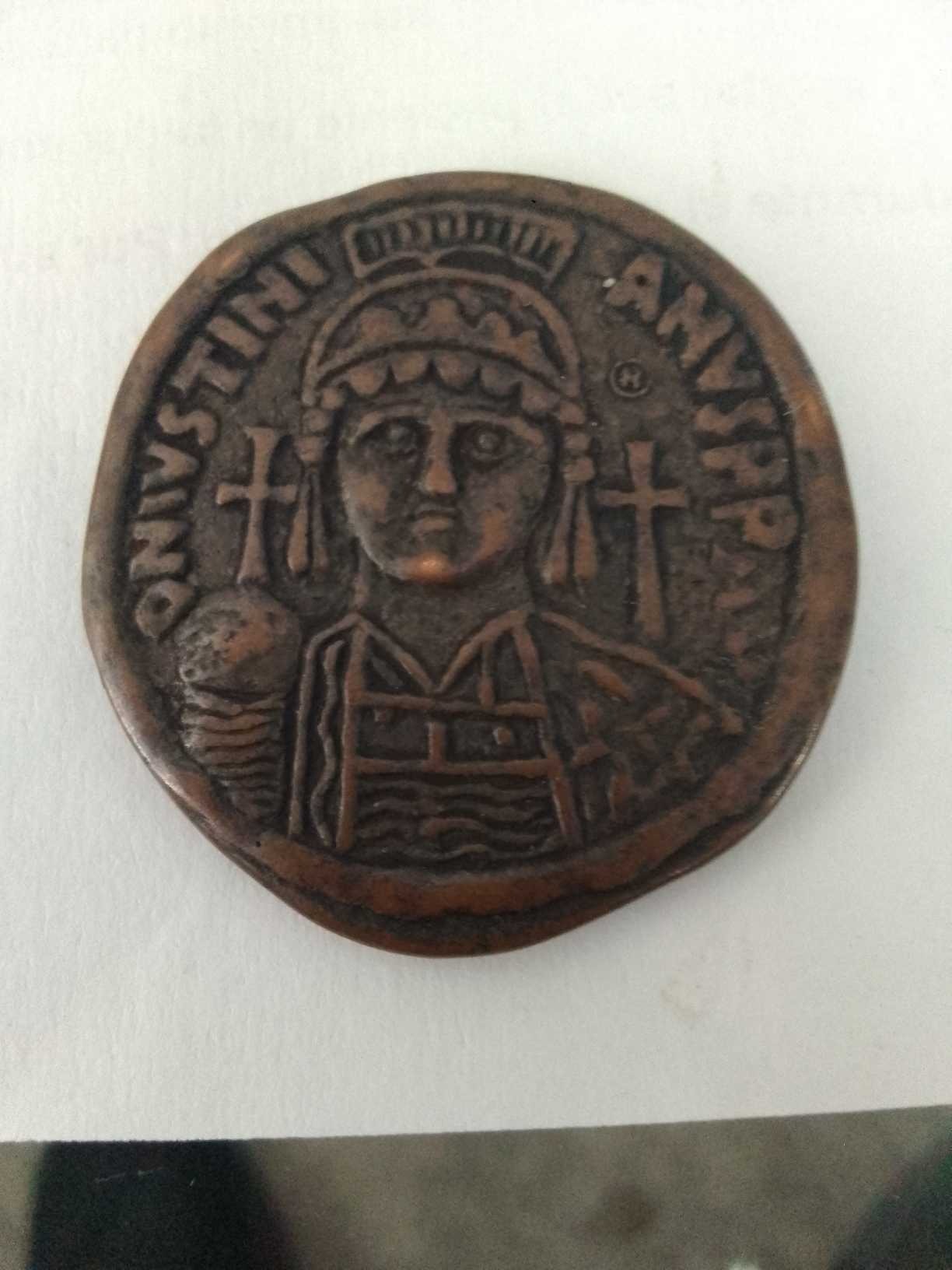
Brief Description
A thick, large bronze Byzantine coin featuring a frontal portrait of Emperor Justinian I and a large 'M' on the reverse. Note: This specific specimen appears to be a modern cast replica due to its soft details and 'H' in a circle mark.
Historical Significance
Under Justinian I, Byzantine coinage underwent a major reform in 538 AD. This coin reflects the peak of the Empire's power, including the reconquest of Italy and North Africa. The introduction of the frontal portrait replaced the traditional Roman profile.
Estimated Value
$1 - $5 (As a modern replica/souvenir). Genuine examples range from $40 - $250 depending on condition.
Care Instructions
This specific piece is likely a modern souvenir; no special numismatic care is required. For genuine coins, avoid cleaning or scrubbing, as it destroys the natural patina.
Mint Mark
CON (Constantinople / Istanbul)
Mintage & Rarity
Common (as a type), but this physical item is a modern reproduction.
Weight & Diameter
Originals: ~18-22g, ~35-40mm. Replicas vary.
Edge
Plain
Apparent Grade
Extremely Fine (if genuine), but lacks the sharp striking characteristics of an authentic 6th-century coin.
Obverse (Front)
Helmeted and cuirassed bust of Justinian I facing forward, holding globus cruciger and shield. Legend: D N IVSTINIANVS P P AVG.
Reverse (Back)
Large letter 'M' (Greek for 40), cross above, 'ANNO' on left, 'XII' (Year 12) on right. 'E' (5th officina/workshop) below M. 'CON' in exergue.
What Drives This Coin's Value
The most significant factor here is the 'H' in a circle on the obverse, identifying it as a modern reproduction rather than an ancient artifact.
Similar Coins
Follis of Justin II or Maurice Tiberius, which also use the large 'M' design but feature different portraits and names.
Authenticity & Counterfeit Red Flags
Look for the small circled 'H' on the obverse right field; this is a hallmark of modern museum replicas. Real coins have sharper edges and show 'striking' characteristics rather than 'casting' characteristics (bubbles, soft edges).
Notable Varieties & Errors
Genuine varieties include different years (XII through XXXVIII) and different mints (Nicomedia, Antioch, Carthage).
Created At: 2026-04-21T11:47:06.410276