Jefferson Nickel
Country of Origin: United States
Year of Issue: 1972
Denomination: 5 Cents
Composition: 75% copper, 25% nickel
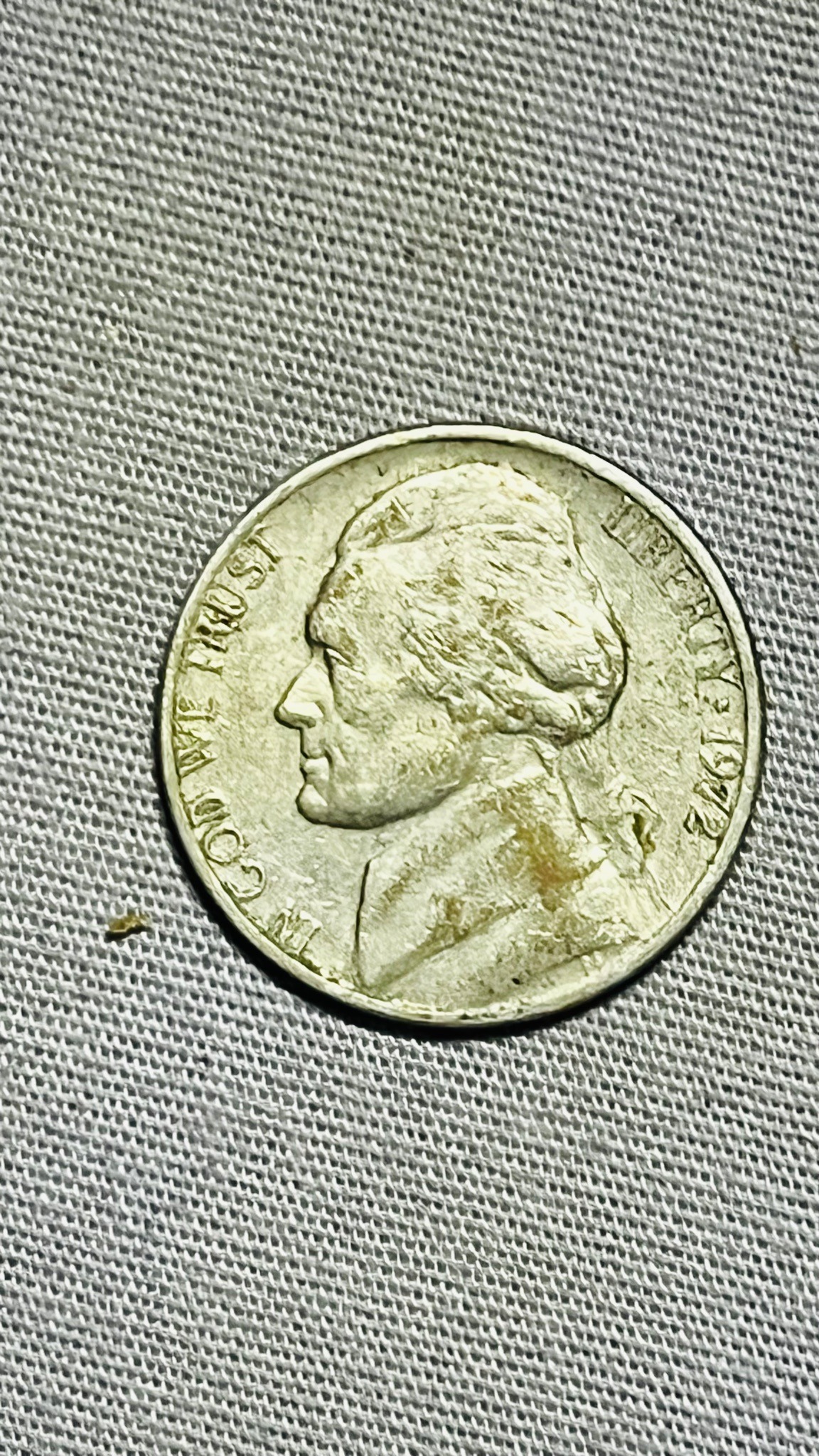
Brief Description
A standard 1972 Jefferson Nickel featuring the profile of Thomas Jefferson and his home, Monticello.
Historical Significance
The Jefferson Nickel replaced the Buffalo Nickel in 1938 and remains the current design for the five-cent coin. The 1972 issue represents a standard circulation year from the 'cladding' era.
Estimated Value
$0.05 circulating, up to $1.00-$5.00 in uncirculated (MS-65) condition. Only rare error coins or high specimens with 'Full Steps' on the reverse carry high premiums.
Care Instructions
Store in a cool, dry place. While this coin is common, avoid cleaning with chemicals or abrasives as it destroys any remaining numismatic value.
Mint Mark
None visible (Philadelphia Mint)
Mintage & Rarity
Common; Philadelphia minted approximately 388,424,000 of these.
Weight & Diameter
5.0 grams / 21.21 mm
Edge
Plain
Apparent Grade
Fine/Very Fine; shows significant circulation wear and surface dullness.
Obverse (Front)
Left-facing profile of Thomas Jefferson. Legends include 'IN GOD WE TRUST', 'LIBERTY', and the year '1972'. Designed by Felix Schlag.
Reverse (Back)
A front view of Monticello, Jefferson's Virginia estate. Legends include 'E PLURIBUS UNUM', 'MONTICELLO', 'FIVE CENTS', and 'UNITED STATES OF AMERICA'.
What Drives This Coin's Value
Condition (grade), presence of 'Full Steps' on the reverse design, and potential doubled die errors.
Similar Coins
1972-D and 1972-S Nickels (distinguished by the 'D' or 'S' mint mark near the date) and the 1942-1945 silver 'War Nickels' (distinguished by large mint marks above the dome).
Authenticity & Counterfeit Red Flags
Authenticity is rarely an issue for this high-mintage common date; check weight and magnetic properties to ensure it is not a non-magnetic counterfeit.
Notable Varieties & Errors
Check for Doubled Die Obverse (DDO) or potential die cracks; however, no major high-value varieties are widely documented for Philadelphia in 1972.
Created At: 2026-05-18T05:21:00.696423