Westward Journey Nickel - Lewis and Clark Keelboat
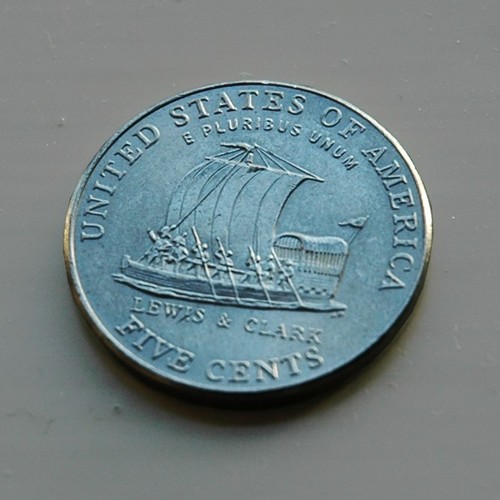
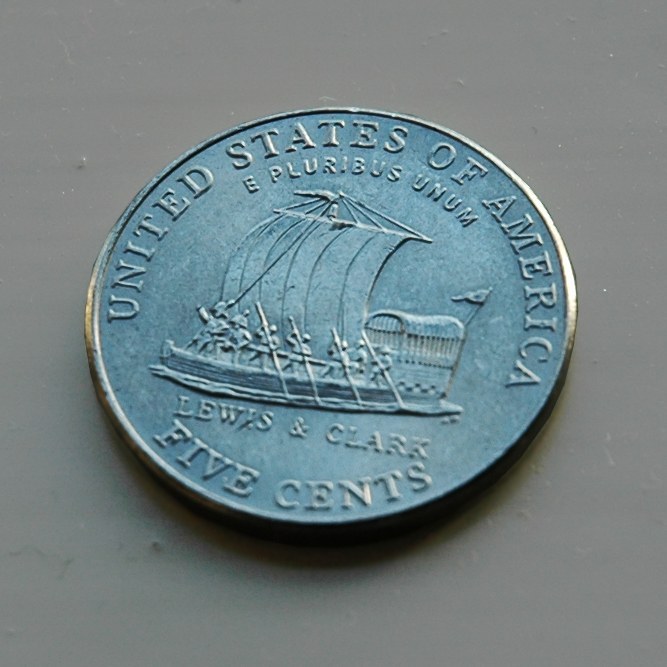
A 2004 Jefferson five-cent piece from the Westward Journey series, its reverse showing the keelboat that carried the Lewis and Clark expedition upriver.
- Country
- United States
- Denomination
- 5 cents
- Metal
- Copper-nickel
Got a coin like this?
Identify any coin from a photo, free.
Overview
The Lewis and Clark Keelboat nickel is one of four special reverse designs issued under the U.S. Mint's Westward Journey Nickel Series of 2004 and 2005, which marked the bicentennial of the Louisiana Purchase and the Lewis and Clark expedition. It is a standard-size Jefferson five-cent coin: the difference from an ordinary nickel is entirely in the reverse imagery.
The reverse depicts the keelboat used by the Corps of Discovery to move men and supplies up the Missouri River, shown under sail with two figures representing Captains Meriwether Lewis and William Clark toward the bow. The obverse keeps the familiar left-facing Thomas Jefferson portrait used on the nickel since 1938.
Because it was struck in enormous quantities for circulation, the Keelboat nickel is inexpensive and easy to find, but it remains popular as an affordable, attractively designed piece of early-2000s U.S. commemorative coinage.
History & Background
In 2003 Congress and the U.S. Mint authorized a two-year departure from the long-running Jefferson nickel reverse to commemorate the 200th anniversaries of the 1803 Louisiana Purchase and the 1804-1806 expedition led by Meriwether Lewis and William Clark. The program was named the Westward Journey Nickel Series. In 2004 the Mint issued two reverses: a Peace Medal design early in the year and the Keelboat design later in the year. In 2005 two further reverses followed (an American Bison and an "Ocean in view" coastal scene), paired with a new forward-facing Jefferson portrait.
The Keelboat reverse was designed by U.S. Mint sculptor-engraver Al Maletsky. It was struck for circulation at the Philadelphia and Denver mints, with collector proofs produced at San Francisco. Combined circulation output ran into the hundreds of millions of coins.
After 2005 the nickel returned to a Monticello reverse, so the four Westward Journey designs were issued only during those two years, making the series a compact and self-contained modern set.
How to Identify
Look first at the reverse: a single-masted keelboat under sail moving to the right, with two standing figures near the bow representing Lewis and Clark, surrounded by the usual legends UNITED STATES OF AMERICA, E PLURIBUS UNUM and the FIVE CENTS denomination. This boat scene is the defining feature and distinguishes it from the Peace Medal, Bison, and "Ocean in view" reverses of the same series.
The obverse shows the classic left-facing bust of Thomas Jefferson with LIBERTY and the date. Genuine Keelboat coins carry the date 2004; the 2005 nickels of the series use the Bison or coastal reverses and a different, forward-facing Jefferson portrait, so a keelboat paired with a 2005 date would not be a normal Mint product.
The coin is a standard nickel: about 21.2 mm in diameter, 5.0 grams, a copper-nickel alloy of roughly 75% copper and 25% nickel, with a plain (smooth) edge. A small mint mark, P or D, appears on the obverse near the date on circulation strikes; S denotes a San Francisco proof.
Value & Collectibility
As a modern coin struck in very large numbers, the Keelboat nickel is worth face value in worn, circulated condition and is commonly found in pocket change and rolls. Uncirculated examples pulled from mint sets or original rolls typically bring only a modest premium over face.
Higher value is concentrated in top-grade certified coins and in San Francisco proof strikes, which were sold to collectors and carry a small premium as individual pieces. As always, sharp strike, full detail on the keelboat, and clean surfaces drive the difference between a common coin and a desirable one.
Exact prices vary with the market and grade, so treat any figures as general context rather than fixed values; for current levels consult a recent price guide or completed-sale listings.
Frequently asked questions
Is the Lewis and Clark Keelboat nickel rare or valuable?
No. It was struck in the hundreds of millions for circulation, so it is common and usually worth face value when worn. Only high-grade certified coins and proofs carry a modest premium.
What year is the Keelboat nickel?
The Keelboat design was issued in 2004 as one of the two 2004 reverses in the Westward Journey series. The 2005 nickels of the series used the Bison and coastal 'Ocean in view' designs instead.
Is the keelboat on the front or the back of the coin?
The keelboat is on the reverse (back). The obverse (front) keeps the traditional left-facing Thomas Jefferson portrait used on the nickel since 1938.
What is the coin made of?
Like other Jefferson nickels, it is a copper-nickel alloy, about 75% copper and 25% nickel, weighing 5.0 grams and measuring roughly 21.2 mm across.
Does it contain any silver?
No. Circulating Westward Journey nickels contain no silver or precious metal; their value comes from the design and condition, not metal content.
Westward Journey Nickel - Lewis and Clark Keelboat guides
In-depth guides for identifying, valuing, and collecting Westward Journey Nickel - Lewis and Clark Keelboat.