
How to Identify the Walking Liberty Half Dollar Centennial Gold
Spot the 2016-W gold Walking Liberty half by its striding Liberty obverse, eagle reverse, "AU 24K" markings, W mint mark, and dense half-ounce gold planchet.
Read the full Walking Liberty Half Dollar Centennial Gold encyclopedia entry →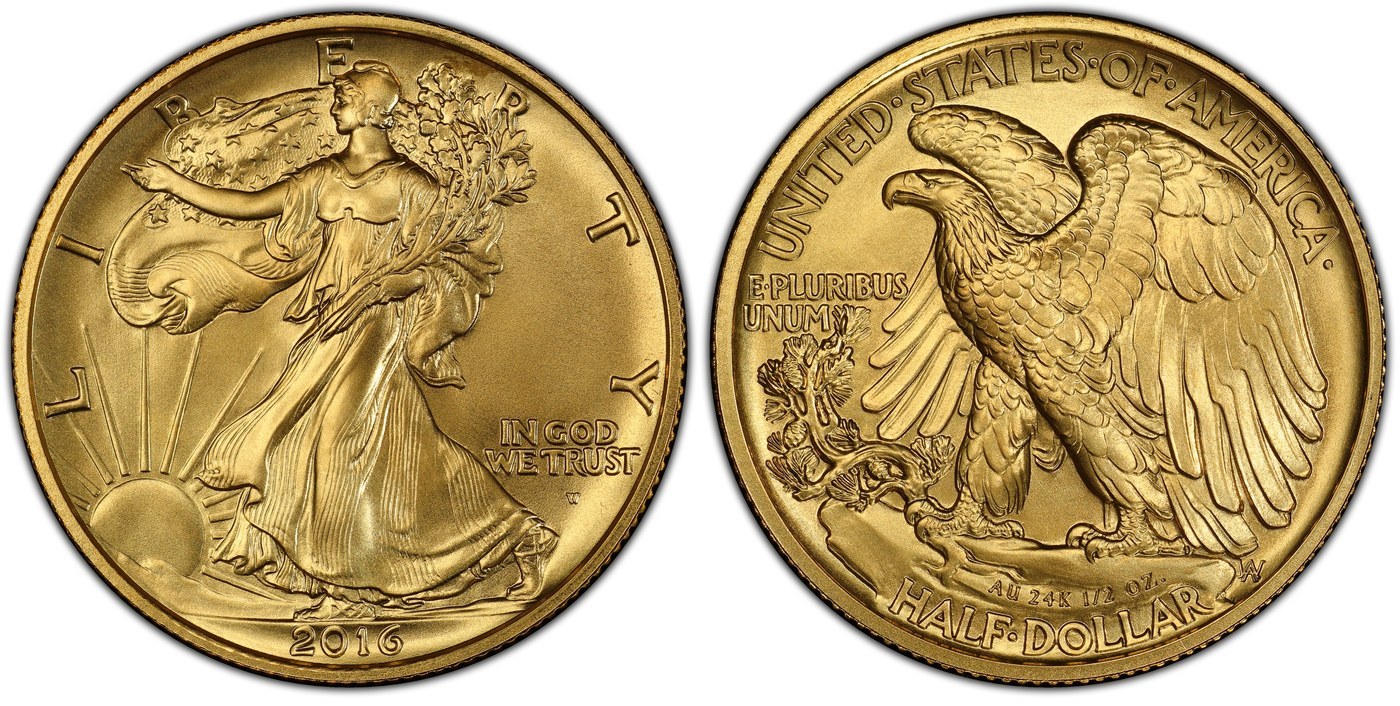
What It Is
The Walking Liberty Half Dollar Centennial Gold Coin is a 2016 U.S. Mint collector issue that reproduces Adolph A. Weinman's 1916 half-dollar design in gold. Unlike the silver original, it is a bullion-content keepsake, so the fastest way to confirm it is to look for the gold-content wording that never appears on circulating half dollars.
Obverse Check
The front shows Liberty in full stride toward the sunrise, draped in the American flag and carrying branches, with "LIBERTY" arcing around the rim, "IN GOD WE TRUST" in the field, and the date "2016." A 2016 date is itself a strong clue — original Walking Liberty halves are dated 1916 through 1947 only. Locate the "W" mint mark and confirm its clarity, since it identifies the West Point striking.
Reverse Check
The back shows an eagle with outstretched wings perched on a mountain crag, ringed by "UNITED STATES OF AMERICA" and "E PLURIBUS UNUM," with "HALF DOLLAR" below. The decisive markings are "1/2 OZ." and "AU 24K," which state the gold weight and purity. No genuine 1916–1947 silver half bears these inscriptions.
Size, Weight, and Metal
The coin is about 27 mm in diameter — smaller than the 30.6 mm silver half dollar — yet weighs roughly 15.55 grams (one-half troy ounce), so it feels notably dense for its size. It is .9999 fine gold with a rich yellow color and a reeded edge. A calibrated scale and caliper are the best quick authentication tools; correct diameter paired with correct weight is hard to fake.
Look-Alikes and Cautions
Do not confuse this coin with original silver Walking Liberty halves (pale gray, larger, no fineness markings), with the modern Walking Liberty design on the American Silver Eagle, or with gold-plated novelty pieces that weigh far less than a half ounce of solid gold and lack the "AU 24K" inscription. Counterfeits of popular centennial coins exist, so favor examples in sealed U.S. Mint packaging with the certificate of authenticity, or coins certified and encapsulated by a major grading service such as NGC or PCGS. When in doubt, verify weight and dimensions before purchase.
Frequently asked questions
Where is the mint mark on the gold Walking Liberty half?
It carries a "W" for the West Point Mint. Look for a small "W" on the coin, which marks it as the 2016 gold centennial issue rather than an original circulating half dollar.
What is the quickest way to tell it from a silver Walking Liberty half?
Read the reverse. The gold coin is dated 2016 and inscribed "1/2 OZ." and "AU 24K." Original silver halves are dated 1916–1947 and have no fineness markings, and they are wider but lighter.
How can I confirm it is solid gold and not plated?
Weigh and measure it. A genuine coin holds one-half troy ounce of gold (about 15.55 g) at roughly 27 mm. Gold-plated fakes weigh far less. For certainty, buy graded or Mint-sealed examples.
Is a lower-grade example still valuable?
It still holds its gold content value regardless of condition, but crisp, unblemished coins — especially certified high grades — bring the largest collector premiums.