
How to Identify the Victorian Crown
Practical checks for the Old Head Victorian crown: veiled portrait, Saint George reverse, size and silver, edge year, and look-alikes.
Read the full Victorian Crown encyclopedia entry →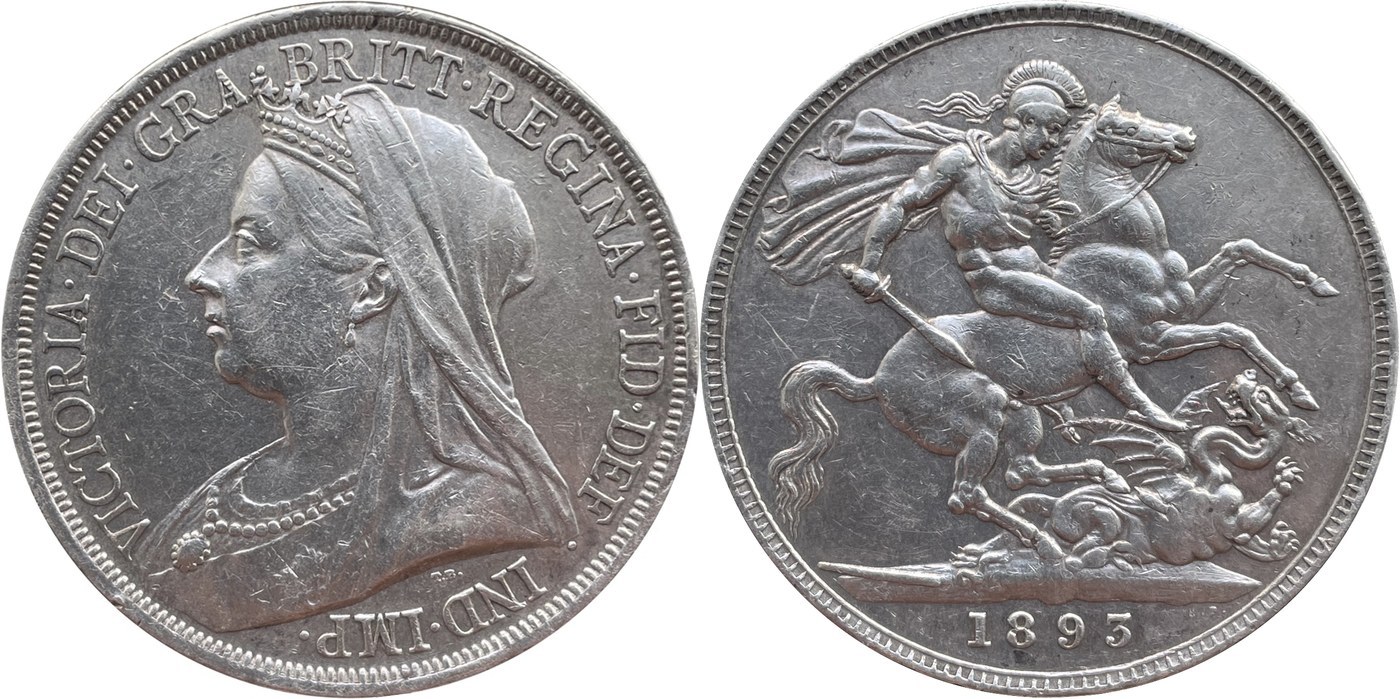
Start with size and metal. The crown is a large, heavy silver coin, about 38-39 mm across, noticeably bigger than a halfcrown or florin. It should look and ring like silver; a dull, coppery, or magnetic piece points to a base-metal replica rather than a genuine Victorian sterling crown.
Read the obverse. The example here shows the "Old Head" or "Veiled Head": Queen Victoria facing left, veiled, with a Latin legend naming her as queen. This veiled portrait is specific to 1893 and later; the earlier "Young Head" shows an uncrowned youthful bust, and the 1887 "Jubilee Head" shows a small crown perched high on the head, so the plain veil without that small crown is a key marker of the Old Head type.
Check the reverse and date. Look for Saint George, helmeted and nude, on a rearing horse driving a weapon into a dragon below, with the date in the exergue. An 1893 reading places the coin in the first year of the Old Head crown. Note that this Pistrucci Saint George design distinguishes the crown from Victorian crowns with heraldic-shield reverses used earlier in the reign.
Inspect the edge. Old Head crowns carry incuse edge lettering with a Latin inscription and a Roman-numeral regnal year. On 1893 crowns this reads LVI or LVII, which identifies the variety and is a useful authenticity check, since many cast fakes have a plain, mushy, or seamed edge instead of crisp incuse lettering.
Separate look-alikes and authenticate with care. Do not confuse the crown with the smaller halfcrown, which shares Victorian portraits but is much lighter and smaller, or with later Saint George crowns of other reigns. Because these coins are popular, be alert to cast copies, cleaned surfaces, and altered edges: weigh and measure the coin, examine the edge lettering and surfaces under good light for casting seams or tooling, and for any higher-grade example seek an experienced dealer or third-party grading before buying or selling.
Frequently asked questions
How do I tell the Old Head from Victoria's other portraits?
The Old Head (1893 onward) shows Victoria veiled without a small crown. The earlier Young Head is an uncrowned youthful bust, and the 1887 Jubilee Head has a small crown perched high on the head.
What size and weight should a crown be?
Expect a large sterling-silver coin about 38-39 mm across with real heft. If it is much smaller and lighter it is likely a halfcrown or florin, which share similar Victorian designs.
What is the edge lettering for?
Old Head crowns have incuse edge lettering including a Roman-numeral regnal year, LVI or LVII on 1893 pieces. Crisp lettering helps confirm authenticity and identifies the variety; a mushy or seamed edge is a warning sign.
Is it worth having authenticated?
Common worn examples usually are not, but for sharp, high-grade, or proof pieces it is worth confirming metal, weight, edge, and surfaces, and consulting a dealer or grading service before a significant sale.