
How to Identify the Vermont Sesquicentennial Half Dollar
A 1927 silver commemorative marking Vermont's 150th anniversary of independence, identified by its Ira Allen portrait obverse and a catamount reverse.
Read the full Vermont Sesquicentennial Half Dollar encyclopedia entry →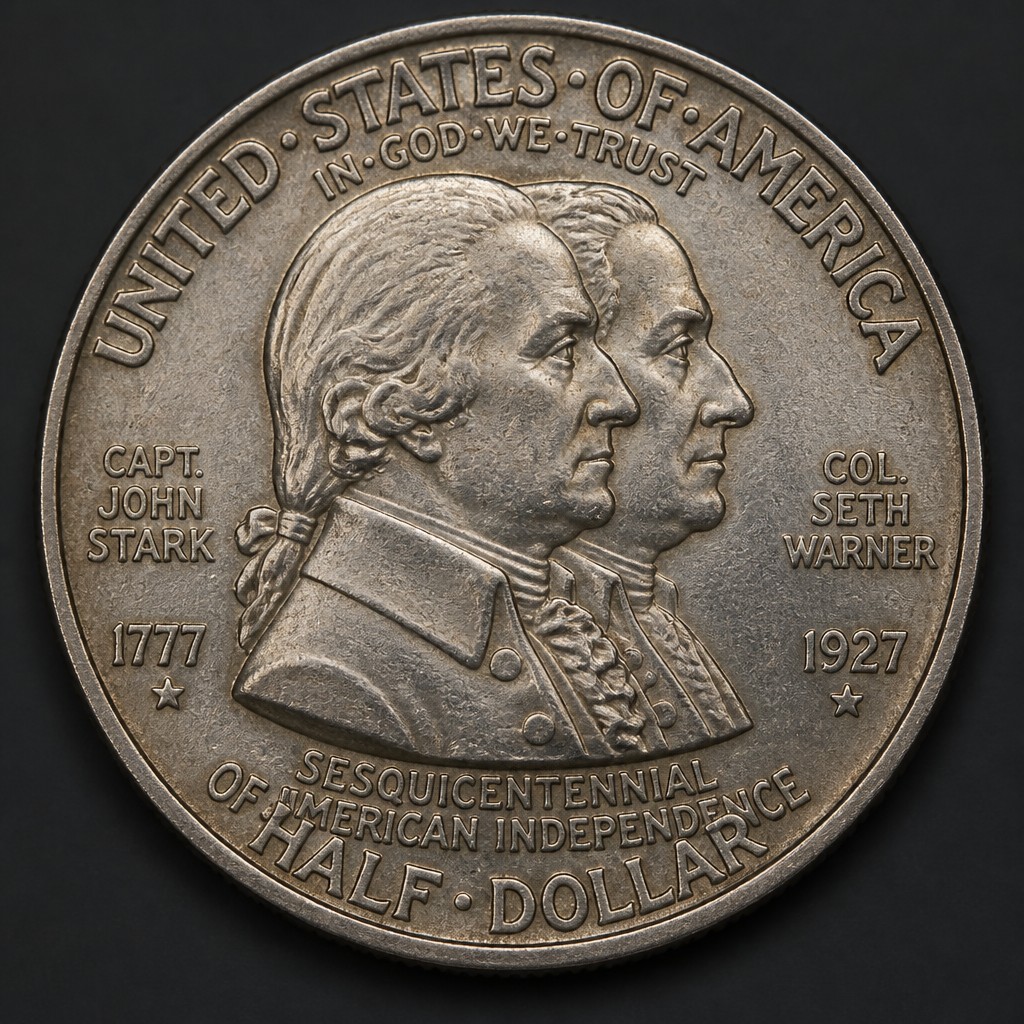
What This Coin Is
The Vermont Sesquicentennial Half Dollar, also known as the Bennington Half Dollar, was struck in 1927 to commemorate the 150th anniversary of Vermont's declaration of independence in 1777 and the Battle of Bennington. Designed by Charles Keck, it is a single-year issue tied to Vermont's early revolutionary history rather than its later U.S. statehood.
Obverse Design
The obverse shows a left-facing bust of Ira Allen, considered a founder of Vermont and brother of Ethan Allen. "VERMONT" appears above the portrait, with "UNITED STATES OF AMERICA" arcing near the rim and "HALF DOLLAR" below.
Reverse Design
The reverse depicts a catamount (mountain lion), an animal symbolically tied to Vermont folklore, standing in a alert, crouching pose. "IN GOD WE TRUST" and "E PLURIBUS UNUM" appear in the field, along with "BENNINGTON" and the dates "1777-1927."
Size, Weight, Metal, and Edge
The coin is composed of 90% silver, 10% copper, weighs about 12.5 grams, measures roughly 30.6mm in diameter, and has a reeded edge, consistent with other classic commemorative half dollars.
Mint Marks and Where to Find Them
All Vermont Sesquicentennial halves were struck at the Philadelphia Mint and carry no mint mark, so there is no mint mark to search for on this single-mint issue.
Telling It Apart from Similar Coins
The Ira Allen portrait and catamount reverse are unique to this coin and not easily confused with other commemoratives. The catamount pose is sometimes mistaken at a glance for other animal-themed commemorative reverses, but the specific crouching stance and "BENNINGTON 1777-1927" wording confirm this issue.
Judging Condition at a Glance
On the obverse, examine Ira Allen's cheek, hair, and coat collar for wear. On the reverse, check the catamount's back, legs, and tail for definition, since these raised areas flatten first with circulation. A coin with crisp fur texture on the catamount and sharply defined facial features on Allen's portrait indicates lighter wear.
Authenticity Red Flags
Watch for blurred or overly smooth detail in the catamount's body or Allen's facial features, which can indicate a cast counterfeit rather than a genuine struck coin. Confirm standard weight and diameter, and check the edge for even, machine-produced reeding. As with other silver commemoratives of this era, be skeptical of unnaturally uniform or artificially applied toning rather than the varied, mellow tone typical of genuinely aged silver.
Frequently asked questions
What does the Vermont Sesquicentennial half dollar commemorate?
The 150th anniversary of Vermont's 1777 declaration of independence and the Battle of Bennington, marked with this 1927 coin.
Who is portrayed on the obverse?
Ira Allen, an early Vermont founder and brother of Ethan Allen.
What animal appears on the reverse?
A catamount, or mountain lion, shown in a crouching, alert pose, tied to Vermont folklore.
Does this coin carry a mint mark?
No, it was struck only at the Philadelphia Mint with no mint mark.
Why is this coin also called the Bennington half dollar?
Because it honors the Battle of Bennington, and 'BENNINGTON' appears directly in the coin's reverse inscription.