
How to Identify the U.S. Gold Five Dollar (Half Eagle)
Spot the $5 American Gold Eagle: striding Liberty with a torch, an eagle reverse, a tiny 16.5 mm 22-karat flan, and a "1/10 OZ. GOLD $5" legend.
Read the full U.S. Gold Five Dollar (Half Eagle) encyclopedia entry →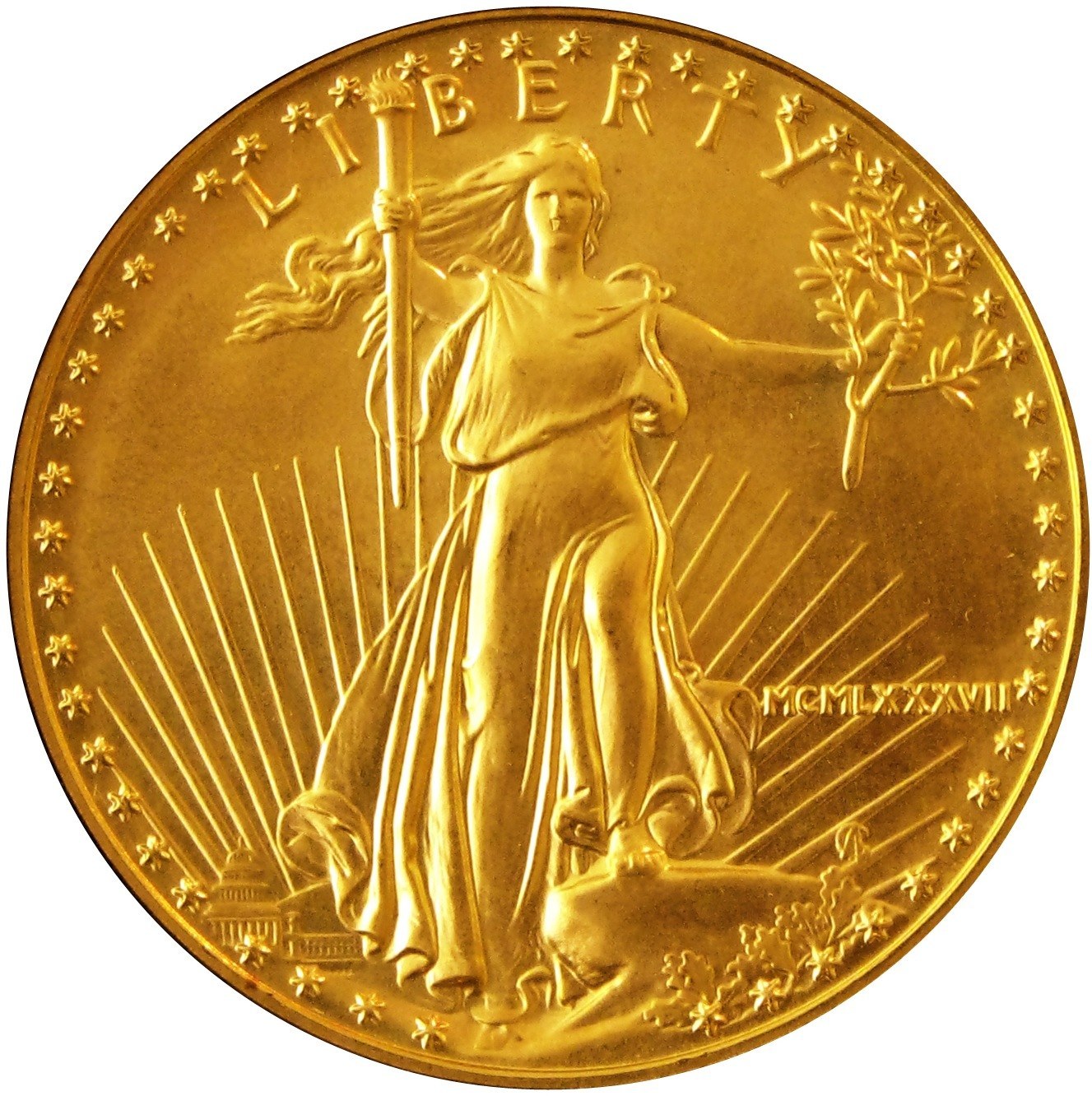
Begin with the obverse figure. A genuine modern $5 Gold Eagle shows Saint-Gaudens' Liberty striding toward the viewer, torch raised in one hand and olive branch in the other, with sun rays and the Capitol dome behind her, "LIBERTY" above and the date—here 1987—at lower right. This full-length torch-bearing Liberty is the key obverse diagnostic and separates it instantly from the classic Half Eagle, whose obverse is only a coroneted or feathered Liberty head.
Confirm the reverse and legends. The reverse shows a flying eagle bringing an olive branch to a nest of eagles, encircled by "UNITED STATES OF AMERICA," "E PLURIBUS UNUM," "IN GOD WE TRUST," and the crucial weight statement "1/10 OZ. GOLD $5." That inscription both identifies the coin and states its exact gold content; if a $5 gold coin lacks it, you are likely looking at a different series or a copy.
Check size and metal. The tenth-ounce Gold Eagle is small and chunky—about 16.5 mm across and roughly 3.39 grams. Its 22-karat alloy gives a warm, slightly reddish-yellow tone rather than the brighter color of pure 24-karat gold. Weighing the coin is one of the most useful quick tests: a genuine piece should be very close to 3.39 grams gross.
Watch for look-alikes and fakes. Common confusables include the other American Gold Eagle sizes (which share the design but are larger and read $10, $25, or $50), gold-plated base-metal copies, and thin "tribute" or replica pieces sold as novelties. Counterfeits often miss the target weight, ring dull, show soft or mushy detail, or carry incorrect edge and rim work. Because the coin is small and valuable, small deviations in weight or diameter matter.
Authenticate valuable pieces properly. For anything beyond ordinary bullion trading—especially certified or proof coins—verify with a scale and caliper, and consider a reputable third-party grading service. Buy from established dealers, and be cautious of "gold" coins priced far below the current tenth-ounce melt value, which is a classic sign of a plated or counterfeit piece.
Frequently asked questions
How do I tell the $5 Gold Eagle from the larger sizes?
All four American Gold Eagle sizes share the same designs, so read the reverse legend and check size. The $5 is the smallest at about 16.5 mm and states "1/10 OZ. GOLD $5"; the $10, $25, and $50 are larger and quote their own weights.
What is the fastest authenticity check?
Weigh it. A genuine tenth-ounce Gold Eagle should be very close to 3.39 grams gross and about 16.5 mm across. Wrong weight, dull ring, or soft detail are warning signs of a plated or counterfeit coin.
Is a torch-bearing Liberty proof it is a Gold Eagle and not a classic Half Eagle?
Effectively yes. The classic Half Eagle shows only a Liberty head. The full striding Liberty with a torch is the modern American Gold Eagle obverse, used since 1986.
Should I clean a dull or spotted example?
No. Cleaning can scratch the soft 22-karat surface and reduce value. Leave the coin as found and let a dealer or grading service assess it.