
How to Identify the U.S. Capitol Bicentennial Silver Dollar
A collector's guide to confirming the 1994 Capitol silver dollar by its dome design, eagle reverse, silver specs, and mint marks.
Read the full U.S. Capitol Bicentennial Silver Dollar encyclopedia entry →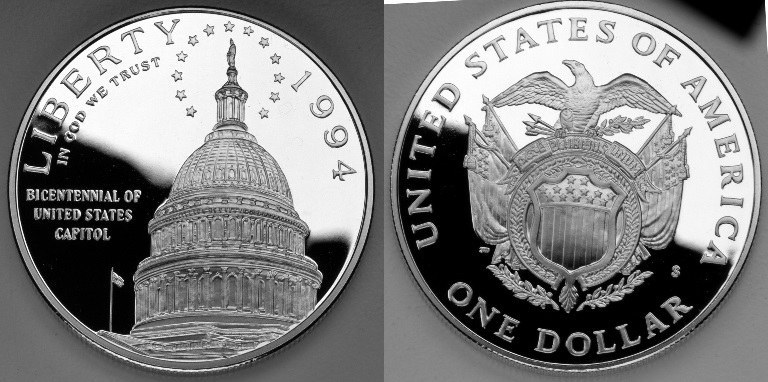
Begin with the obverse subject: this coin shows the domed U.S. Capitol topped by the Statue of Freedom, set among stars, not a portrait or allegorical figure. The surrounding text should read LIBERTY, IN GOD WE TRUST, and a legend naming the BICENTENNIAL OF THE UNITED STATES CAPITOL, with the date 1994. If the obverse shows anything other than the Capitol building, it is a different coin.
Turn to the reverse, which must display a heraldic bald eagle with a shield and the inscriptions UNITED STATES OF AMERICA, ONE DOLLAR, and E PLURIBUS UNUM. This eagle-and-shield reverse, paired with the Capitol obverse, is the diagnostic combination for this specific issue.
Confirm the physical specs, which are the strongest authenticity check. Expect roughly 26.7 g, about 38.1 mm in diameter, a reeded edge, and a 90% silver composition (silver is non-magnetic). A scale and caliper will quickly flag underweight, undersized, or magnetic fakes. Then check the mint mark on the obverse: a D points to the Denver uncirculated strike and an S to the San Francisco proof; a mirror-like field indicates a proof, while a satin finish indicates the uncirculated version.
Watch for look-alikes and cautions. Do not confuse this with circulating dollars (Eisenhower, Susan B. Anthony, or Sacagawea) or with other 1990s commemorative dollars that also use eagle reverses but carry entirely different obverse subjects and legends. Privately made "tribute" medals may copy Capitol imagery but will lack the exact denomination, legends, or silver specs. For coins bought loose or graded, favor examples in sealed PCGS or NGC holders, and match the coin against its original certificate of authenticity when available.
Frequently asked questions
How do I know it's the Capitol dollar and not another commemorative?
Look for the Capitol dome with the Statue of Freedom on the obverse plus the 'Bicentennial of the United States Capitol' legend. That obverse, combined with the shielded-eagle reverse and 1994 date, is unique to this issue.
Where is the mint mark, and what should it be?
The mint mark is on the obverse. A 'D' indicates the Denver uncirculated coin and an 'S' the San Francisco proof. A missing or different letter warrants a closer look.
What are the correct specifications?
About 26.73 g, roughly 38.1 mm across, a reeded edge, and 90% silver / 10% copper. A coin that is magnetic, lightweight, or the wrong size is suspect.
How can I tell a proof from an uncirculated example?
Proofs have deeply reflective, mirror-like fields with frosted design elements; uncirculated coins have a softer satin luster. The mint mark and packaging usually confirm which finish you have.