
How to Identify the Texas Centennial Half Dollar
A collector's guide to recognizing the 1934–1938 Texas commemorative half dollar by its eagle-on-star obverse, Alamo reverse, size, and mint marks.
Read the full Texas Centennial Half Dollar encyclopedia entry →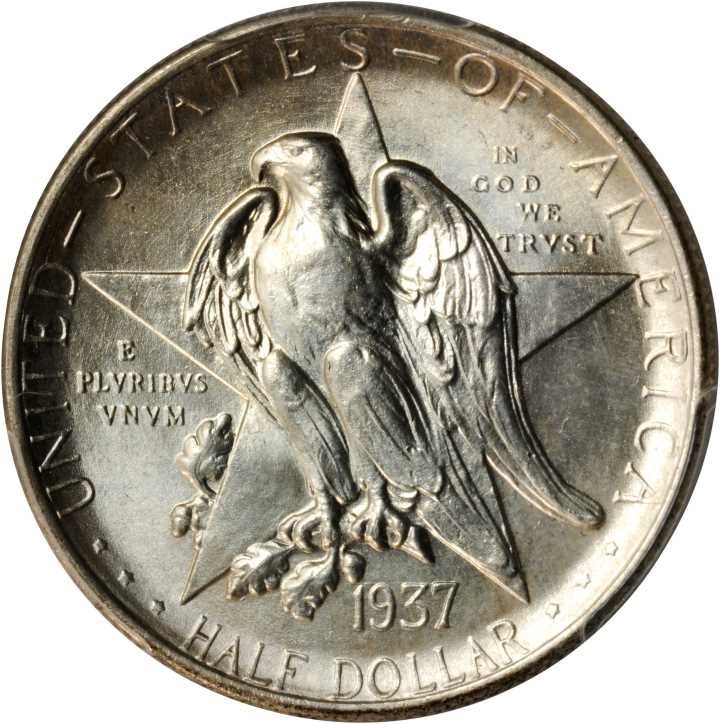
Start with the obverse image. A genuine Texas Centennial half dollar shows an eagle with spread wings laid over a single large five-pointed star, with the motto IN GOD WE TRUST placed to the side. This eagle-and-star device is the fastest way to recognize the type at a glance and is exactly what appears on the photographed coin. The design is distinct from circulating Walking Liberty half dollars of the same era, which show a striding Liberty figure instead.
Turn the coin over to confirm the reverse. The correct reverse carries a kneeling winged Victory in front of the Alamo, with small portrait medallions of Sam Houston and Stephen F. Austin at the left and right, and lettering that includes the anniversary dates. Verify the denomination reads HALF DOLLAR and that the legend UNITED STATES OF AMERICA is present, which separates a true U.S. commemorative from souvenir medals or tokens that borrow similar imagery.
Check the physical specifications. The coin should be struck in .900 fine silver, weigh about 12.5 grams, measure 30.6 mm in diameter, and have a reeded edge. Weight or diameter noticeably outside those figures is a warning sign. Because the metal is real silver, the coin should feel and sound like a standard half dollar of the 1930s.
Locate the mint mark to attribute the variety. On issues that have one, the mint mark sits on the reverse: D for Denver or S for San Francisco, with Philadelphia coins carrying none. Combined with the date, the mint mark identifies the specific 1934 through 1938 issue, which matters because some branch-mint dates are scarcer than others. Read the date carefully, as it determines where a given coin falls in the series.
Finally, watch for authentication concerns. Commemoratives are sometimes cleaned, artificially toned, or counterfeited, and altered mint marks exist on some 1930s issues. Look for consistent original surfaces, correct weight and diameter, and crisp design detail. For higher-value or key-date examples, certification by a major third-party grading service is the safest way to confirm authenticity and grade.
Frequently asked questions
How do I tell this from a regular Walking Liberty half dollar?
The Texas Centennial obverse shows an eagle over a large star with IN GOD WE TRUST, not the striding Liberty of a circulating Walking Liberty half dollar, and its reverse depicts the Alamo with Houston and Austin.
What denomination and legends should it have?
The coin reads HALF DOLLAR with UNITED STATES OF AMERICA, confirming it is a U.S. fifty-cent piece rather than a commemorative medal or token.
Where do I find the mint mark?
On the reverse. A D indicates Denver and an S indicates San Francisco; Philadelphia-struck coins have no mint mark.
Should I have one authenticated?
For scarcer dates or high-grade pieces, yes. Certification by a reputable grading service guards against cleaning, altered mint marks, and counterfeits, and confirms the grade.