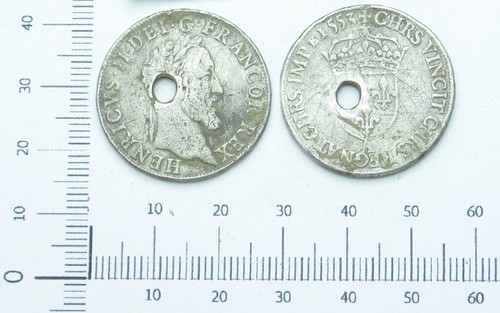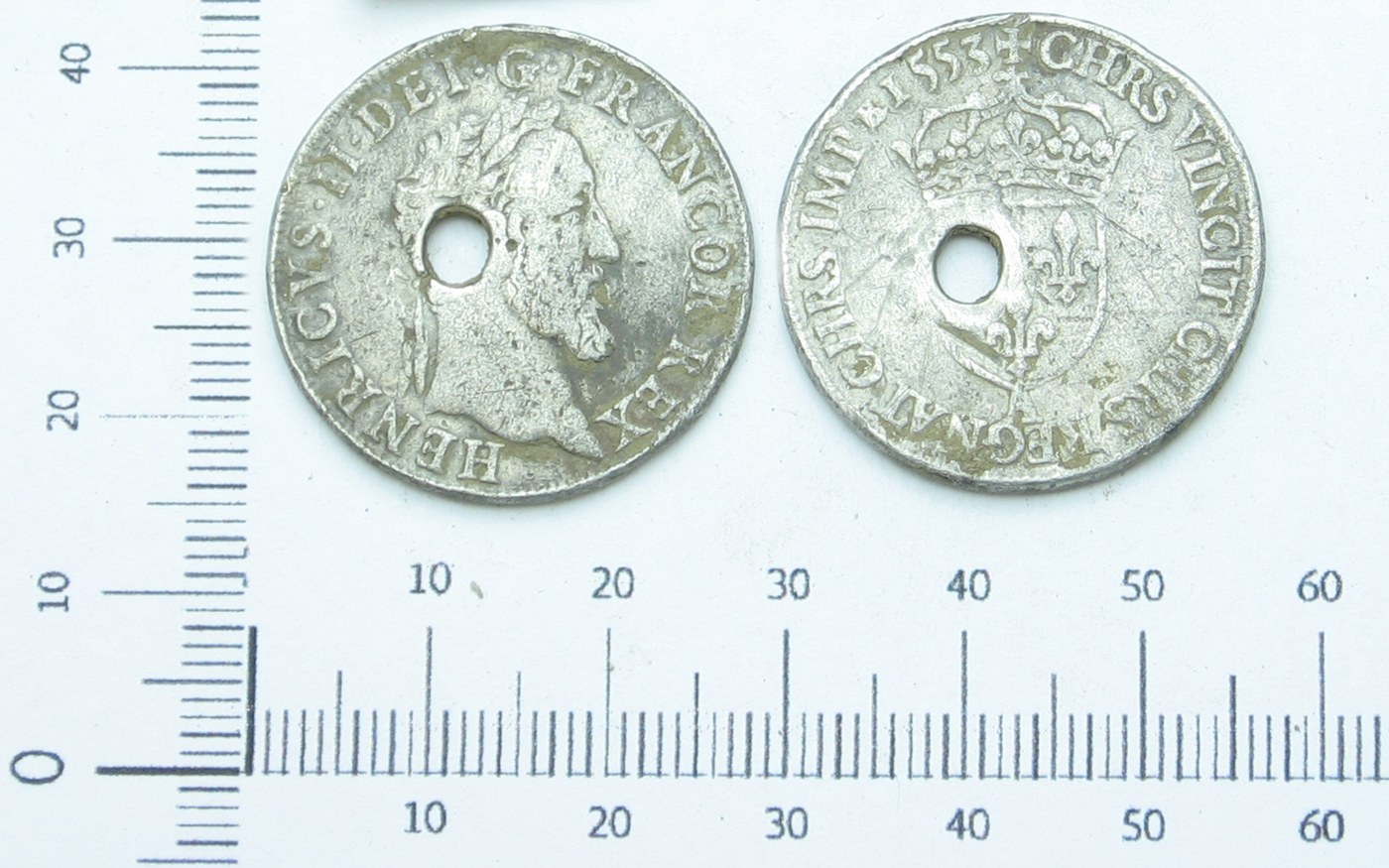
Teston of Henri II
A French Renaissance silver teston of Henri II (1547-1559): the king's realistic profile bust right, a crowned fleur-de-lis coat of arms on the reverse.
- Country
- France
- Denomination
- Teston
- Metal
- Silver
Got a coin like this?
Identify any coin from a photo, free.
Overview
The teston of Henri II is a large silver coin of Renaissance France, struck during the reign of King Henri II from 1547 to 1559. Its obverse carries a carefully modelled profile bust of the king facing right, in the portrait tradition that gave the coin its name—teston, from the Italian testa, meaning 'head.' The reverse shows the crowned coat of arms of France, a shield of three fleur-de-lis.
Among the most prestigious circulating silver of its day, the teston was valued well above the small billon and copper coins ordinary people handled. Its lifelike portraiture made it a showcase of French Renaissance die-engraving, and the type seen here—Henri II's bust paired with the crowned royal arms—is the classic form of his silver teston.
History & Background
The teston was introduced into French coinage in the early 1500s under Louis XII, inspired by the Italian testone and its fashion for realistic ruler portraits. By the reign of Henri II it had become the flagship silver denomination, and the king's engravers rendered his features with the confident naturalism of the High Renaissance.
Henri II ruled France from 1547 until his death in 1559 from a jousting wound. His coinage circulated during a period of religious tension and costly wars with the Habsburgs, and the teston functioned as substantial money for merchants, officials and the well-to-do. It is also associated with an important technical experiment: during Henri II's reign the Paris mint trialled the moulin (mill or screw press), producing some of France's earliest machine-struck testons alongside the traditional hammered pieces.
Because the denomination spanned several reigns and mints, Henri II's testons survive in a range of styles and mint marks. They are collected today as tangible relics of Renaissance France and of a monarchy that placed the king's own likeness at the centre of its money.
How to Identify
Start with the portrait. A Henri II teston shows the king in profile facing right, bare-headed or with cropped Renaissance hair and a beard, surrounded by a Latin legend naming him—typically a form of HENRICVS II DEI GRATIA FRANCORVM REX (Henri II, by the grace of God King of the French). The realism of the bust is characteristic of the type.
Turn the coin over to confirm. The reverse bears the crowned arms of France—a shield charged with three fleur-de-lis beneath a royal crown—often flanked by ornaments and accompanied by a pious Latin legend and, on many issues, a date. The coin is silver, roughly the size of a large circulating crown-type piece, and heavier than the small billon coins of the era.
Mint marks and privy marks (small letters or symbols in the legend or beneath the bust) identify where a given teston was struck, as several French mints produced them. Read the obverse legend, the crowned fleur-de-lis shield and any mint letter together to pin a coin to Henri II's series rather than to a neighbouring reign.
Value & Collectibility
As a large Renaissance silver coin nearly five centuries old, a Henri II teston carries collector value well above its silver content. Demand comes from its historical importance and its Renaissance portraiture rather than from bullion alone.
Condition is the leading factor in price. Worn, corroded or damaged testons are relatively affordable, while sharply struck examples with a clear portrait, full legends and original surfaces command a strong premium. Mint, date, die variety, and whether a piece is hammered or an early mill-struck issue all matter to specialists.
Because values vary widely with grade and variety, judge any particular teston against recent auction and dealer results for its exact mint, date and condition. Cleaning, holing, mounting, bending or tooling reduce value markedly, so original and undamaged silver is always preferred.
Frequently asked questions
Why is it called a 'teston'?
The name comes from the Italian *testone*, from *testa* ('head'), because the coin was defined by its realistic portrait head of the ruler. France adopted the term for its large portrait silver, and Henri II's bust continues that tradition.
What is shown on the reverse?
The reverse bears the crowned coat of arms of France—a shield of three fleur-de-lis beneath a royal crown—usually with a Latin legend and, on many issues, a date.
Is the teston made of real silver?
Yes. The teston was a good-quality silver denomination, distinctly above the base-metal billon coins of the period. Its collector value today, however, rests mainly on its history and condition rather than metal weight.
Are all Henri II testons hammered by hand?
Most are traditional hammered coins, but Henri II's reign also saw early machine-struck testons made on the Paris *moulin* (screw press). Mill-struck pieces tend to be rounder and more uniform and are of special interest to collectors.
Teston of Henri II guides
In-depth guides for identifying, valuing, and collecting Teston of Henri II.