
How to Identify the Swiss 5 Francs Silver
Switzerland's silver 5 Francs coin, featuring either the Helvetia head or the herdsman design, was a hefty circulating silver piece minted for nearly a century before being replaced by cupronickel.
Read the full Swiss 5 Francs Silver encyclopedia entry →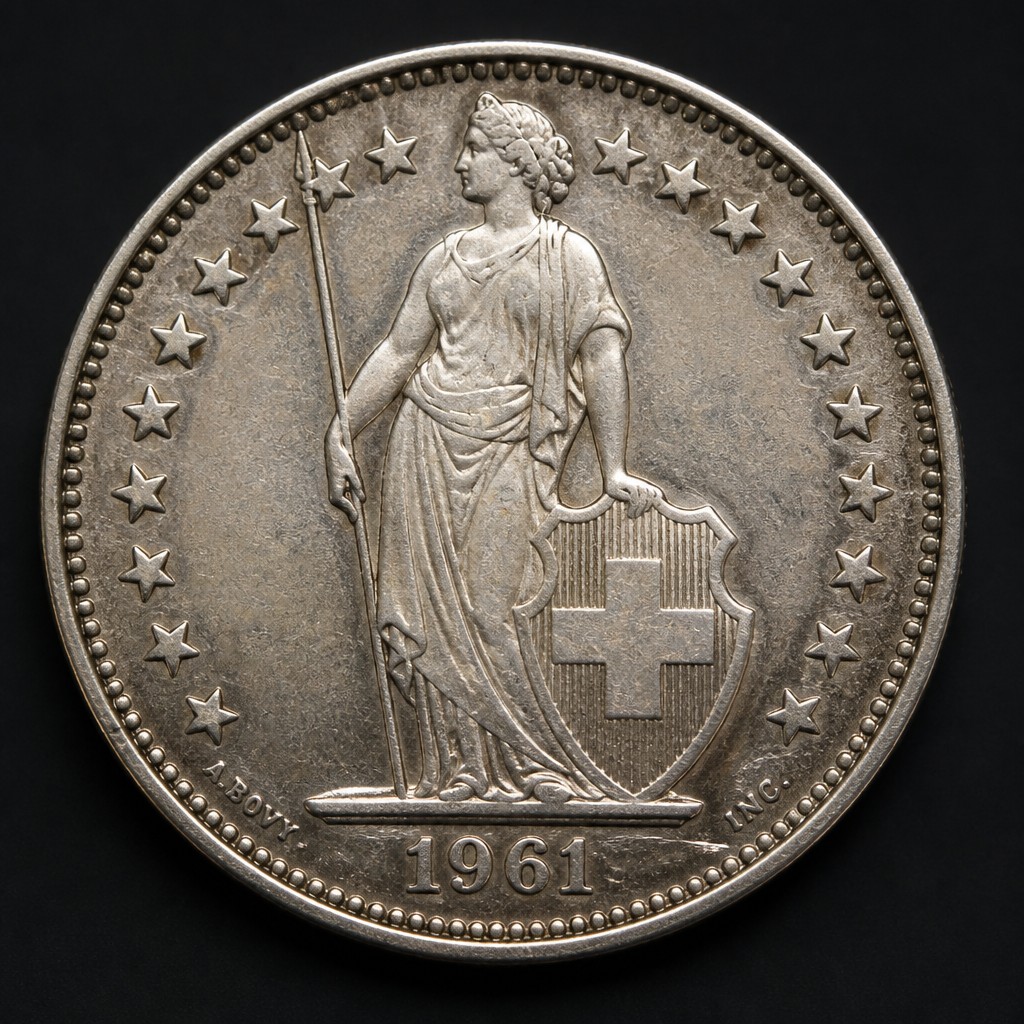
What Is the Swiss 5 Francs Silver Coin
This large silver coin was issued by the Swiss Confederation with different obverse designs over time, most famously the "Herdsman" (Alpine herdsman with cattle) type used from the 1920s into the 1960s, and earlier Helvetia head designs from the late 19th century. As Switzerland's highest circulating silver denomination for decades, it was a familiar sight in everyday commerce before base-metal coinage took over.
Obverse Design and Inscriptions
Depending on the type, the obverse shows either a female Helvetia head personifying Switzerland with the legend "HELVETIA," or a standing Alpine herdsman figure with mountains and cattle in the background, inscribed with "CONFOEDERATIO HELVETICA" (Swiss Confederation).
Reverse Design and Inscriptions
The reverse shows the Swiss federal shield within a wreath, with the denomination "5 FRANCS" or "5 FR" and the date.
Size, Weight, Metal, and Edge
The coin was struck in .900 fine silver, approximately 31mm in diameter and about 25 grams, with a lettered edge reading "DOMINUS PROVIDEBIT" (The Lord will provide).
Mint Marks and Where to Find Them
The Bern mint, Switzerland's sole federal mint, marks its coins with a small symbol near the rim on the reverse, sometimes alongside the engraver's initials. Because Switzerland has centralized all federal coin production at a single mint since the Confederation's founding, there is no need to distinguish between multiple mint locations as with many other European countries.
Telling It Apart From Similar Coins
After 1968, Switzerland switched the 5 Franc coin to a cupronickel composition using a similar design, so distinguishing silver from later cupronickel issues requires checking the date (pre-1968 for silver) or weighing the coin, since cupronickel pieces are noticeably lighter. Comparing the specific figure on the obverse also helps separate this coin from other Latin Monetary Union silver coins of similar size, which use national symbols and legends unique to their own countries.
Judging Condition at a Glance
Check the herdsman's or Helvetia's facial and clothing details, plus the shield's fine lines, for wear. A well-struck coin shows crisp mountain and cattle details in the background scene. The lettered edge is also a useful condition check, since heavily worn or cleaned coins often show softened or partially illegible edge letters compared to a crisp, well-preserved example. Beyond domestic Swiss commerce, this coin also circulated in cross-border trade with neighboring countries that shared the Latin Monetary Union's standardized coin weights and silver content.
Authenticity Red Flags
Confirm the weight (about 25 grams for silver issues) and the presence of correct edge lettering. Because Swiss minting is known for precision, blurred lettering, an incorrect diameter, or an inconsistent edge inscription is a strong sign of a counterfeit or altered coin.
Frequently asked questions
What is the difference between the silver and later 5 Francs coins?
Silver 5 Franc coins were minted through the late 1960s at .900 fine silver, after which Switzerland switched to a lighter cupronickel alloy using a similar design.
Who or what is depicted on the obverse?
Either a personification of Switzerland called Helvetia, or an Alpine herdsman figure, depending on the specific design era.
What does 'CONFOEDERATIO HELVETICA' mean?
It's Latin for 'Swiss Confederation,' the official name of Switzerland, which is why Swiss coins use 'CH' as a country abbreviation.
How much does the silver version weigh?
Approximately 25 grams.
Where do Swiss coins get minted?
All Swiss federal coins are produced at the Bern mint, sometimes marked with a small symbol identifying it.