
How to Identify the Swiss 10 Francs Gold Vreneli
The Swiss 10 Francs Vreneli is a petite gold coin from the famous Vreneli series, showing a Swiss maiden's profile and an Alpine backdrop, treasured for its classic Art Nouveau design.
Read the full Swiss 10 Francs Gold Vreneli encyclopedia entry →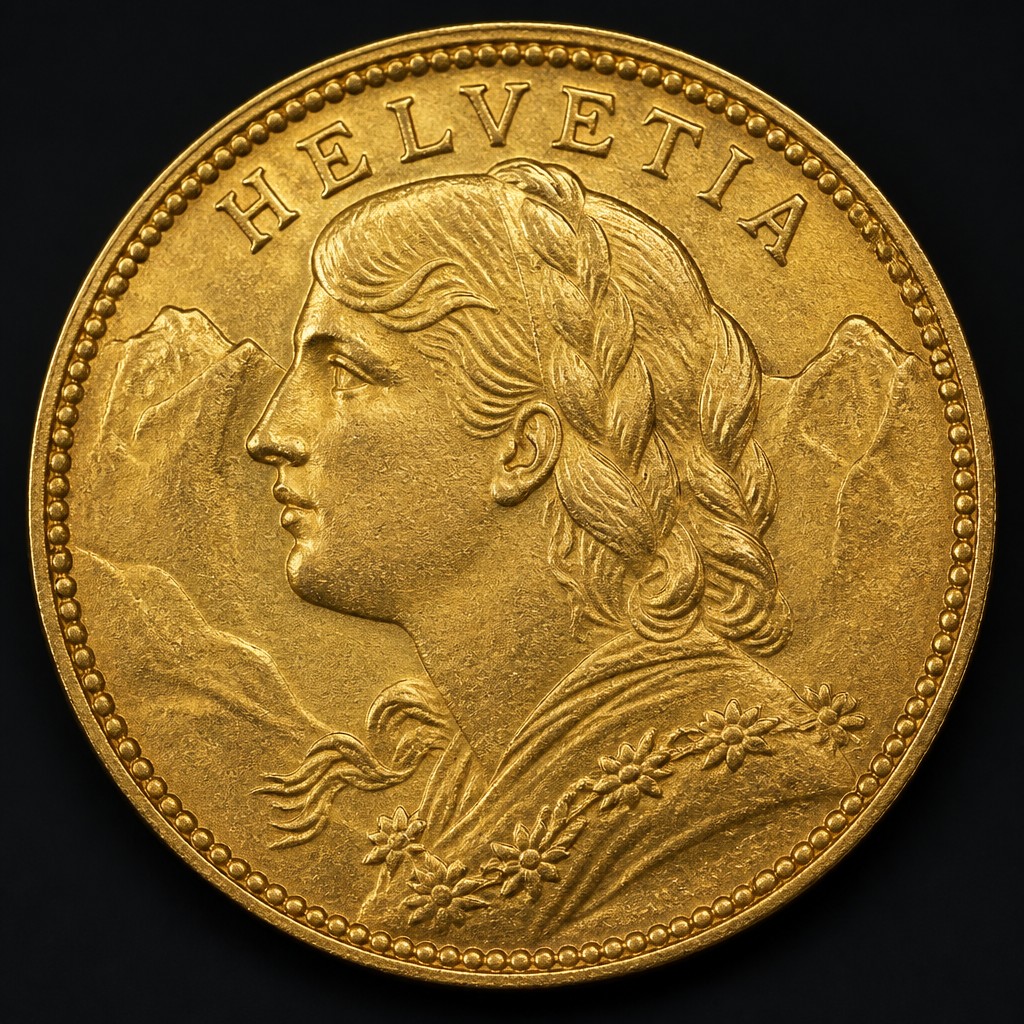
What It Is
The Vreneli series, designed by Fritz Ulisse Landry, is one of Switzerland's most iconic gold coin families, issued in 10, 20, and 100 franc denominations in the early 20th century. The 10 francs is the smallest of the regularly issued denominations and a popular started piece for collectors of Swiss gold. Its enduring popularity comes from the combination of a beloved Art Nouveau design and Switzerland's long reputation for stable, well-struck coinage.
Obverse Design
The obverse shows the bust of a young Swiss woman (nicknamed "Vreneli," a diminutive of Verena) in profile, wearing a braided hairstyle with a flower or edelweiss motif, and the word "HELVETIA" arcing above her head. Alpine peaks are visible in the background behind her shoulder.
Reverse Design
The reverse depicts the Swiss federal shield (cross) suspended from an oak branch, surrounded by a ring of small stars representing the Swiss cantons, with the denomination "10 FR" and the date below.
Size, Weight & Metal
The 10 francs Vreneli measures about 19mm in diameter and weighs roughly 3.23 grams, struck in .900 fine gold. Its compact size and warm yellow-gold luster are quick visual cues.
Mint Marks and Where to Find Them
Look along the coin's edge for the mint mark "B" (Bern), the sole mint that struck these coins, along with a small privy mark or the Latin motto on the edge lettering of larger denominations; the 10 franc's edge is typically reeded rather than lettered.
Telling It Apart from Similar Coins
The Vreneli is often confused with French "Rooster" francs or other small European gold pieces of similar size. The key giveaways are the "HELVETIA" legend, the maiden's distinctive braided profile, and the Swiss cross-and-stars reverse, none of which appear on French, Belgian, or Italian gold coins of comparable size. French 20 franc gold pieces of similar era instead show either a rooster or a portrait of Marianne, and read "REPUBLIQUE FRANCAISE" rather than "HELVETIA," making the two easy to separate once the wording is checked.
Judging Condition at a Glance
Check the high points of the maiden's cheek, hair braid, and the tip of her nose for flatness, as these wear first. On the reverse, examine the fine detail of the cross's edges and the sharpness of the small stars; blurred or rounded stars suggest circulation wear.
Authenticity Red Flags
Genuine Vrenelis have crisp, well-centered strikes with a fine reeded edge and correct diameter and weight. Be cautious of pieces that are noticeably thin, show a grainy or pitted surface (a sign of casting rather than striking), or have a diameter or weight that falls outside normal tolerances, as well as any softness in the lettering that suggests a struck copy rather than an official mint product.
Frequently asked questions
What does the nickname 'Vreneli' mean?
It is an affectionate Swiss-German diminutive of the name Verena, referring to the maiden depicted on the coin's obverse.
Which mint produced these coins?
All Vreneli gold coins, including the 10 francs, were struck at the Bern mint in Switzerland.
How do I distinguish a 10 francs Vreneli from a 20 francs Vreneli?
Compare size and denomination wording: the 10 francs is smaller (about 19mm) and reads '10 FR,' while the 20 francs is larger and heavier and reads '20 FR.'
Is the edge lettered or plain?
The 10 francs Vreneli generally has a reeded (grooved) edge rather than the lettered edge found on some larger Swiss gold denominations.
What purity is the gold in this coin?
It is struck in .900 fine gold, consistent with most Latin Monetary Union-era gold coinage.