
How to Identify the South African Mandela R5 Coin
A bi-metallic five-rand circulation coin bearing Nelson Mandela's portrait, issued by the South African Reserve Bank in commemorative and standard editions.
Read the full South African Mandela R5 Coin encyclopedia entry →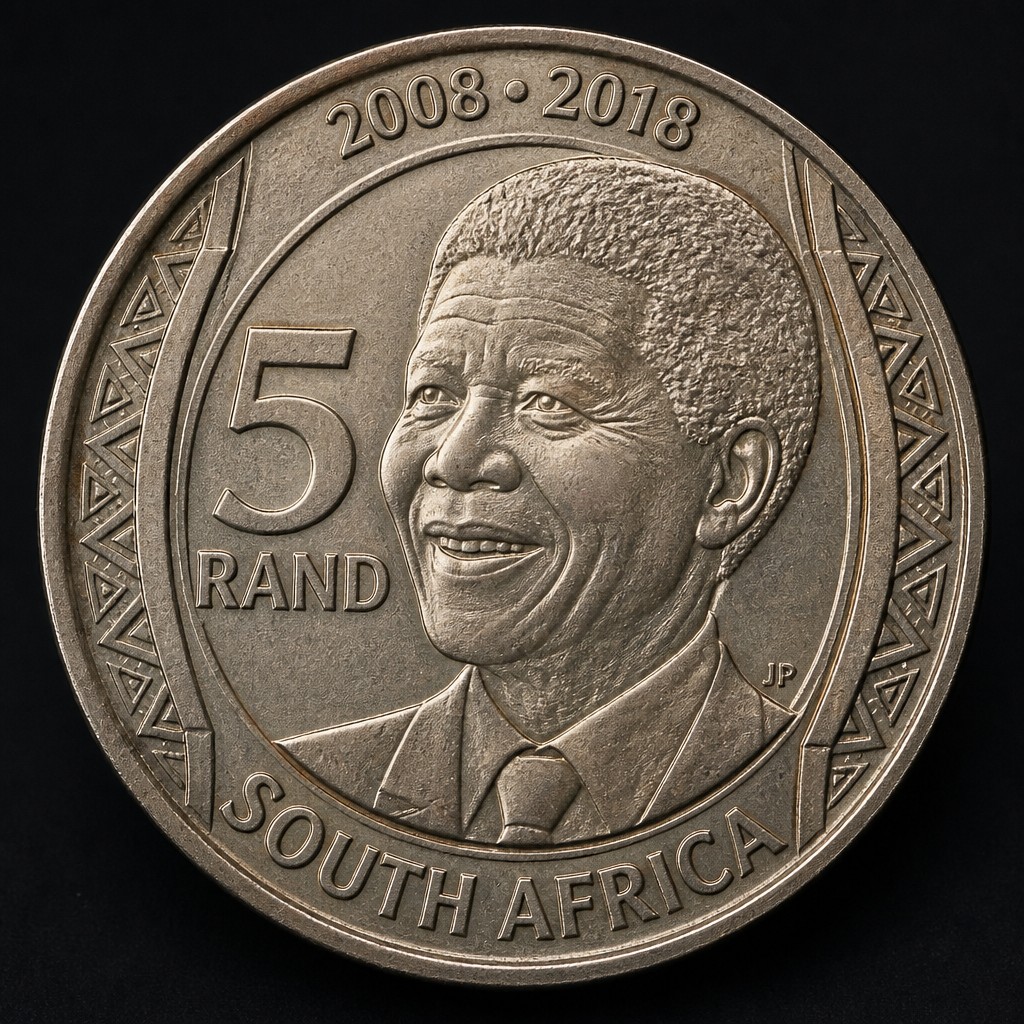
What Is the Mandela R5?
South Africa's five-rand coin has carried Nelson Mandela's portrait on several occasions, most notably on a special edition marking his 90th birthday in 2008. It is a workhorse circulation coin rather than a bullion piece, so identification is mostly about recognizing the design rather than assessing precious-metal content. Because millions of these coins have been struck and continue to circulate in everyday South African commerce, most examples encountered today are common pocket change rather than scarce collectibles, and value tends to rest on condition and specific-date demand rather than rarity alone.
Obverse Design
Mandela editions show a portrait of Nelson Mandela, generally smiling, with the country name given bilingually as "SOUTH AFRICA" and "SUID-AFRIKA" around the rim. Standard R5 coins from other years instead show South Africa's coat of arms or a national animal; a coin showing an animal rather than a portrait is from a different design cycle, not a Mandela issue.
Reverse Design
The reverse carries the large numeral "5" together with the word "RAND," often alongside a stylized design element and the date of issue. Commemorative Mandela strikes sometimes add a short inscription referencing the occasion, such as a birthday, near the numeral.
Size, Weight, and Metal
The R5 is a bi-metallic coin: a steel-based core plated to give a two-tone appearance, with an outer ring in one tone and a distinct center disc in a contrasting tone, roughly 26mm in diameter. This bi-metallic construction is a quick way to confirm you have a genuine R5 rather than a similarly sized single-metal token.
Mint Marks and Dates
South African coins do not use a separate mint-mark letter system; identification instead relies on the date and design combination stamped on the coin. Confirm the year matches a documented Mandela-portrait design year before assuming a coin is a commemorative piece.
Telling Genuine Commemoratives from Standard Issues
Not every R5 bearing Mandela's portrait is identical: some years used the portrait as the standard circulating design, while the 2008 issue was struck specifically to mark his 90th birthday and may carry additional wording. Compare the exact rim text and any birthday-related inscription to confirm which version you have. If your coin instead shows a rhino, elephant, or other wildlife image, or the national coat of arms, it belongs to a different R5 design cycle entirely and is not a Mandela portrait issue, regardless of how similar the overall size and color feel.
Condition and Grading at a Glance
Because these are common circulation coins, wear shows first on Mandela's cheek and hairline and on the raised numeral on the reverse. A coin with full luster on the portrait's high points and crisp numeral edges is in better condition than a smoothed, dull example.
Authenticity Red Flags
Genuine R5 coins have a precise, consistent bi-metallic join with no visible glue line or gap between the ring and center disc. Be wary of coins where the two metal zones look painted on, where the disc is a single uniform color, or where weight and diameter deviate noticeably from a standard R5, since these suggest a novelty token rather than a genuine Reserve Bank issue.
Frequently asked questions
Is the Mandela R5 rare?
No, it was struck in large numbers for circulation, so most examples are common; any added value depends on specific date and variety combinations.
What metal is the R5 coin made of?
It is a bi-metallic coin with a steel-based core, plated to create a two-tone appearance, rather than being made from precious metal.
How do I know if my R5 is the 2008 90th-birthday edition?
Check that the date reads 2008 and look for birthday-related wording near the rim or reverse, distinguishing it from other years using a similar portrait.
Does the coin have a mint mark?
South African coins don't carry mint marks the way some other countries' coinage does; the date and design year are what you check instead.