
How to Identify the Seated Liberty Quarter
A step-by-step look at the seated Liberty obverse, shield-eagle reverse, silver size and color, the date arrows, mint marks, and look-alikes to rule out.
Read the full Seated Liberty Quarter encyclopedia entry →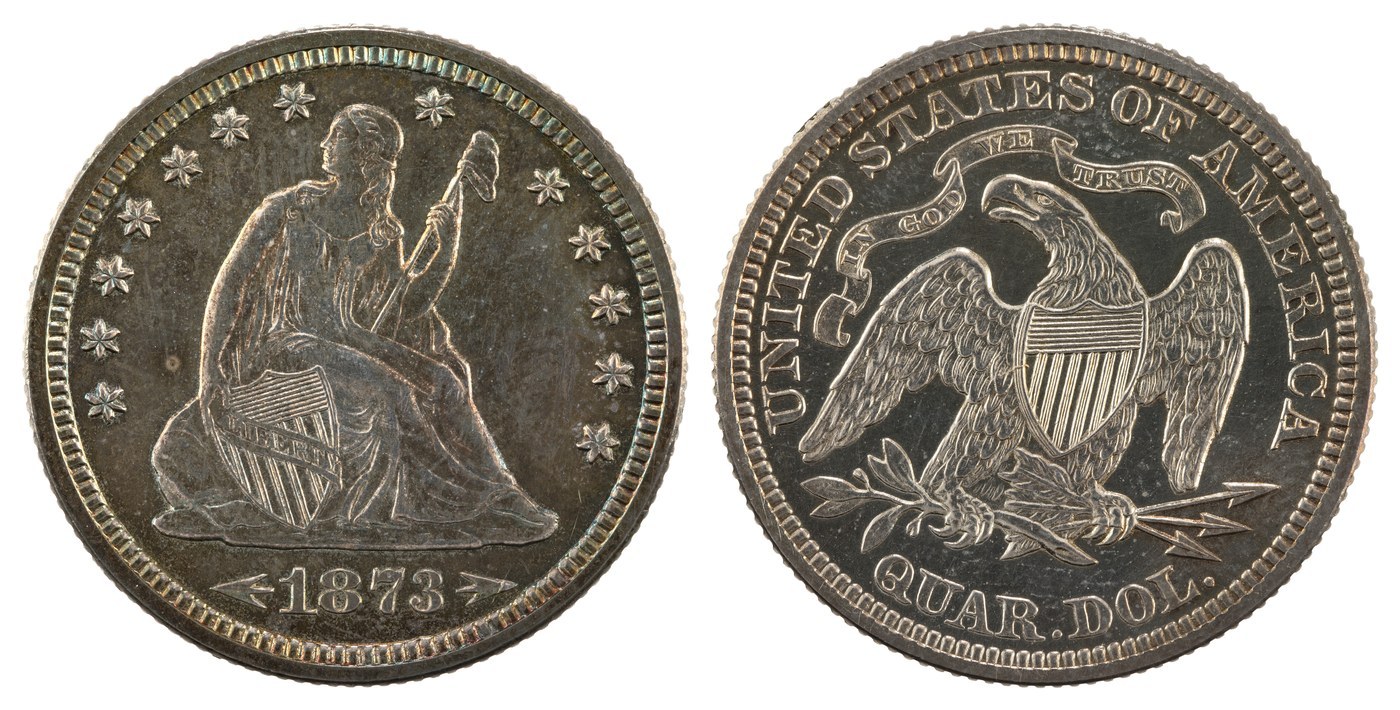
Start With the Obverse
Look for a full-length figure of Liberty seated on a rock. Her right hand rests on a striped shield bearing the word "LIBERTY" on a diagonal banner, and her left hand holds a pole topped by a liberty cap. Thirteen stars ring the border and the four-digit date sits at the bottom — our example reads 1854. On this coin, note the small arrowhead on each side of the date: that detail places it firmly in the 1853–1855 "Arrows" period and rules out the plain-date years.
Check the Reverse Eagle
Turn the coin over and confirm a naturalistic eagle with a heraldic shield on its breast, gripping an olive branch on one side and a bundle of arrows on the other. "UNITED STATES OF AMERICA" curves over the top and the abbreviated denomination "QUAR. DOL." sits below the eagle. Confirm there is no scroll reading "IN GOD WE TRUST" above the eagle — its absence is consistent with an 1854 date, since the motto was only added in 1866.
Confirm Size, Metal, and Edge
The Seated Liberty Quarter is 90% silver: about 24.3 mm in diameter with a reeded (grooved) edge and a muted gray silver luster. It is larger than the matching Seated Liberty dime and half dime and smaller than the half dollar, all of which share the same seated design. The reeded edge and true silver color help separate a genuine coin from later copper-nickel pieces and from plated or cast fakes.
Find the Mint Mark and Read the Date
On the reverse, look directly beneath the eagle for a mint mark. For 1854 you may see an "O" (New Orleans) or no mark at all (Philadelphia); across the wider series you may also encounter "S" (San Francisco) or "CC" (Carson City). Read the exact date carefully and note whether arrows flank it — date, arrows, and mint mark together pin down the specific issue and strongly affect value.
Watch for Look-Alikes and Altered Coins
Because the seated design was used across five denominations, size and the "QUAR. DOL." reverse are the surest tests that you have a quarter rather than a dime or half dollar. Be cautious with scarce Carson City dates and high-grade coins, where added or altered mint marks and re-cut dates are known; likewise treat any suspiciously bright, "perfect" surface with care, as cleaning and tooling are common. For any coin that appears rare or unusually well preserved, rely on a reputable third-party grading service to confirm the date, mint, and authenticity.
Frequently asked questions
How do I tell a Seated Liberty Quarter from a Seated Liberty dime or half dollar?
They share the same seated design, so use size and the reverse legend. The quarter is about 24.3 mm across and its reverse reads 'QUAR. DOL.'; the dime is much smaller with a wreath reverse, and the half dollar is larger and reads 'HALF DOL.'
What do the arrows at the date tell me?
Arrows flanking the date indicate a coin struck under the reduced-weight standard of 1853. On quarters they appear from 1853 through 1855, so an 1854 with arrows is a normal example of that short sub-type.
Is the mint mark below the eagle important?
Yes. A mark under the eagle — 'O', 'S', or 'CC' — identifies a branch-mint coin, and for some dates those are far scarcer than the no-mint-mark Philadelphia version. Always note it, and be alert to altered mint marks on scarce issues.
Should I clean an old Seated Liberty Quarter?
No. Cleaning scratches the soft silver and removes original surface, lowering value to collectors. Examine it under good light and magnification and leave any conservation to professionals.