
How to Identify the Quarter Angel of Elizabeth I
Confirm an Elizabethan gold quarter angel by its crowned left-facing portrait, cross-and-shields reverse, small gold flan, and mint mark.
Read the full Quarter Angel of Elizabeth I encyclopedia entry →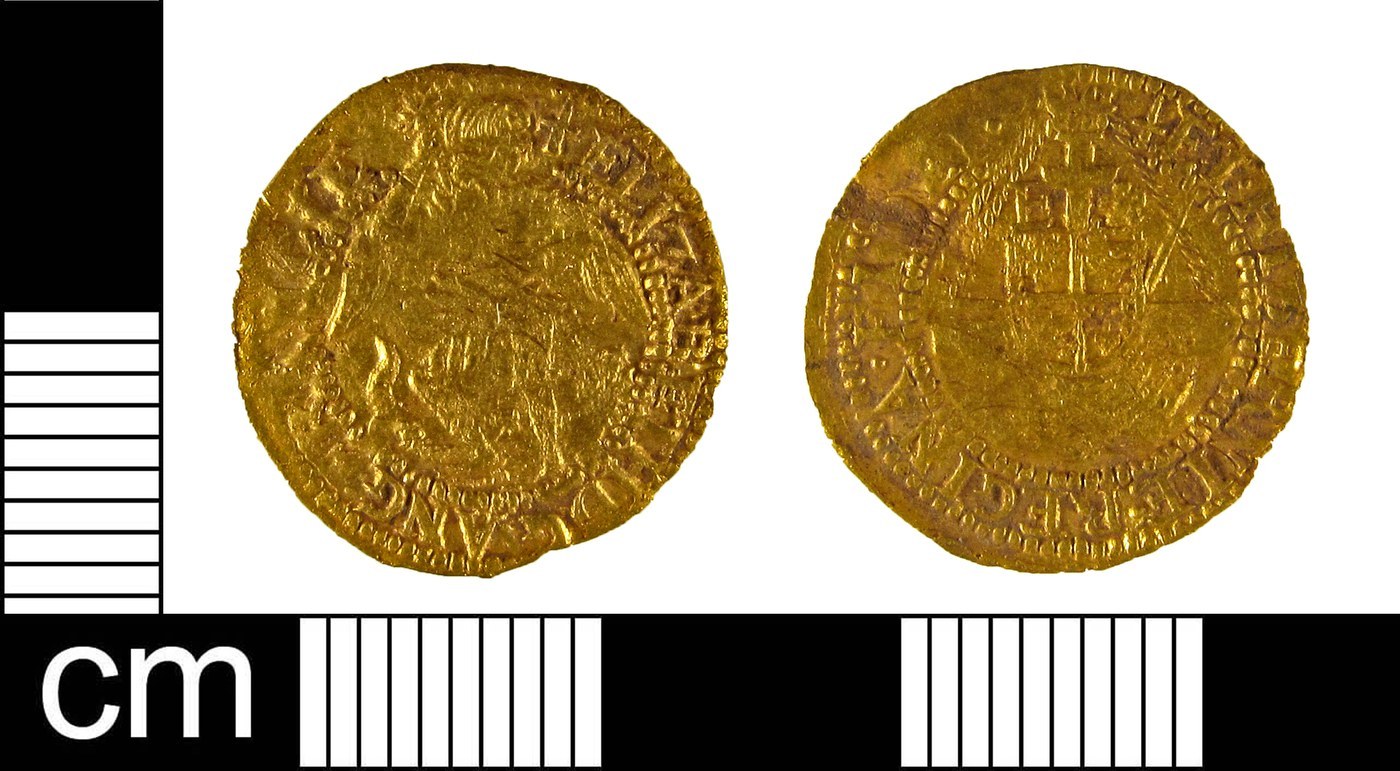
Begin with the portrait. A genuine coin of this type shows a crowned bust of Elizabeth I facing left, holding regalia, framed by a Latin legend that names her as queen. A royal portrait, rather than a saintly or religious scene, tells you this is Elizabethan gold and not an earlier angel design.
Check the reverse next. Expect a long cross with heraldic shields arranged around it and a Latin legend running the full circumference. The pairing of a crowned obverse bust with this cross-and-shields reverse is the combination to confirm; a ship or a standing winged figure would point to a different denomination or reign.
Assess size, metal, and fabric. This is a small, thin gold coin, appropriate to a minor fractional value, not a broad sovereign-sized piece. Because it is hand-hammered, lettering is slightly uneven, the flan edge is irregular, and part of the strike may be weak. A perfectly round, uniformly sharp coin should invite caution.
Locate the initial mark (mint mark) at the start of a legend. These marks changed through the reign and are the primary tool for narrowing the date; a mark consistent with the early 1580s supports a 1581-1583 attribution. Reading the legend also guards against confusing the piece with foreign or later look-alikes.
Finally, weigh authentication cautions. Do not confuse the quarter angel with the full angel or half-angel (which use St Michael and a ship) or with larger crowned-bust gold of the reign; scale and legend distinguish them. Because Tudor gold is valuable, cast copies, tooled coins, and modern replicas exist, so watch for casting seams, wrong weight or diameter, and lifeless detail, and obtain independent authentication before buying.
Frequently asked questions
How do I tell a quarter angel from a full angel?
The full angel and half-angel show St Michael and a ship, not a royal portrait. A crowned bust of Elizabeth with a cross-and-shields reverse points to the crowned-bust gold, of which the quarter angel is the small fractional piece.
What does the mint mark tell me?
The initial mark at the start of the legend indicates the period of striking within Elizabeth's reign, helping date the coin. A mark used in the early 1580s is consistent with a 1581-1583 issue.
How can I spot a fake?
Watch for casting seams, incorrect weight or diameter, unnaturally uniform lettering, and dull, soft detail. Given the value of Tudor gold, always seek professional authentication before a significant purchase.
Which side is the obverse?
The crowned portrait of Elizabeth I is treated as the obverse; the cross-and-shields side is the reverse. For identification what matters is that both appear together on a small gold flan.