
How to Identify the Pennsylvania State Quarter
A collector's walkthrough for confirming a 1999 Pennsylvania State Quarter: the Commonwealth statue, keystone, state outline, size, metal, and mint marks.
Read the full Pennsylvania State Quarter encyclopedia entry →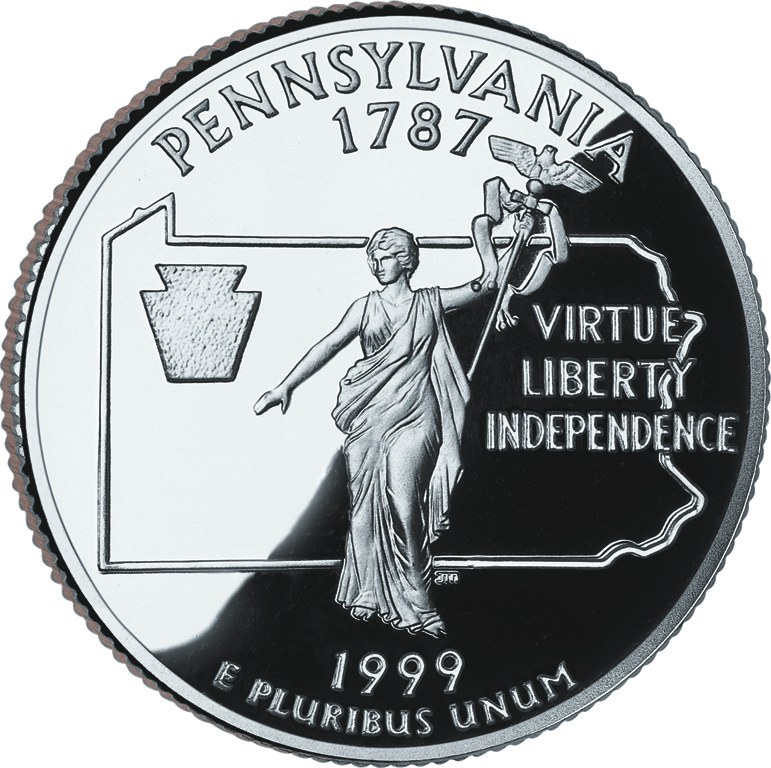
Start with the reverse, because the George Washington obverse is shared by every state quarter and tells you nothing about the state. A genuine Pennsylvania quarter shows a robed standing figure — the Commonwealth statue — with one arm raised, positioned with an outline of the state and a keystone shape. Read the inscriptions: PENNSYLVANIA and the date 1787 arc across the top, VIRTUE LIBERTY INDEPENDENCE appears on a ribbon below, and the year 1999 and E PLURIBUS UNUM are also present. The keystone-plus-state-outline pairing is the single most reliable diagnostic.
Do not be thrown by the raised-arm figure. It resembles a Liberty figure holding a torch and is easy to misread, but it is specifically the Commonwealth statue from the state capitol dome, holding a mace and a wreathed staff rather than a torch. If the reverse instead shows a caesar-rounder scene, a state bird, or any other motif, you have a different state quarter — Delaware (a horseman) and New Jersey (Washington crossing the Delaware) flank Pennsylvania in the 1999 releases and are common confusions.
Confirm the physical specs. The Pennsylvania quarter is a standard modern U.S. quarter: about 24.26 mm in diameter, roughly 5.67 g, with a reeded edge. Examine that edge — a copper-nickel clad quarter shows a copper-colored stripe sandwiched between silvery outer layers. A uniformly silvery edge with no copper stripe suggests a special silver-proof strike rather than a circulation coin.
Check the mint mark on the obverse, to the right of Washington's neck behind the ribbon: P for Philadelphia, D for Denver, and S for San Francisco proofs. For the vast majority of these coins authentication is unnecessary — they are ordinary circulation quarters. Reserve professional grading through a service such as PCGS or NGC for coins you believe are true mint errors, scarce die varieties, or high-grade uncirculated and proof examples where certification affects value.
Frequently asked questions
How do I tell the Pennsylvania quarter from other 1999 state quarters?
Look at the reverse for the Commonwealth statue, the state outline, and the keystone with the motto VIRTUE LIBERTY INDEPENDENCE. Delaware shows a horseman and New Jersey shows Washington crossing the Delaware.
The figure looks like Liberty with a torch — is this the right coin?
Yes. The raised-arm figure is the Commonwealth statue, which is often mistaken for a torch-bearing Liberty. The keystone and state outline confirm it is the Pennsylvania quarter.
Where is the mint mark on this quarter?
On the obverse, to the right of George Washington's neck, just behind the ribbon of his queue. P is Philadelphia, D is Denver, and S is a San Francisco proof.
Do I need to authenticate a Pennsylvania State Quarter?
Generally no — they are common circulation coins worth face value. Consider grading only for suspected errors, recognized varieties, or high-grade uncirculated and proof pieces.