
How to Identify the North Yemen 1 Rial
A collector's guide to recognizing the silver 1 Rial of the Yemen Arab Republic by its wreath, Arabic inscriptions, date, size, and metal.
Read the full North Yemen 1 Rial encyclopedia entry →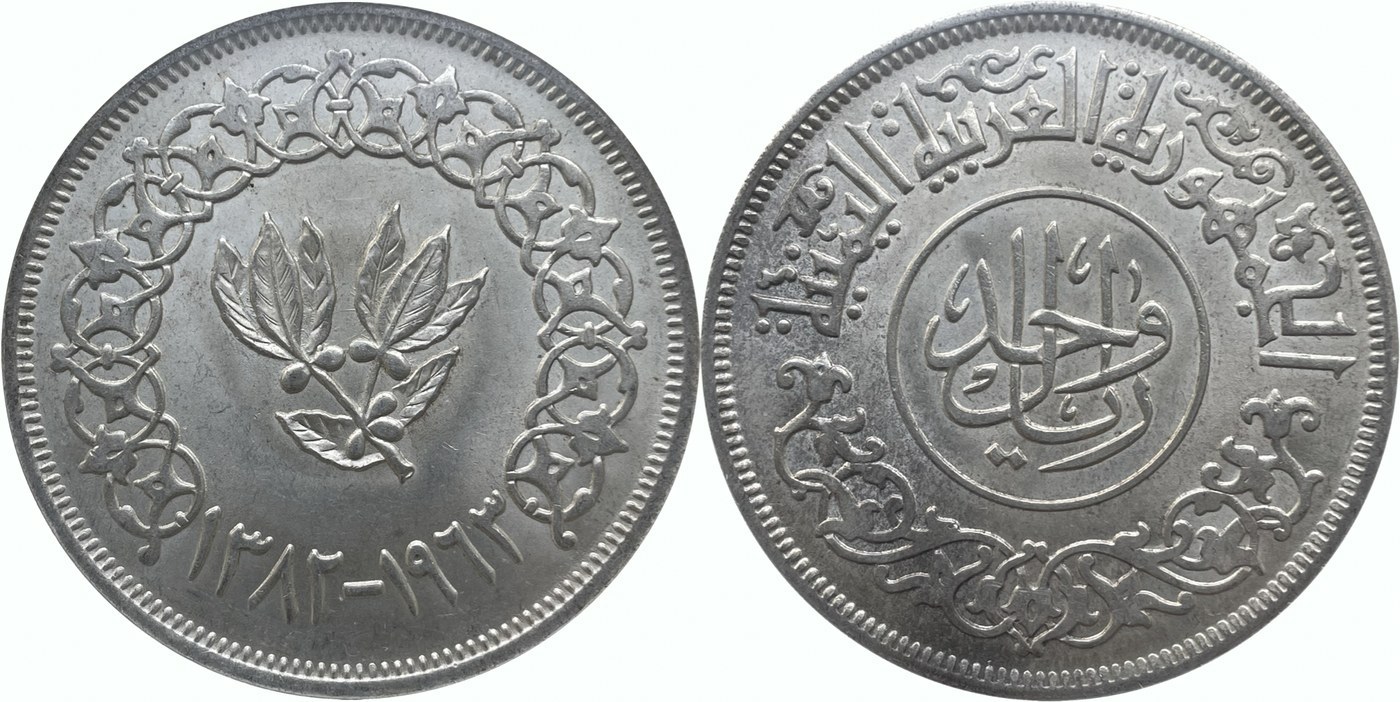
Begin with the two faces. The North Yemen 1 Rial is a non-figural coin: one side displays a floral wreath of leaves curving around a central Arabic legend, and the other shows Arabic text framed by an ornamental circular border. If your coin has a portrait, bird, or building, it is not this type. The combination of leafy wreath and circular-framed inscription is the quickest visual signature.
Confirm the date in Arabic form. This issue is dated 1963, but the coin itself carries the Islamic year 1382 in Arabic-Indic numerals. Learn to read the digits so you can match 1382 to 1963; a coin marked 1382 is not a different or later coin. The date sits among the legends rather than in a Western-style field, so scan the inscriptions carefully.
Check size, weight, and metal. As a silver crown, the 1 Rial is large and heavy, roughly on the scale of a big silver dollar, and should feel solid with a bright-to-gray silver surface. Weigh and measure the coin and compare it against a Yemen Arab Republic catalog listing; a piece that is markedly light, magnetic, or the wrong diameter is a warning sign. Silver is non-magnetic, so any pull toward a magnet points to a base-metal fake or a different coin.
Watch for look-alikes and lower denominations. The republic and the wider region issued several silver and base-metal denominations with similar wreath-and-inscription styling, so do not assume every wreathed Yemeni coin is a 1 Rial; the denomination is stated in the Arabic legend and confirmed by size and weight. Older imamate (kingdom) silver and neighboring Arabian silver coins can look broadly similar at a glance, making legend-reading essential.
Finally, be cautious with cleaning and counterfeits. Harsh cleaning leaves hairline scratches and an unnatural brightness that reduce value, while cast copies may show soft detail, seams, or bubbles instead of sharp struck relief. When a coin matters, verify the weight and diameter, examine the strike under magnification, and check the Arabic legends against a trusted reference or a specialist in Islamic and world coinage.
Frequently asked questions
How do I read the date on this coin?
The coin uses Arabic-Indic numerals and the Islamic calendar. Look for the year 1382 within the legends, which converts to 1963. Learning the shapes of the Arabic digits is the reliable way to confirm the date.
How can I tell it is silver and not a fake?
Silver is non-magnetic and gives a bright-to-gray sheen. Weigh and measure the coin against catalog specifications for the Yemen Arab Republic 1 Rial; a piece that is magnetic, underweight, or the wrong size is suspect.
How do I distinguish the 1 Rial from smaller denominations?
Match size and weight to the crown-sized 1 Rial and read the denomination in the Arabic legend. Smaller fractional coins share the wreath-and-inscription style but are lighter and smaller in diameter.
Could this be an older kingdom coin instead?
It can resemble earlier imamate silver, but republican issues like the 1963 rial belong to the Yemen Arab Republic and carry its legends and the 1382 AH date. Reading the Arabic inscriptions is the surest way to tell them apart.