
How to Identify the Maine Centennial Half Dollar
A 1920 silver commemorative celebrating Maine's 100th year of statehood, recognizable by the state's coat of arms on the obverse and a simple inscribed wreath reverse.
Read the full Maine Centennial Half Dollar encyclopedia entry →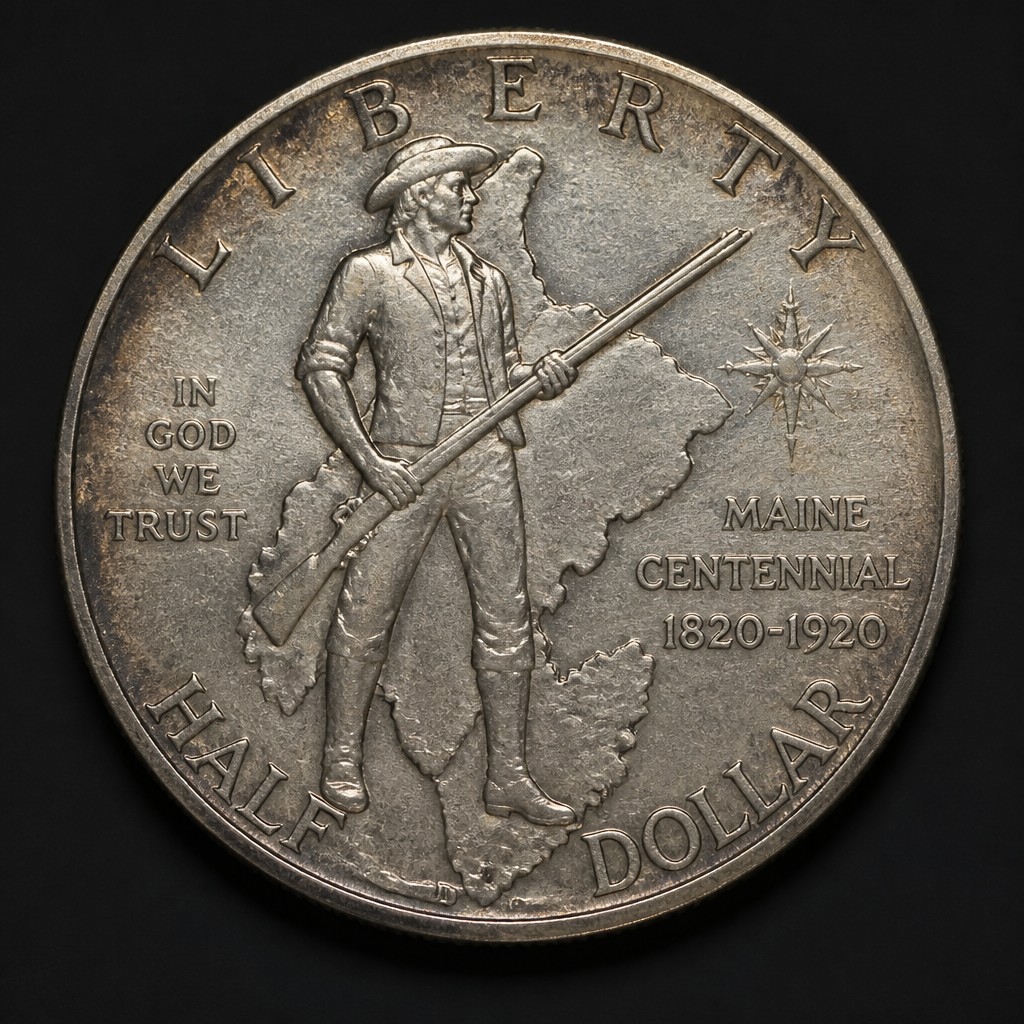
What This Coin Is
The Maine Centennial Half Dollar was struck in 1920 to commemorate the 100th anniversary of Maine achieving statehood in 1820. It is a single-year commemorative designed by sculptor Anthony de Francisci, who later created the Peace Dollar.
Obverse Design
The obverse reproduces the coat of arms of the State of Maine: a shield bearing a pine tree and a resting moose, flanked by a farmer holding a scythe and a seaman leaning on an anchor. Above the shield sits the North Star with the state motto "DIRIGO" ("I lead") on a ribbon, and "MAINE" appears below. "UNITED STATES OF AMERICA" and "HALF DOLLAR" surround the design near the rim.
Reverse Design
The reverse is simpler than the obverse, featuring a wreath of pine boughs (a nod to Maine's nickname, the Pine Tree State) enclosing the inscriptions "MAINE CENTENNIAL" and "1820-1920," with "E PLURIBUS UNUM" arcing above and "STATE OF MAINE" below the wreath.
Size, Weight, Metal, and Edge
The coin measures about 30.6mm across, weighs approximately 12.5 grams, is composed of 90% silver and 10% copper, and has a reeded edge, matching other classic commemorative halves.
Mint Marks and Where to Find Them
Every Maine Centennial half dollar was struck at the Philadelphia Mint and shows no mint mark. This is a single-mint issue, so mint mark verification is not a factor in identifying it.
Telling It Apart from Similar Coins
The Maine half's coat-of-arms obverse is distinctive and not easily mistaken for other commemoratives, most of which feature portrait busts. The closest visual comparison collectors sometimes make is to other state-seal commemoratives (such as the Missouri or Alabama issues), but the specific combination of pine tree, moose, farmer, and seaman is unique to Maine.
Judging Condition at a Glance
On the obverse, look closely at the moose's body, the farmer's arm and scythe, and the seaman's figure — these raised, detailed elements wear down first. On the reverse, check the pine wreath's individual needles and ribbon ties for crispness. A well-preserved coin retains sharp separation between the shield's figures and the surrounding field.
Authenticity Red Flags
Because this coin's obverse contains several small, detailed figures, counterfeits often show blurred or "melted" detail in the farmer, seaman, and moose rather than crisp individual lines. Verify the coin's weight and diameter match specifications, examine the edge for consistent, machine-made reeding, and be wary of artificial toning that looks uniform or unnaturally vivid compared to the mellow, uneven tone typical of a century-old silver coin.
Frequently asked questions
What historical event does the Maine Centennial half dollar mark?
It celebrates the 100th anniversary of Maine's admission to the Union as a state in 1820.
Does the Maine half dollar have a mint mark?
No. All pieces were struck at the Philadelphia Mint and carry no mint mark.
What symbols appear on the obverse?
Maine's state coat of arms: a shield with a pine tree and moose, flanked by a farmer and a seaman, with the North Star and motto DIRIGO above.
How do I judge wear on this coin?
Focus on the small raised figures on the obverse (moose, farmer, seaman) and the pine needle detail in the reverse wreath, which flatten first.
Was the Maine Centennial half dollar issued more than one year?
No, it was struck only in 1920 as a single-year commemorative.